Representative End User Clients







Representative Automation Clients







Representative Software Clients








Key Takeaway: AI is no longer being positioned as a standalone feature. It is becoming a foundational capability across the formulation lifecycle.
Artificial intelligence continues to dominate conversations across the formulation technology landscape, but the discussion has evolved significantly over the past two years. AI is no longer being positioned as a standalone capability or experimental add-on. Instead, suppliers are embedding AI directly into formulation workflows, scientific knowledge management, regulatory compliance, supplier collaboration, and product lifecycle processes. This shift reflects a broader market transition: organizations are no longer asking whether they should adopt AI, but rather how quickly they can operationalize it to accelerate innovation and improve business outcomes.
Recent supplier announcements reinforce this trend. For example, Trace One highlighted AI-powered regulatory assistance, automated data extraction, and intelligent content summarization as core parts of its platform strategy rather than separate innovation projects. The company's messaging reflects an industry-wide movement toward integrating AI into the daily activities of formulation scientists, product developers, regulatory specialists, and R&D teams.
The formulation process has historically been constrained by fragmented data, manual knowledge transfer, regulatory complexity, and lengthy experimentation cycles. Scientists often spend significant time searching for historical formulations, reviewing supplier specifications, validating regulatory requirements, and documenting decisions.
AI can help organizations:
Access institutional knowledge more efficiently.
Identify formulation alternatives faster.
Improve ingredient and material selection.
Accelerate product reformulation efforts.
Reduce compliance risks.
Capture expertise from experienced personnel before it is lost.
As a result, AI is becoming a critical enabler of faster product innovation while simultaneously helping organizations manage increasing complexity.
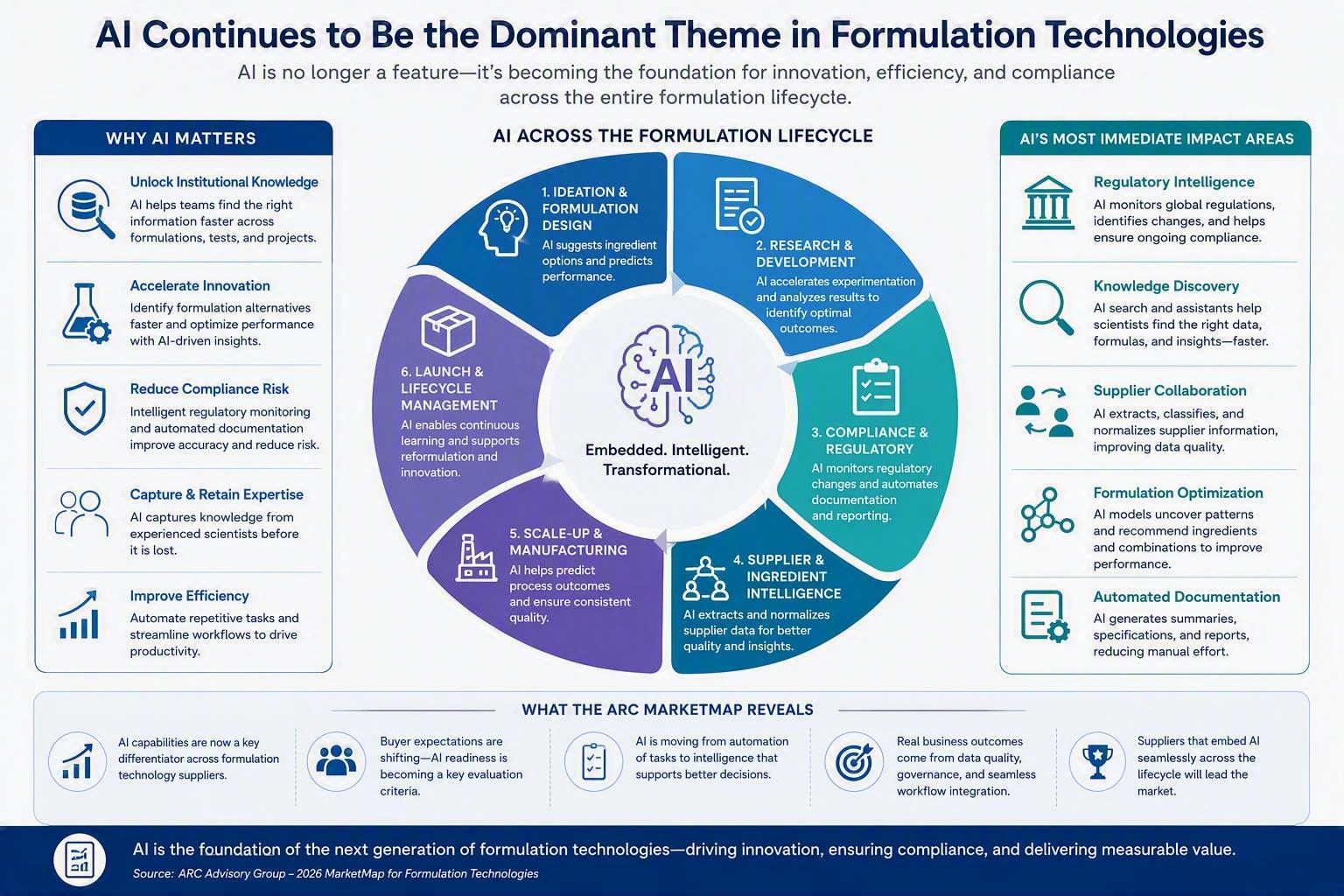
The findings from ARC's 2026 MarketMap for Formulation Technologies align closely with these developments. Across the evaluated supplier landscape, AI capabilities increasingly appeared as a differentiator within broader platform strategies rather than as isolated functionality. Suppliers are investing in intelligent assistants, knowledge discovery, predictive analytics, automated documentation, regulatory intelligence, and machine learning-driven recommendations that support formulation decisions throughout the product lifecycle.
Importantly, buyers are also changing their expectations. Historically, evaluation criteria focused primarily on recipe management, formula authoring, specifications management, and compliance functionality. Today, organizations increasingly expect formulation platforms to help users find information faster, generate recommendations, automate repetitive tasks, and support data-driven decision-making.
The result is that AI readiness has become an important consideration when assessing long-term platform value and strategic fit.
While visions of autonomous formulation remain largely aspirational for many industries, several practical use cases are already delivering measurable value today.
Organizations face growing regulatory complexity across global markets. AI-enabled systems can help monitor regulatory changes, identify affected formulations, flag non-compliant ingredients, and assist with documentation activities. This capability is particularly valuable in highly regulated industries such as food and beverage, chemicals, life sciences, and consumer packaged goods.
One of the most common challenges in formulation environments is locating relevant historical data. AI-powered search and knowledge assistants can help scientists retrieve previous formulations, test results, specifications, and project documentation more efficiently, reducing duplicated work and accelerating innovation cycles.
Modern formulations rely heavily on ingredient and material intelligence from external suppliers. AI can help extract and normalize information from supplier documentation, improving data quality while reducing manual effort.
As formulation datasets grow, AI models can identify patterns and relationships that may not be obvious through traditional analysis. Organizations are increasingly exploring AI-assisted approaches for ingredient selection, performance optimization, and reformulation initiatives.
Perhaps the most significant trend emerging in the formulation software market is the transition from process automation to decision support.
Earlier generations of formulation systems focused primarily on digitizing workflows and managing data. The next generation of platforms aims to help users interpret information, generate insights, and make better decisions.
This distinction is important because it fundamentally changes the role of software. Instead of acting solely as a repository of information, formulation platforms increasingly function as active participants in the innovation process.
Organizations that successfully leverage these capabilities will likely gain advantages in product development speed, compliance management, knowledge retention, and operational efficiency.
Despite the excitement surrounding generative AI and advanced analytics, organizations should remain focused on business outcomes rather than technology alone. Successful AI initiatives depend on data quality, governance, scientific context, and integration into existing workflows.
The suppliers that emerge as market leaders will not necessarily be those with the most AI features. Rather, leadership will likely come from those that can embed AI seamlessly into the formulation lifecycle while delivering measurable improvements in productivity, innovation, and compliance.
Our 2026 ARC MarketMap for Formulation Technologies indicates that this transition is already underway. AI is becoming a foundational capability that influences platform architecture, product strategy, and customer expectations across the supplier landscape. As organizations evaluate formulation technology investments over the next several years, AI readiness will increasingly move from a desirable feature to a strategic necessity.
AI remains the dominant theme in formulation technologies not because suppliers are talking about it, but because they are embedding it directly into the workflows where scientists, engineers, and product developers create value. The ARC MarketMap demonstrates that leading suppliers are moving in this direction, signaling a broader transformation of how formulation work will be performed in the years ahead.
Together, ARC’s Formulation Technologies MarketMap and Formulation Management Software MAR provide:
A transparent view of a complex supplier landscape.
A disciplined definition of FMS market boundaries and core domains.
Actionable insights into adoption patterns, capability trends, and the future of virtual-twin-driven R&D.
Whether you are an organization modernizing your formulation workflows or a supplier navigating a competitive market, this research offers a clear, forward-looking foundation.
For more information about ARC MarketMap: