Representative End User Clients







Representative Automation Clients







Representative Software Clients








The environmental impact of AI is no longer a side note in the technology conversation. As artificial intelligence moves from experimentation to enterprise scale, its growing appetite for computing power is putting new pressure on electricity systems, water resources, and physical infrastructure. At the same time, AI is being positioned as a powerful tool for efficiency, optimization, and sustainability. That tension is what makes this such an important business issue. AI is not simply a climate problem or a climate solution. It is both, depending on how it is built, deployed, and powered.
AI runs on energy-intensive infrastructure, especially data centers packed with high-performance processors that use large amounts of electricity and generate significant heat. Demand is rising quickly as organizations train larger models and deploy AI more widely across products and operations. Data centers already use about 1.5 percent to 2 percent of global electricity, and the International Energy Agency says that demand could double by 2030, with AI-focused facilities growing even faster. As a result, AI’s climate impact depends not only on how much compute it uses, but also on the energy source behind it.
This creates a paradox: AI can improve efficiency and reduce waste, yet the infrastructure behind it can also increase emissions, resource use, and local environmental stress.
In short, if AI growth relies on carbon-intensive grids, it increases emissions even when it delivers productivity gains elsewhere.
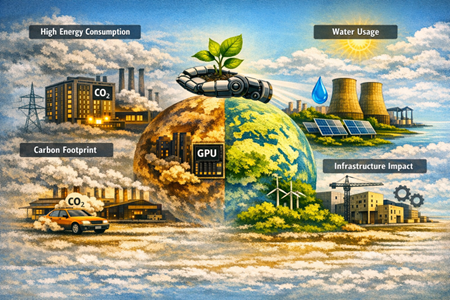
AI’s carbon footprint comes from two phases: training and inference. Training is the most energy-intensive, requiring large computing runs over long periods across specialized chips. Estimates suggest advanced models can use vast amounts of electricity and emit hundreds of tons of carbon dioxide, depending on model size and power source. Inference makes each query seem minor, but at scale, billions of prompts and generated outputs add up to a significant load.
Electricity is only part of AI’s environmental cost. Data centers also use large amounts of water for cooling, and research suggests training a large language model can consume hundreds of thousands of liters directly and indirectly. A recent study projects that, if current growth continues, AI infrastructure could push annual water use into the hundreds of millions of cubic meters by 2030. In water-stressed regions, that makes AI a policy and sustainability issue, not just an operational one.
AI’s environmental impact goes beyond running servers. Building and expanding data centers requires steel, concrete, cooling equipment, networking hardware, and backup systems, all of which add embodied carbon. MIT News notes that discussions often focus on operational emissions while overlooking the carbon cost of construction. As AI workloads grow, companies must also consider grid pressure, land use, and localized heat from large data center clusters.
This is why AI’s sustainability story is more complex than a simple warning. AI can increase emissions, cooling demand, and infrastructure growth, but it can also cut environmental impact by optimizing energy use, improving asset performance, strengthening predictive maintenance, and supporting better climate and operational modeling. In industrial settings, AI can uncover inefficiencies that traditional systems miss, so its true value depends on whether these gains outweigh its footprint.
That is why many organizations are embracing Green AI: designing models, systems, and data centers that reduce energy intensity without slowing innovation. This includes more efficient algorithms, specialized chips, renewable-powered facilities, better cooling, and smarter workload management. According to recent findings, while data centers still account for a relatively small share of global electricity use, AI could roughly double their power demand by 2030, making efficiency and cleaner energy essential.
For business leaders, the message is not to retreat from AI but to scale it more deliberately. Organizations should ask tougher questions about model efficiency, infrastructure, energy sourcing, cooling, and the return on compute-intensive use cases. They should also distinguish meaningful adoption from wasteful experimentation. As the latest data from the International Energy Agency and other research shows, AI’s environmental impact will grow with adoption unless efficiency and clean energy are built in from the start.
Ultimately, AI is neither inherently sustainable nor inherently harmful. Its impact will be shaped by the choices organizations make now about architecture, energy, regulation, and operational discipline. The companies that lead in the next phase of AI adoption will not just be the ones that build the most powerful systems. They will be the ones that build them responsibly.