Representative End User Clients







Representative Automation Clients







Representative Software Clients








At ARC Advisory Group’s 23rd India Forum titled Winning in the Industrial AI Era in Bangalore on July 10-11, 2025, Red Hat participated as a Gold Sponsor. Addressing an audience of over 300 delegates, Dr. Arnaud Buisine, Director Enterprise Sales for Manufacturing, Retail and Transport, Red Hat Asia Pacific and Vikas Maurya, Global Product Line Manager, ABB Ability Edgenius shared their transformative journey of integrating open-source IT solutions into industrial automation, marking a significant milestone in the digital transformation of manufacturing. Their joint presentation drove home the point that in the rapidly evolving landscape of smart manufacturing, the convergence of Information Technology (IT) and Operational Technology (OT) is no longer a futuristic concept—it’s a present-day imperative. At the end of the session on Industrial AI, Data Fabric, and Metaverse, both speakers participated in a lively panel discussion. This blog captures the essence of their joint presentation; you can watch it on YouTube and/or here.
The collaboration between ABB and Red Hat began three years ago with a shared vision: to bridge the gap between IT and OT and enable software-defined industrial operations. This partnership has matured into a robust alliance, recently expanded to bring open-source technologies deeper into ABB’s core process automation systems.
Dr. Arnaud Buisine emphasized how this integration is helping manufacturers transition from automated to autonomous operations. Red Hat’s enterprise-grade open-source platforms are used to support ABB’s distributed control systems (DCS) in the energy, marine, and process industries.
ABB’s approach to digital transformation is rooted in addressing critical industry challenges:
Energy transition and sustainability
Workforce modernization
Protection of installed base investments
Compliance with evolving regulations
Initiatives like Open Process Automation, Namur Open Architecture (NOA), and Module Type Package (MTP) are guiding ABB’s strategy to create open, secure, and interoperable systems. These frameworks enable a clear separation between core process control and digital innovation environments, ensuring reliability while embracing agility.
Red Hat brings the IT expertise and infrastructure needed to support this transformation. Their platforms—such as Red Hat OpenShift and Red Hat Device Edge—offer consistent, secure, and scalable environments for deploying applications from edge to cloud. This allows ABB to focus on delivering industrial value without worrying about the underlying “plumbing.” The adoption of Linux-based operating systems and Kubernetes has enabled ABB to build lightweight, secure, and high-availability solutions tailored for resource-constrained industrial environments.
One of the most exciting developments is the use of AI at the edge to support control room operators and process engineers. ABB is deploying LLMs (Large Language Models) on Red Hat Device Edge, using GPU acceleration to run AI models locally. This ensures low latency, data privacy, and real-time insights—critical for industries where uptime and safety are paramount.
Red Hat’s OpenShift AI platform further supports the lifecycle of these models, enabling continuous learning and centralized management across distributed environments.
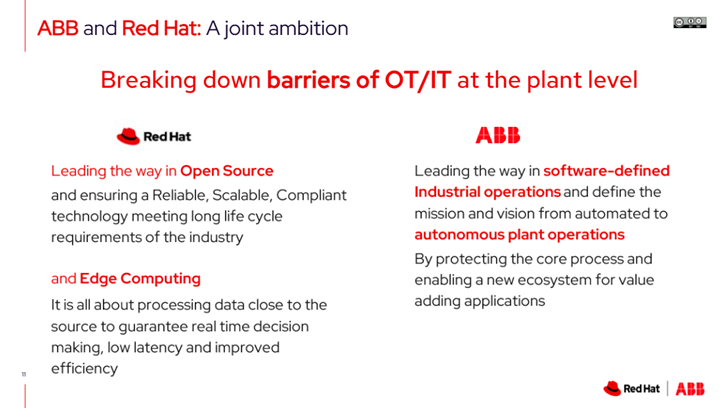
The ABB and Red Hat partnership exemplifies how Industry 4.0 is being realized through collaborative innovation. By decoupling hardware from software and embracing open-source ecosystems, manufacturers can reduce total cost of ownership, automate engineering processes, and accelerate digital transformation.
In industrial environments, integrating AI requires rigorous checks and balances to ensure that outputs are accurate and reliable, as errors could have serious consequences, particularly in critical systems like distributed control systems (DCS). To address this, human oversight is maintained as a safeguard, and industry standards such as those from Namur Open Architecture (NOA) are followed to verify AI-generated requests before they are applied. The open-source community offers tools like TrustyAI to validate model outputs and minimize risks such as hallucinations, which are more prevalent in Generative AI than in predictive AI. Increasingly, organizations are turning to multi-modal AI systems—combining engines that predict specific outcomes with large language models (LLMs) tailored for user interaction or orchestration. For instance, domain-specific LLMs, such as the SemiKong model for the semiconductor industry, can be enhanced with retrieval augmented generation (RAG) methods, allowing companies to safely incorporate their own documents and data, thereby enabling secure and effective deployment of AI in manufacturing and industrial automation.