Representative End User Clients







Representative Automation Clients







Representative Software Clients









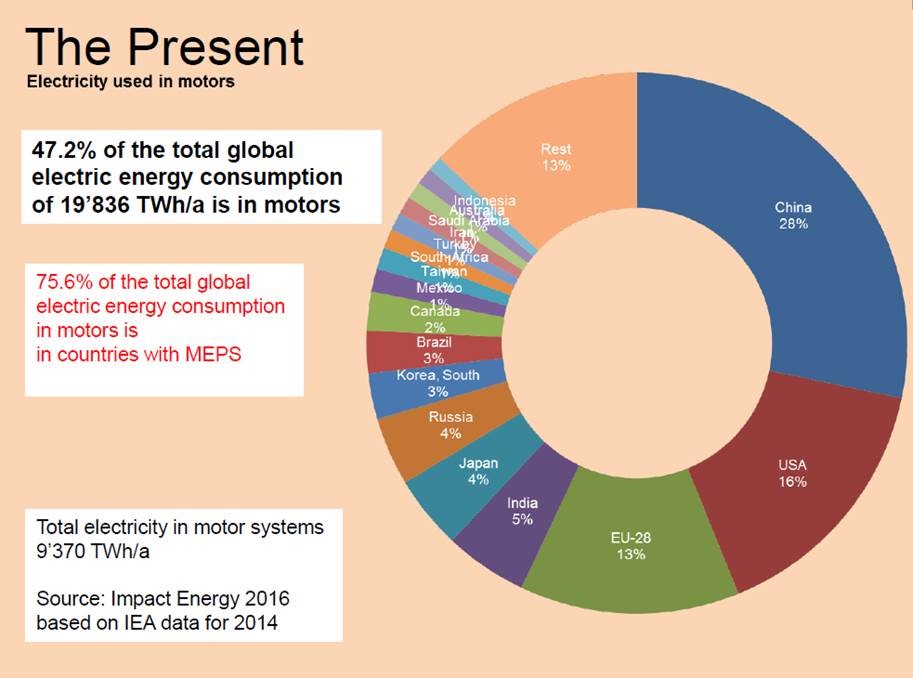
Global demand for energy is rising steadily. At the same time, pressures to reduce energy consumption, and to lower carbon dioxide (CO2) emissions are becoming stronger. It is estimated that electric motors consume over 47 percent of the total electric energy consumed worldwide. Reducing this consumption by a small fraction of a percent can reduce a significant amount of electricity consumed, costs for running the industrial operations, and CO2 emissions. Connected High Efficiency Motors can significantly improve the situation.
Furthermore, electric motors account for about 60 percent of the electricity consumed in industrial applications. The most common applications include pumps, fans, compressors, conveyors, kilns, centrifuges, mixers, hoists, cranes, extruders, printing machinery, wood processing, and textile machinery. Thus, the energy saving potential among user industries is enormous. Usually, energy consumption depends on the kW rating of the motor, load, and the motor operating hours.
But selecting motors that deliver better energy performance involves a variety of factors including energy efficiency, cost, temperature rise, vibration, noise, bearing, and such others. High-efficiency motors help users reduce energy costs and can play a significant part in achieving targeted reductions in CO2 emissions. Estimates indicate that a single electric motor with just a small fraction of percent efficiency improvement could save an industrial user up to half a million dollars in electrical energy costs and reduce CO2 emissions significantly over its 15- to 20-year lifetime. And that’s just for one motor!
Many industrial users still focus on the purchase price when investing on motors, instead of considering operating and maintenance costs over the long run. To see the real benefits, users need to look at total lifecycle cost including purchasing, installing, operating, maintaining and disposing, when considering buying an electric motor.
Also, recently, a key trend has been the Industrial Internet of Things (IIoT) and the desire to better understand the health of motors to improve manufacturing operations. With motors being a major asset in many industries, IIoT plays a key role in operational/maintenance-related activities. For motors to leverage the benefits of IIoT-enabled predictive maintenance, they need to be fitted with sensors. This would help both suppliers and end users achieve their goals of cost-effective and energy-efficient motors. A few motor manufacturers started offering smart motors (motors fitted with sensors) to enable motors digitally connected.
ARC’s recently completed global market analysis report on Low Voltage motors provides an overview of the technology, market, and leading suppliers and provides current market analysis plus a five-year market and technology forecast. For more information, readers can click here.