Representative End User Clients







Representative Automation Clients







Representative Software Clients








At the last ARC Industry Forum in India, a speaker from Siemens said that “Digitalization changes everything.” Then it struck me as a good opening line, but now I realize that digitalization has had a cascading effect on every aspect of our lives. “Everything” refers to more than breakthrough technologies and processes; people’s thought processes have changed and commonly used words take on a whole new dimension. When I requested a colleague to open the window to let some fresh air in he seemed confused and asked, “You mean restart and refresh?” But that was not what I meant. In today’s digital world, the same words mean something else.
Let us begin with the question relevant to this blog: Is it digitization or digitalization? Both are used interchangeably and mean the same thing to most people. However, there are some regional preferences; in the US digitize predominates, whereas in India digitalization is used more commonly. ARC has also blogged on this - Do you Digitize or Digitalize?
Just think: Windows don’t open, they crash; clouds are not fluffy balls floating in an azure sky, they store Big Data and are private, hybrid, or public clouds; an agnostic is not a believer or disbeliever of God, the word is platform-agnostic and can run on any operating system; a lake is not a placid body of water where men sit patiently with fishing lines, they are data lakes; security does not mean a burglar alarm, it means cybersecurity. Smart is no longer about good grooming or looking dapper, it is used in reference to cities, lighting, or factories. Doesn’t end there. Recently while editing a report I learned that Smart stands for specific, measurable, attainable, realistic and timely. Now we are getting intelligent; but it is AI (artificial intelligence) or BI (business intelligence). Architecture is not about heritage sites, it is about a high level view of software and system integration. And traffic is not about cars and trucks on our roads, it refers to the number of people who visit your website. On a daily basis I get at least five emails about data security blankets, scale-out storage architecture, reality modeling, meta-algorithms etc. To me it seems that there is a language within another language where everything that I know of seems to mean something else!
If you’ve adapted to these new connotations and word usage, it means that your digital journey has begun. So let the ride begin!
• First Industrial Revolution: From the 18th to 19th centuries in Europe and America; a period when societies became industrial and urban. Major technological development: steam engine.
• Second Industrial Revolution: Between 1870 -1914, prior to World War 1. It was a period of industrial growth. Major technological advances: telephone, light bulb, and internal combustion engine.
• Third Industrial Revolution: Began in the 1980s and is still continuing. Technology moved from analog, electronic, and mechanical devices to the digital technology of today. Major technology developments: personal computer, the Internet, Information and Communications Technology (ICT).
• Fourth Industrial Revolution: This is where we are today and is marked by emerging technology breakthroughs: robotics, 3D printing, autonomous vehicles, and the Internet of things (IoT).
In his book, The Fourth Industrial Revolution, Professor Klaus Schwab, Founder and Executive Chairman of the World Economic Forum, says that technology will define the future of industry and humanity. He says that the fourth industrial revolution is fundamentally different from the previous three; it is characterized by a range of new technologies that are fusing the physical, digital and biological worlds, impacting all disciplines, economies and industries, and even challenging ideas about what it means to be human.

At ARC we understand digitalization at multiple levels: analysts attend conferences; editors edit reports on the same topic, but about different suppliers and products; industry experts at ARC provide a third party perspective to improve IT-OT convergence, do custom projects, and are interviewed on the digital transformation journey. And there is a “digital thread” of connectivity, collaboration, and convergence across geographies and global teams, which is information driven.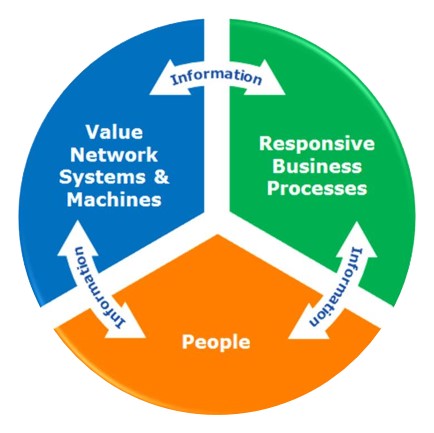
Digitalization is the core theme at all ARC forums across the world. The session topics are usually about moving towards the digital enterprise; automation trends and cybersecurity; evolving technology trends; and end user experiences. We talk about how the internet is revolutionizing the business world and creates major challenges for manufacturing companies as they have to constantly remain agile and alert. Across industries customers have essential requirements – speed, flexibility, quality, and efficiency; and these must operate on a foundation of security.
A digital enterprise is:
At some level I understand all this about digitalization, but the simplest explanation would be – “Everyone, Everywhere is connected to Everything.”
ARC Advisory Group clients can view the complete report at ARC Client Portal
If you would like to buy this report or obtain information about how to become a client, please Contact Us