Representative End User Clients







Representative Automation Clients







Representative Software Clients








Overview
 With the emergence of the Industrial Internet of Things (IIoT), major global technology suppliers have developed and are now communicating their future visions for the IoT in manufacturing and the value that it will bring. This became apparent at the 2015 ARC Tokyo Forum in July, where global suppliers, including Rockwell Automation, revealed their respective visions to the approximately 250 attendees from Japan and the rest of Asia. Attendees had an opportunity to compare and contrast the suppliers' respective IoT visions and consider how these could potentially apply to their own businesses and operations.
This ARC View summarizes the presentation made by Mukund, Software Business Manager of APAC, Rockwell Automation.
Market Requirements and Opportunities
Mr. Mukund began his presentation by outlining the dynamic changes taking place in the marketplace for manufacturers. According to numerous sources, over the next few years, the global population will exceed seven billion, with more than 70 million people annually crossing into the middle class. This middle class could add $8 trillion in consumer spending by 2020. These trends will increase the demands on manufacturing, resources, and infrastructure. Specifically, over the next 20 years, we will see significant increases in demand for water, raw materials for infrastructure build-out, vehicles, and ultimately, energy.
Accordingly, all producers will be pressured to produce more, but without unlimited resources to do so. Additionally, tremendous price pressure resulting from the increasingly technologically enabled global economy, will force manufacturers to drive any inefficiencies out of their processes to stay competitive. An estimated $1 trillion will be spent on resource productivity improvement projects annually, said Mr. Mukund.
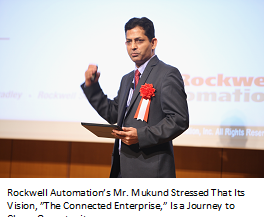 Bringing the discussion forward to the Internet of Things, Mr. Mukund explained that IoT is not one technology, but a wide-ranging term. But the key point is that it is meant to make lives better across the board, from production operations up to the consumer level.
In one example he provided, a pharmaceutical manufacturer could use the IoT to gain enough visibility across its entire supply chain to help an end consumer determine whether a particular vial of a prescribed drug was counterfeit or real. "The IoT vision is much larger than just one company." he said. "It's going to help people at large."
Where is the value? He showed the results of a widely publicized Cisco survey that indicates that, overall, $14 trillion in value is at stake in using IoT technologies, of which an estimated $3.9 trillion would relate to manufacturing operations. Five drivers fueling IoT value are at stake, including asset utilization, employee productivity, supply chain logistics, customer experience, and innovation.
For example, relative to asset utilization, turbine or compressor suppliers supply services as well as equipment. Those services are not just for equipment monitoring, but also for applying knowledge that enables users to predictively manage their assets to improve productivity.
According to Mr. Mukund, "The bigger portion of this value is in supporting innovation. The IoT enables innovation to do things differently, changing the way we will do our business."
The Connected Enterprise and IoT
Multiple government initiatives, industry standards groups, and industry consortiums are working to develop smart manufacturing concepts.  Rockwell Automation calls its vision, "The Connected Enterprise," which the company believes encompasses all that these various initiatives aim to achieve, according to Mr. Mukund.
The Connected Enterprise is not about technology, but about the value that can be derived by adopting technologies. "We see The Connected Enterprise as being more sustainable, optimized, and demand-driven," he says.
However, the current reality paints a very different picture. A US market survey revealed that:
Mr. Mukund believes that statistics such as this make it a business imperative to realize The Connected Enterprise.
Current enabling technologies include information management and analytics, scalable computing, mobility and visualization, secure network infrastructure, multi-discipline control and information, and smart assets.
According to Mr. Mukund, when we look at how Industrial IoT can play out and help us, industrial applications such as data analytics, cloud and virtualization, and mobility, are already available. Contextualizing and analyzing data using today's technologies make data meaningful. Smart devices create more things to analyze. This is potentially easier to adopt, even with existing legacy systems.
Second, cloud and virtualization are going to change the way a lot of companies operate. "By moving to cloud to manage corporate IT infrastructure, the work that used to require 50 or so specialists to do in the past can now be done by one person today," he said. Another aspect of the cloud is obvious – moving from a capex model to a flexible and scalable opex model. The third thing IoT works for on the industrial side is mobility. Operators or maintenance technicians working anywhere in a plant can get the exact information they need at any time right on their tablets.
The Connected Enterprise Starts with Network Convergence
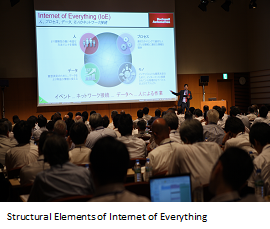 The Connected Enterprise starts with network convergence. This requires moving from proprietary standards to open standards; and from disparate IT and OT networks to converged, secure and collaborative operations. "Convergence between IT and OT is not a new topic. For 15 years, the industry has been talking about connecting plant systems to ERP systems; about connecting from shop floor to top floor. What is new is how we think about accomplishing it," Mr. Mukund said.
He believes that The Connected Enterprise is not just about connecting applications. It's about connecting people. It's connecting processes in more flexible ways so those processes can extend beyond the organization, connecting companies with both their suppliers and their customers. "The big piece here is gaining access to the data from all those previously unconnected smart things or devices, contextualizing that data, and providing it to those processes. When this happens at an enterprise level, based on their respective roles, people throughout the enterprise can get the actionable data they need," he explained.
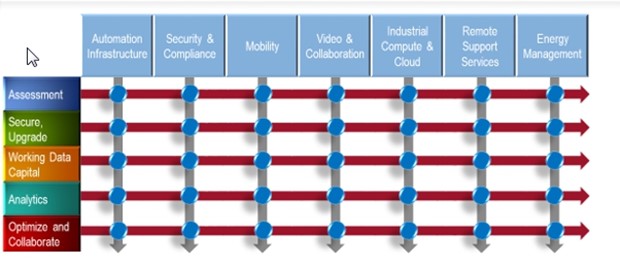
Mr. Mukund believes that scalable and complementary solution sets are available to make this achievable today within multi-capability industrial architectures encompassing automation infrastructure, security and compliance, mobility, video and collaboration, industrial computing and cloud, remote support services, and energy management.
 Rockwell Automation itself went through a similar transformation. As a global manufacturing company with a variety of manufacturing operations, it has employed elements of The Connected Enterprise from which the company is seeing benefits in lower cost, faster time to market, and enterprise risk management. "Through operational improvements related to The Connected Enterprise, Rockwell Automation has seen productivity improvements of 4 to 5 percent every year on a $6 billion revenue. That's not a small number," he stressed.
Mr. Mukund added, "We are still on our journey to The Connected Enterprise and I wanted share it with you. Implementation challenges include organizational alignment, competency and talent, technology adoption, data security and privacy, and interoperability standards. Some of these are related to transforming an organization's structure to be able to derive value from innovation. This often requires some skill sets that you don't have. We've found that IoT-enabled collaboration can help make up for these gaps in competency and talent by making expertise that resides elsewhere in the company available remotely," he explained.
Execution Model
To share its experience with customers, Rockwell Automation created an execution model. It shows how to build a Connected Enterprise in five steps or stages: 1) Assessment, 2) Secure and Upgrade, 3) Working Data Capital, 4) Analytics, and 5) Optimize & Collaborate. These are not one-time activities, but rather a continuous cyclical journey.
The first step, Assessment, develops the blueprint, increases value, and reduces risk. In the Secure & Upgrade step, the company does some of the basic things needed to achieve both connectivity and security to protect the data flow all the way to the end points. This where the unified infrastructure is created. In the Working Data Capital stage, the organization transforms data into information to unleash the value of the stranded data from devices in and around operations. Operational benefits are realized in the Analytics stage, where information is transformed into knowledge. Finally, in the Optimize & Collaborate stage, the company transforms knowledge into wisdom to generate actionable insight.
Where Are You on Your Journey Today?
In conclusion, he asked attendees to identify where they stand within blueprint for The Connected Enterprise and invited them to join the transformation journey of Rockwell Automation.
ARC Advisory Group clients can view the complete report at ARC Client Portal on www.ARCweb.com or Box.com
If you would like to buy this report or obtain information about how to become a client, please Request ARC Info
Keywords: Rockwell Automation, ARC Tokyo Forum, The Connected Enterprise, IoT, Execution Model, ARC Advisory Group.