Representative End User Clients







Representative Automation Clients







Representative Software Clients








Summary
ARC Advisory Group recently attended Schneider Electric's 2014 Influencer Summit at the company's new Boston One Campus in Andover, MA. This facility serves as the company's North American headquarters as well as one of five global R&D facilities. The theme, "The Next Age of Change," was very fitting. The Summit largely focused on the convergence of operations technology (OT) with information technology (IT), infrastructure modernization, sustainability, smart cities, utilities, and digital services.
Going into the summit, many of us had questions about the company's progress integrating its Invensys acquisition as well as how the company plans to respond to today's changing industrial and business landscape.
New CMO Sets the Tone
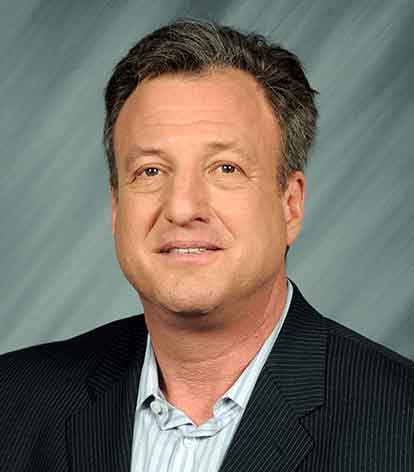
Chris Hummel, Schneider Electric's CMO and Executive VP, kicked off the event by pointing out critical market trends not always in the headlines. These included increasing urbanization and industrialization, with a third industrial revolution centered on renewable energy and the integration of IT into virtually everything. Mr. Hummel also addressed digitization, and how the Internet of Things (IoT), or what he believes is really the "Interconnection of Things," is fostering new levels of integration.
Mr. Hummel stressed that urbanization, industrialization, and digitization will require a lot of energy and that the world's appetite for energy remains insatiable. He cited data indicating that energy demand will grow by 56 percent by 2040 and the food supply will need to be doubled by 2050. These demands, which will have to be met without increasing emissions, will require investments of $57 trillion in new infrastructure. Schneider Electric believes sustainable progress is possible and that advances in operational technologies, the modernization of infrastructure, and sustainability practices will form the core of the company's business strategy to reshape industries and transform cities.
Mr. Hummel stated that Schneider Electric sees an opportunity to close the efficiency gap at an operational level, where connectivity, computing, and energy intersect. His vision calls for linking devices, buildings and equipment to a network to save time and money, increase safety, and improve reliability. IoT is ultimately a blend of IT and OT, but to truly make a difference, OT will need to take a dominant role over IT.
North America CEO Talks Global and US Strategy
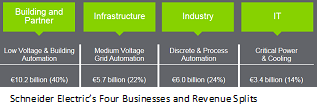
Laurent Vernerey, Schneider Electric North America Operation's President and CEO, stressed the company's position as a leading global specialist in energy management and efficiency technologies. Mr. Vernerey cited the company's revenue balance of 28 percent Western Europe, 27 percent Asia Pacific, and 25 percent North America, and 20 percent rest of world; with 43 percent of revenues in emerging economies. The company's key focus industries are water & wastewater, utilities, healthcare, oil & gas, food & beverage, data centers, mining, minerals, and metals, and OEM machine builders. To emphasize that Schneider Electric is a major service provider, Mr. Vernerey cited the company's 12,000 service delivery professionals, 250 service centers, and 15 service bureaus globally.
Although all acquired businesses will use the Schneider Electric name, the company recognized the value of some of the key brands, and will maintain those brand names globally. Mr. Vernerey also took note to call out the company's US presence, with $6 billion in sales and 20,000 employees. He expressed the company's interest in the US was due to its being the world's largest economy and home to over 25 percent of top 500 global company headquarters. Finally, Mr. Vernerey spelled out Schneider Electric's top US priorities: to enhance the customer experience, excel in services and software, differentiate with segment expertise, and innovate with new business.
Protecting Operational Integrity
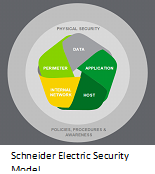
Clemens Blum, Schneider Electric's Executive VP of Industry Business, discussed the ongoing challenge for industry to maintain operational integrity in a connected world, and how safety must always be priority one. The industry paradox is how commercial off-the-shelf systems improve capabilities, and interconnectivity increases operational insight; but also create system security challenges, as interconnectivity poses a potential threat to operational integrity. Mr. Blum stressed that cyber security is absolutely critical for safety in OT; is foundational to industrial IoT; and must be secure through initial design, not a late stage add on. He also noted that connectivity may be a given, but must be inherently secure; and that increasing volumes of big data will further emphasize the need and importance of the right data.
Mr. Blum acknowledged that the Invensys acquisition helped move Schneider Electric forward in the process market with its industry knowledge, industrial software, automation and safety systems, and safety and security expertise, including expertise in safety processes.
IoT: Evolution or Revolution?
Pascal Brosset, Schneider Electric's CTO, discussed how IoT can change the way large infrastructures are operated. Mr. Brosset feels that most industries are reaching the limit of traditional architectures and that both enterprise and control are gravitating towards IoT and must deal with Big Data. He feels that IoT provides the context and Big Data the scale, which are missing at both the enterprise and control levels. He also believes that control architectures will need to evolve towards data-centricity and truly distributed intelligence. The ROI of operational intelligence is compelling and industry will start to notice. This will drive "systems on a chip," with built-in IP connectivity to all Schneider Electric devices.
Digital Services Transformation

Cyril Perducat, Schneider Electric's Executive VP of Digital Services Transformation, presented the company's new services model designed for the IoT and digital age. This brand new model focuses on providing services based on the company's five pillars: energy and sustainability, information, asset management, monitoring, and cyber security. This "Efficiency as a Service" model will enable the company to deliver a robust ecosystem that aligns with its customers' current and future expectations.
With this new model, existing services and new services can be delivered on a common platform. Customer data and external data can be integrated through devices and appliances and shared with stakeholders ranging from field technicians to the supply chain ecosystem. The Schneider Electric Cloud provides the vehicle for customer and partner connectivity in a secure digital space. A service ecosystem of partners can provide, for example, services and analytics based on vertical applications, such as asset or energy management.
Sustainability as a Competitive Differentiator
John Hoekstra, Schneider Electric's Director of Sustainability Services, presented the company's perspective of the growing investment philosophy of "ESG" or environmental, social and governance, and how sustainability today is more about profit and return on equity versus just "doing the right thing." Mr. Hoekstra explained that renewable energy investments have been steady and why an integrated strategy that incorporates supply, demand, demand response, and sustainability is critical; but that global intelligence is key to be able to be able to provide the tools to deploy this integrated strategy.
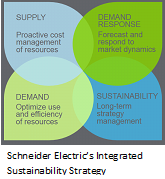
Mr. Hoekstra presented the case for VF Corp., a $12 billion global apparel company with diverse brands and products ranging from high-performance apparel such as North Face and Nautica, to footwear such as Timberland and Vans. The company has a significant retail footprint, and is a vertically integrated manufacturer with and extensive supply chain. Schneider Electric provides an "enterprise scorecard" report card to VF executives that incorporates data from facilities, procurement, products, supply chain, and retail operations designed to drive efficiencies at all levels. This information helps VF make decisions regarding whether to buy LED lighting for particular stores, which plants could be more water efficient, or what materials as most cost efficient to manufacture.
He also discussed Schneider Electric's partnership with "SAC" or the Sustainable Apparel Coalition, whose members include retailers and brands, such as Walmart, Target, IKEA, and H&M; partners such as Bayer and DuPont; and the use of the "Higg Index" for self-assessment, goals and measures, and as a benchmark for comparison. This has resulted in the apparel industry achieving tremendous improvements in sustainability.
Greenovate Boston
Todd Isherwood is the City of Boston's Director of Energy Efficiency and Alternative Energy and manager of the city's energy consumption and $50 million energy budget. Mr. Isherwood presented the city's evolution into a more sustainable city and how Schneider Electric, as a partner, provides solutions to achieve the city's sustainability goals. He described how a branding campaign, "Greenovate Boston," was needed to generate interest to get city employees and politicians on board to seek and support energy efficiency projects in this 384-year-old city. Isherwood has to compete for resources with ten different city departments and ten facility managers responsible for the city's offices, schools, fire and police buildings, 60,000 street lights and even 2,700 gas lamps. The city uses Schneider Electric's "Resource Advisor" platform to collect and analyze date to help make CAPEX and OPEX decisions and improve the operational efficiency of much of Boston's energy-consuming infrastructure. This partnership with Schneider Electric has helped Boston to become known as one of the most sustainable major cities in the US.
Technology to Bring Power to Poor Nations
Besides opening up its new Boston One Campus and North American headquarters, Schneider Electric also opened up an office in Kendall Square in Cambridge, MA. The objective, obviously, is to be able to leverage its proximity to some of the world's great universities, such as the Massachusetts Institute of Technology (MIT).
Working with the MIT Media Lab, several Schneider Electric researchers presented the concept of "NanoGrid," a method of distributing electricity to areas in poor nations in need of charging or powering low-power-consuming devices, such as smart phones, small LED lamps, and small flat screen TVs. NanoGrid provides a shoebox-sized container with six plugs that can be connected to a cellular network, enabling users to access small amounts of electricity at minimal cost. The concept is named "Samabaza Watts," which means "share or distribute something for the common good" in Swahili.
Conclusion
ARC believes that Schneider Electric did a good job of working the company's blanket energy theme into it "The Next Age of Change" message. The company also appears to be making substantial progress integrating Invensys and is responding to a changing industrial landscape, including IoT and balancing growing energy demand with responsible sustainability practices.
Going forward, Schneider Electric would be well served to focus on some of its technology differentiators in this extremely competitive space, as control architectures become more data-centric and dependent on distributed intelligence. Schneider Electric should continue driving its "systems on a chip" approach with built-in IP connectivity to all of its devices and help its customers merge their enterprise and control domains to improve overall energy and resource efficiency.
All signed-in ARC Advisory Group clients can view this report in pdf format at this Link
If you would like to buy this report or obtain information about how to become a client, please Request ARC Info
Keywords: Efficiency, Energy, IoT, OT, IT, Convergence, Security, Infrastructure.