Representative End User Clients







Representative Automation Clients







Representative Software Clients








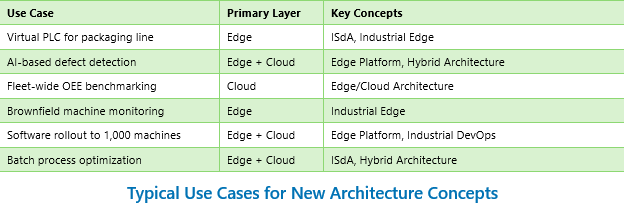
Industrial companies are entering a structural transition in automation architectures. Traditional, hardware‑centric control systems built around proprietary PLCs, DCSs, and fixed‑function controllers are giving way to software‑defined, edge‑centric architectures. These architectures decouple automation software from hardware, leverage standardized industrial compute platforms, and apply modern software lifecycle practices across distributed environments. At the center of this transition are five tightly linked concepts:
Together, they form the foundation of next‑generation industrial systems that are more flexible, scalable, and resilient than legacy designs, while preserving the determinism, safety, and availability required for industrial operations.
Industrial Software‑Defined Automation (ISdA) refers to the execution of industrial control and automation functions, such as PLC logic, motion control, robot control, and process control, as software applications running on standardized hardware platforms rather than dedicated, proprietary controllers.
This ARC Strategy Report establishes clear definitions for new terms and concepts emerging around software‑defined automation, industrial edge, edge platforms, and hybrid edge‑to‑cloud architectures, providing a common framework for understanding how next‑generation industrial automation systems are being designed and deployed.
With ISdA, the decoupling of hardware and software enables applications to be portable across hardware generations, independently versioned and updated, and virtualized or containerized. This approach fundamentally decouples automation software from the underlying hardware and traditional lifecycle constraints that have long defined industrial control systems.
By breaking this coupling, ISdA enables faster innovation cycles, reduces hardware lock‑in, and allows automation workloads to coexist with digital and analytics applications on shared platforms. It also opens the door to new ecosystems and business models for both suppliers and end users, as automation becomes a software asset rather than a fixed hardware function.
ISdA does not remove or weaken real‑time requirements. Automation suppliers continue to harden operating systems, runtimes, and networking stacks to ensure deterministic performance, reliability, and availability at the industrial edge. Also, ISdA does not always imply “open” as some vendors claim. In fact, some environments can be quite proprietary.
Table of Contents
ARC Advisory Group clients can view the complete report at the ARC Client Portal.
Contact Us if you would like to speak with the author.
Obtain more ARC In-depth Research Market Analysis.