Representative End User Clients







Representative Automation Clients







Representative Software Clients








KEYWORDS: Software-Defined Factory, Virtual PLC, Rollout, Redundancy
What motivated Audi to redesign its traditional shop floor architecture? The automotive industry is changing rapidly in the face of new cost structures driven by the electric vehicle transition and fierce competition from China. In Audi’s view, the traditional model of delivering production equipment floor is outdated, and the future is software-driven production.
Audi calls it “IT-based factory automation,” a concept that is turning IT/OT convergence theory into practice at the premium automaker. To achieve this, Audi kicked off an initiative back in 2018 called Edge Cloud 4 Production (EC4P). The goal is to replace thousands of shop floor industrial PCs with a much more efficient and flexible IT architecture of scalable local servers, effectively uniting the cloud and the edge on the shop floor.
This ARC View is part of a series of reports that dig deeper into the cultural and technical aspects of the EC4P initiative and roll out.
EC4P was initiated to evolve shop-floor automation and manufacturing IT toward a more scalable and operable platform model. Early work started with mixed deployment patterns: some components ran on shop floor IPCs and others on server hardware, progressing through multiple stages of testing focused on performance and real-time behavior while also surfacing hidden requirements that only become visible in production-like conditions.
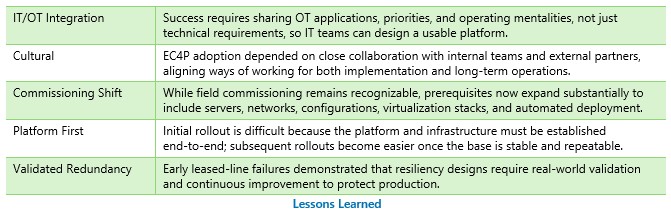
A core architectural direction was to move automation hardware from the shop floor to the data center. The team decided that applications should run on enterprise grade servers, so it became a question of location. Industry consensus was that applications should run as closely as possible to the processes. But Audi’s IT practices require data center deployment rather than on shop floor servers due to constraints such as cooling, power availability, and security. This shift required bidirectional knowledge transfer: OT expertise and priorities had to be shared with the EC4P team beyond “requirements,” while IT practices and platform thinking had to be translated into OT-relevant patterns that commissioning and plant teams could adopt.
After successful testing with two virtual PLCs in a rear axle assembly application, the rollout is extending the technology into additional domains such as final assembly and body shop, including safety-critical areas.
The rollout marks a stepwise shift from shop floor compute to centralized, data center‑hosted services. Where MES clients once ran on local IPCs, EC4P moves these workloads into the data center, leaving only thin clients on the shop floor. Once the platform and networking foundation is in place, new clients can be added quickly through virtualization, reducing the operational burden of distributed endpoints and aligning manufacturing applications with data‑center standards for availability, security, and lifecycle management.
The PLC rollout model also changed. Instead of on‑site installation and manual configuration, vPLC splits commissioning into field and virtual phases. Plant commissioning can only begin once the core infrastructure – data center servers, networking, virtualization, configurations, and automated deployment - is in place.
On the virtual side, a virtual machine is activated and the vPLC license is procured and assigned. The commissioning engineer then receives connection information for the vPLC, connects remotely through a thin client to the engineering tool of choice (e.g., TIA Portal), then uploads the PLC code. While the online commissioning phase remains largely unchanged in intent, the steps leading up to it shift significantly toward platform deployment, automation, and standardized operations.
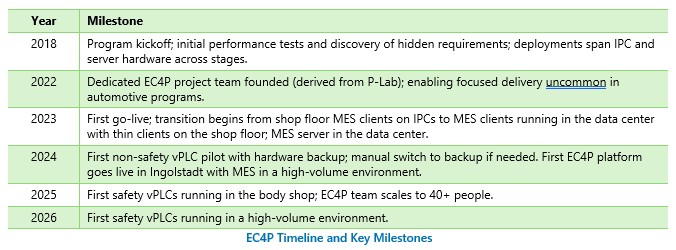
Overall, the rollout did not expose major technical blockers such as an inability to reach required real-time performance. Instead, issues tended to be “unexpected” in nature - most notably repeated licensing-related incidents that required resolution during delivery and operations.
A key early operational lesson emerged shortly after the first safety vPLC go-live: within the first week, a leased line between the factory and the data center failed twice, impairing the HMI. The result was robot cells that operated normally but could no longer be managed. The initial setup relied on multi-line redundancy, but the HMI was connected to only one physical link. This unlikely incident highlighted the fact that redundant designs still require careful validation of failover paths and real-world fault modes, and it triggered improvements to redundancy to better protect production continuity.
Organizational structure evolved alongside the technology. A dedicated EC4P project team was founded in 2022, derived from Production Lab (P-Lab), Audi’s internal innovation hub, with the explicit benefit of focusing only on the initiative. Over time, EC4P became anchored in Audi’s “IT for OT” branch. The team doubled in size compared to the original P-Lab team (20+), reaching 40+ people by 2025 to support broader rollouts, deeper operational maturity, and coordination with internal teams and external key partners.
The EC4P rollout surfaced a set of practical lessons that extend beyond technology, highlighting the importance of platform readiness, validated operations, and organizational alignment in software‑defined factory initiatives. In practice, success depended less on architectural ambition than on disciplined execution across infrastructure, operations, and teams.
Audi’s EC4P initiative demonstrates how manufacturing can adopt data-center-grade infrastructure and operating practices without compromising production requirements. By centralizing client workloads, evolving from physical PLCs to virtual PLCs (including safety use cases), and investing in observability and repeatable operations, Audi is steadily reducing the complexity and fragility of shop-floor compute while improving recoverability and day-to-day operability.
The rollout reinforces that the hardest work happens “before commissioning”: building the platform foundations, validating redundancy in real fault conditions, and aligning IT/OT roles, processes, and partners. With the program now scaled and anchored for long-term ownership, the next phase is to expand footprint and application breadth, while continuing to standardize deployment, clarify fault domains, and accelerate learning so each subsequent factory and domain rollout becomes faster and less disruptive.
ARC Advisory Group clients can view the complete report at the ARC Client Portal.
Contact Us if you would like to speak with the author.
Obtain more ARC In-depth Research Market Analysis.