Representative End User Clients







Representative Automation Clients







Representative Software Clients








Industrial organizations are under pressure to improve frontline productivity, preserve workforce knowledge, standardize work execution, and connect workers more effectively with operational systems. ARC’s MarketMap for Digital Worker Technologies for Manufacturing helps decision makers assess suppliers, understand market structure, and reduce risk when selecting solutions for industrial and infrastructure environments.
Manufacturers, energy companies, infrastructure operators, and other asset-intensive organizations are rethinking how frontline work is performed, supported, measured, and improved. Digital worker technologies provide industrial workers with access to colleagues, work instructions, training resources, systems, and assets while work is being performed.
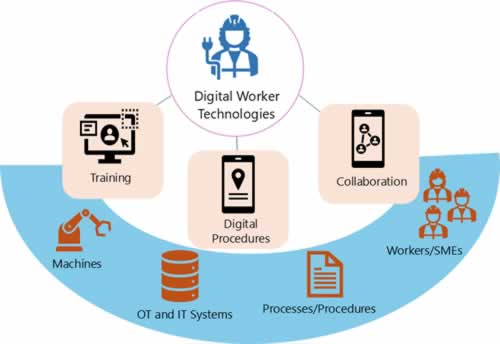
These solutions increasingly support collaboration, training, and digital work instructions, including real-time communication, knowledge sharing, task coordination, role- or event-based training, and interactive SOPs that may include images, video, or augmented reality markers
The market is also being shaped by the widening industrial skills gap, growing demand for mobile-first solutions, increased interest in just-in-time training, integration with business systems, venture investment, 5G availability, and the incorporation of digital worker capabilities into broader automation and industrial software portfolios.
For operational, engineering, IT, and supply chain leaders, this creates both opportunity and complexity. The challenge is no longer whether digital tools can help frontline teams, but which solutions best support enterprise requirements, site-level adoption, integration needs, workforce development priorities, and long-term operational resilience.
Digital worker technology is not a single, uniform software category. Suppliers vary significantly in focus, ranging from work instructions and training platforms to AR-enabled guidance, remote expert collaboration, mobile workforce execution, AI-enabled decision support, and broader industrial operations platforms.
The supplier landscape is fragmented. ARC’s report evaluates a broad set of providers, including specialists, industrial software companies, enterprise-scale technology providers, and emerging vendors with differentiated approaches to frontline enablement.
Regional and industry differences also matter. Some suppliers show stronger presence in North America or EMEA, while others support broader global deployments across Asia, Latin America, and other regions. Industry alignment also varies across automotive, food and beverage, chemicals, life sciences, oil and gas, utilities, machinery, aerospace, and other asset-intensive sectors.
Technology maturity differs across vendors. Some platforms emphasize ease of deployment and structured procedures, while others focus on AI-native capabilities, OT/IT integration, edge connectivity, industrial data contextualization, digital twins, AR visualization, or offline execution in low-connectivity environments.
Differentiation can be difficult to evaluate because many suppliers use similar terminology. Buyers must look beyond broad claims and assess the fit between solution capabilities, deployment models, integration depth, governance, usability, support services, scalability, and supplier strategy.

ARC’s MarketMap provides a structured, analyst-led view of the digital worker technologies market for manufacturing. It helps buyers compare suppliers based on solution capabilities and strategic vision, including technical capabilities, functional capabilities, execution and support services, product vision, corporate strategy, and customer base.
The report groups suppliers into categories such as Leaders, Major Players, Challengers, and Contenders, with definitions that reflect current performance, portfolio breadth, execution consistency, innovation depth, market presence, and strategic clarity. Providers evaluated in the MarketMap include: Andonix, Atheer, Augmentir, Azumuta, Dozuki, Glartek, Innovapptive, L2L, Librestream, Mobideo, Octave, Parsable, Poka, PTC, Redzone, Squint, SymphonyAI, TeamViewer, Tulip.
The MarketMap is intended as a decision-support tool, not a purchase recommendation. It helps organizations narrow supplier shortlists, clarify tradeoffs, identify strengths and gaps, and align technology selection with business objectives, technical requirements, risk profile, budget, and operational environment.
Technology suppliers may license ARC’s MarketMap to support market education, customer conversations, and internal strategic planning. The MarketMap helps suppliers:
ARC’s MarketMap is grounded in independent, research-based analysis of selected technology suppliers within a defined market scope. It reflects ARC’s interpretation of supplier-provided information, briefings, public sources, customer and market inputs where available, and ARC’s domain expertise.
ARC does not present the MarketMap as a guarantee, certification, endorsement, or recommendation to buy a specific product. Instead, it is designed to help organizations conduct better due diligence and evaluate solutions against their own business, technical, operational, and risk requirements.
ARC’s approach reflects deep domain knowledge across industry, energy, and infrastructure. The digital worker technologies analysis is framed around the realities of industrial operations, including workforce constraints, OT/IT integration, cybersecurity, mobile adoption, operational performance, and deployment at scale.
ARC also brings a global perspective. The report scope is global, and the supplier analysis considers technology applicability across industrial sectors, geographic regions, and diverse operational environments.
Because markets, products, strategies, and customer requirements evolve, supplier positioning may change over time. ARC’s MarketMap framework is intended to support ongoing market understanding as technology capabilities mature and buyer expectations shift.
To learn how ARC’s MarketMap for Digital Worker Technologies for Manufacturing can support your supplier evaluation, technology roadmap, or market strategy, contact us to speak with an ARC analyst.
To view a sample MarketMap, please complete the form below.