Representative End User Clients







Representative Automation Clients







Representative Software Clients








Smart and Powerful Sensing Nodes
Sensing for the emerging Internet of Things has been characterized by the use of extremely "smart" and wireless network edge nodes, such as smartphones in the consumer electronics space. Not only do these devices contain powerful sensing, they have significant on-board signal processing, storage, and networking resources; providing the potential to aggregate and analyze data locally at the network edge and in the Cloud.
Such high-powered edge nodes combine sophisticated sensing with analytics and visualization to enable people to "see" previously invisible phenomena, gain insight into these phenomena, and take appropriate action based on this new class of information. By contrast, industrial wireless sensing has focused on adding wireless connectivity to existing field device products, leaving the edge nodes no "smarter" than their wired predecessors. Successful applications in other industries (medical, aerospace, smartphone) show the potential benefits of combining IT power and sensing power in a single device.
Directed Sensing
Directed Sensing, a venture-stage company, is developing industrial versions of this "smart edge" capability. The company was founded by two veterans of industrial wireless sensing whose vision is to create a platform that can aggregate multiple channels of rich sensor data and also perform valuable analysis locally. Rather than a single measurement (such as pressure or temperature), Directed Sensing's vision for the platform is to sense more complex phenomena associated with the natural environment of an operating plant such as radio frequency (RF) emissions, ambient audio, chemical signatures, and local thermal emissions. This type of 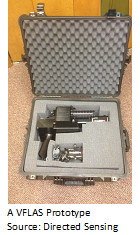
measurement cannot be reduced to a single engineering unit (e.g., degrees Fahrenheit). Rather, the sensor signals must be processed to identify their properties. For RF this includes the carrier frequencies, signal strengths, type of modulation, etc.). The resulting analysis can provide a visible (augmented reality) view of selected RF emissions as if they were visible light. Sound, thermal images, even chemical sensing can yield similar results.
To date, Directed Sensing has developed and tested prototypes of its VFLAS (Visual Frequency Location and Sensing) and xCam visualization platform in several applications. The company has also developed the ability to sense and locate RF sources at distance without triangulation. Directed Sensing believes that its analytics' ability to determine signal source locations from significant distance using a single sensing node represents new and differentiating technology. The initial development and field tests of the platform were done using the company's A-stage financing. The founders now look to the next stage of financing to develop an enhanced, commercial version of the product.
Possible Applications and Markets
The company conducted the initial field trials in three industries; detention (a.k.a., prisons), military, and heavy industry. In the prison environment, the application identified was detecting cell phone handsets from a significant standoff distance. Here the ability to rapidly identify handset locations while using a single sensing platform was critical.
In military applications, the technology was used to detect IEDs (improvised explosive devices), as IEDs often contain a cellular handset or other electronic detonator with an identifiable RF signature. General battlefield surveillance is another application. The existing night vision military equipment amplifies invisible infrared emissions, but battlefields also contain numerous RF sources and ad hoc analysis of these emissions may provide location and friend-or-foe information. Intrusion protection is another possible military application.
Infrastructure sensing applications can benefit from a drive-by or fly-by operation of a rich sensing platform that collects and analyzes the RF signatures of electrical capital equipment such as large transformers, switchgear, solar and wind farms, RF-dependent smart metering systems, and protective equipment. Much of this equipment is unmonitored at present and remains difficult and expensive to instrument with fixed permanent sensing, despite all the smart grid hype of the past six years. Most industrial plants also contain a considerable amount of large electrical equipment that could benefit from monitoring.
Many other potential industrial sensing applications are industry-specific. Applications that are problematic or expensive with traditional sensing include real-time location tracking (personnel and equipment), monitoring fugitive heat losses and fugitive chemical emissions, tracking planned or accidental spills/emissions, and tracking radioactive emissions. The Directed Sensing model could enable these applications without requiring a fixed Wi-Fi infrastructure. Another possible application area is analyzing subsea infrastructure. New offshore oil & gas developments extend to very deep water and will have much more equipment operating on the ocean floor. Such equipment is both expensive and mission critical. There is very little practical experience in diagnostics for subsea equipment and systems operating in deepwater environments.
Routes to Commercialization
Even a single sensing technology needs multiple commercialization plans to address such a wide range of vertical industries and applications. Directed Sensing has worked through partners to gain access to sites for testing and pilot operation. In the industrial space this includes discussions with two top-tier global suppliers of process automation systems.
The process automation industry has many safety-critical applications for which the relevant systems are largely immune to disruption from IT advances. However, many other process automation areas that relate to O&M, production management, optimization, planning, etc. are beginning to experience disruption from IT changes such as the cloud computing model and SaaS. Directed Sensing anticipates that its automation partner(s) will use the company's new sensing technology to differentiate their own offerings in valuable ways – both with and without cloud integration. Automation suppliers in these industries generally keep customers for 15 years or longer and a differentiating application that utilizes proprietary sensing/analytics could help support these long-term customer relationships.
ARC Analysis
Certainly the capability to perform complex sensing, signal processing, and analytics in single field nodes is new, growing, and riding on the rapid development of IT. ARC expects a deluge of video and other streams of multidimensional data from security cameras and similar devices. End users report to ARC that they typically derive near-zero benefit from such data. For example regulations require periodic video surveys of certain linear assets (pipelines, transmission lines) in energy industries, yet without effective analytics these surveys deliver negligible value. Pipeline corrosion alone represents an extremely costly loss where single incidents can cost billions. Recent examples include the Trans-Alaska Pipeline and the Kashagan oil project. Sensing corrosion is very difficult problem, even more so when attempted remotely. However ARC sees potential for a powerful sensing platform, such as Directed Sensing is developing, to deliver untapped value from less intractable industrial problems.
In ARC's view, the principal challenge facing Directed Sensing is partnership strategies. The company has focused its limited resources on developing its VFLAS-xCam sensing/analytics platform, and continues to work on developing its analytical and visualization capabilities. This is a tall order for such a small firm. Its partnership strategies need to engage partners and projects that can offload part of this work so the firm can retain a sharp focus as it deploys limited resources.
As recent acquisitions demonstrate, the process automation industry is consolidating. The remaining major suppliers must differentiate themselves, but do so in a consistent, long-term manner. They serve cautious industries with very sticky customer relationships. Developing very smart sensory/analytics platforms could provide a route to leadership in a key new technology for these firms. However the program needs to be focused and applied to develop applications that are both feasible and high value. That, in a nutshell, is the partnership challenge Directed Sensing faces.
All signed-in ARC Advisory Group clients can view this report in pdf format at this Link
If you would like to buy this report or obtain information about how to become a client, please Request ARC Info
Keywords: Directed Sensing, Industrial Internet of Things, Radio Frequency, Sensing.