Representative End User Clients







Representative Automation Clients







Representative Software Clients








At a hybrid in-person and live streaming press conference hosted by Siemens at Hanover fair 2022, Siemens Digital Industries CEO Cedrik Neike announced that Siemens, along with fourteen partners, has founded “Estainium,” an association supporting an ecosystem of manufacturers across the supply chain with the ultimate goal of improving the sustainability of industrial products and to create impact at scale as quickly as possible.
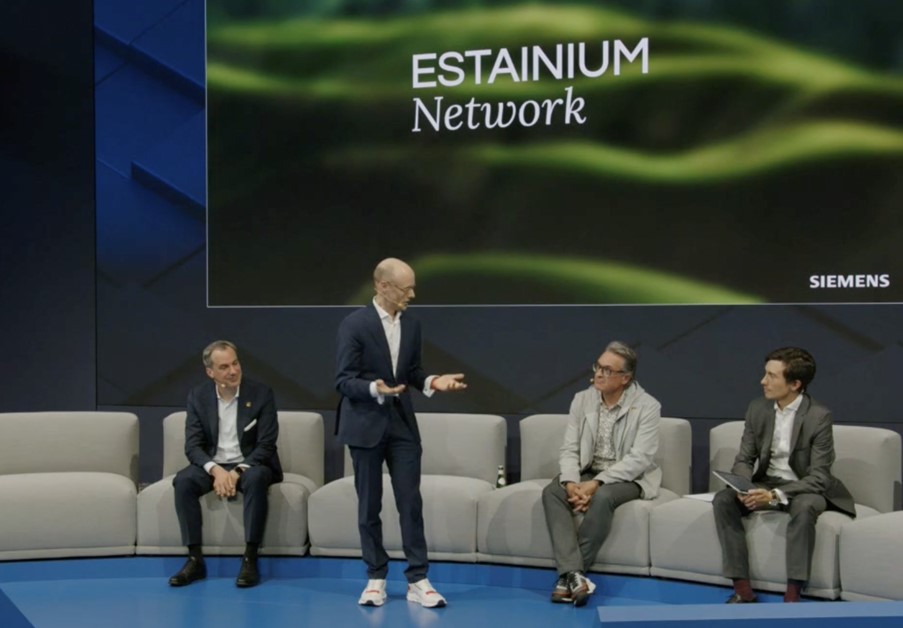
From left to right: Mr Neike (Siemens) Mr. Endress (Merck) Mr. Beitinger (Siemens), and Mr. Lunz (Siemens)
To make significant impact at the corporate, country, or global level, available technologies and methodologies like Industry 4.0, need to be implemented at scale. Has this happened since Industry 4.0 was introduced eleven years ago? Not really. The audience seemed to echo this reaction as they were posed this same question by Cedrik Neike. According to Mr. Neike, here is what needs to be done to make the acceleration happen:
To illustrate what impact through scale and acceleration means, Mr. Neike cited the example of fridges in supermarkets, responsible for about 1% of global electricity consumption. Either the fridges have doors and must compensate for cold air streaming out of the fridge when doors are opened by consumers, or they have no doors, and waste energy all day long. Siemens developed a technology using blades to keep the cold air inside the fridge even when accessed by consumers. It is not one nor a few fridges, but the large scale roll-out in 5,000 shops in the UK that resulted in 1.2 TWh of energy savings, roughly equivalent to 300,000 tons of CO2, or 360 million trips by car to the supermarket. Analogously, the accelerated roll-out of Industry 4.0 technologies can create savings visible at global level.
Dr. Gunther Beitinger, known for the impressive efficiency, quality and productivity improvements he implemented in the company’s automation components producing plant in Amberg (Germany), developed the concept in collaboration with the World Economic Forum, according to Mr. Neike. As around 90% of CO2 emissions associated with Siemens products originate upstream in the supply chain, Siemens realized that next level of improvement of the sustainability of the plant’s products needed to come mainly from the supply chain. (see note)
Sustainability reporting is not standardized, and therefore not transparent, nor comparable throughout the supply chain. For transparency of sustainability contributions along the chain, an international standard is needed, and partners need to agree on common principles of ‘interoperability’ to come to a common, optimized supply chain with minimal footprint.
International standardization, transparent reporting, and collaboration are among the main goals of Estainium, that will be operated as an independently governed ecosystem. The initial technology platform has been donated by Siemens AG, expected to be extended by applications developed by the members. The association also promotes education of stakeholders and building a think tank of sustainability leaders.
Note: The direct emissions (so-called scope-1 emissions), and indirect emissions (scope 2) are tackled by most companies as part of national or European goals and regulations. However, to tackle scope-3 or indirect emissions, created by sourced components or materials, supply chain collaboration is needed.
Dr. Thomas Endress, Executive Director of EMD Digital at Merck explained the company is strongly committed to participate in Estainium, because it realizes that consumers expect the same level of trust in the safety of commodity products such as bottled drinking water and the same levels of ease of comparison currently experienced with quality parameters, as they will soon expect in terms of sustainability. Mr. Endress envisions a trusted digital twin of the product as the repository of the information, and Merck as company that brings technology components to supply chaines to realize this. According to Mr. Endress, Merck also brings data interoperability to the table to make sustainability quantitatively comparable. Merck is committed to act, and make sure Estainium creates real impact.
There is no doubt it is urgent to act in improving sustainability and make global impact. The initiative is also aligned with the recent vision and policies by the European Commission, also identified as Industry 5.0 (see our article), as well as the original definition of Industry 4.0 (link to the Industry 4.0 blog?). Sustainability was also an important theme of the World Economic Forum. There is also little doubt that the planet needs action quicky, at scale, and that transparency and collaboration using available data will be essential.
The standardization aspect may slow-down the speed that the consortium aims for. Hopefully Estainium members will build upon the EU’s past and ongoing work on resource efficiency indicators. While these may be oriented towards measuring resource efficiency of a product of a single site or plant, the standardized quantitative evaluations maybe easily extended to the supply chain.
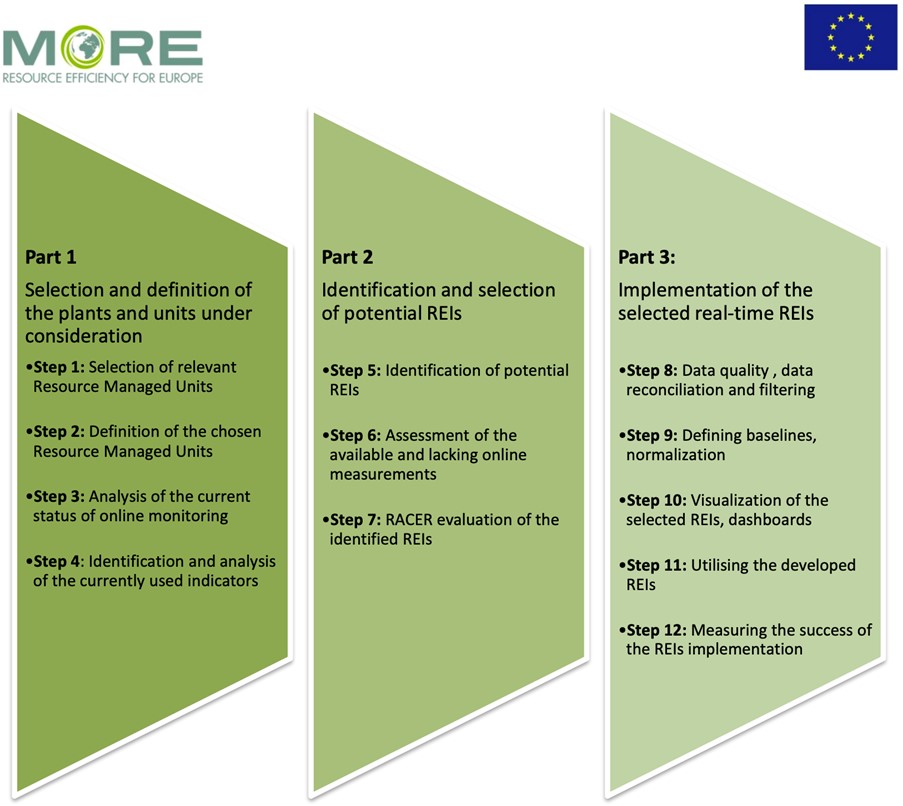
Caption: Methodology to Develop Resource Efficiency Indicators
What ARC is in doubt about is if the technology stack has been setup in the most efficient and strategic way. Estainium seems to have an architecture that is vaguely reminiscent of Gaia-X (see also our article). Estainium is interested in Catena-X, an ecosystem for the automotive industry built upon Gaia-X, according to Mr. Neike, but does not seem to be clearly aligned with or building on the Gaia-X software framework to build ecosystems efficiently. ARC recommends Estainium cooperates with Catena-X or a similar ecosystem to extend their scope.