Representative End User Clients







Representative Automation Clients







Representative Software Clients








For the very first time, AsInt participated as a Silver Sponsor at ARC Advisory Group’s 23rd India Forum titled Winning in the Industrial AI Era on July 10-11, 2025, that saw the convergence of over 300 delegates. Raunak Agarwal, Director - Projects & Delivery Lead at AsInt spoke about smart manufacturing and digital transformation in manufacturing, and the critical challenge that asset-intensive industries face: managing reliability and risk in silos. As organizations strive to modernize operations under the umbrella of Industry 4.0, the convergence of Reliability Centered Maintenance (RCM) and Risk-Based Inspection (RBI) emerges as a strategic imperative. This blog explores how unifying these methodologies can unlock trapped value, enhance operational efficiency, and drive sustainable asset performance. Raunak’s presentation can be watched on YouTube or here:
Many manufacturing organizations still manage RCM and RBI programs separately—often with distinct teams, budgets, and tools. This fragmented approach leads to inefficiencies, duplicated efforts, and missed opportunities for optimization. As Raunak said, “Assets don’t care which team maintains them—they just need to be available and reliable.”
Common industry pain points include: unplanned downtime disrupting production targets; high costs of reactive maintenance; poor data quality undermining AI/ML initiatives; and lack of standardized failure modes and asset hierarchies.
Reliability Centered Maintenance (RCM) is a structured, analytical process used to determine the most effective failure management strategies. It focuses on:
Defining asset functions and failure modes
Assessing failure effects and consequences
Developing preventive, predictive, and reactive strategies
Implementing maintenance plans in ERP systems
RCM has evolved from its aviation roots (RCM2 by John Moubray) to more risk-based approaches like RCM3, guided by standards such as SAE JA1011/1012.
Risk-Based Inspection (RBI) complements RCM by focusing on static assets like heat exchangers, pressure vessels, and tanks. RBI involves:
Identifying damage mechanisms (e.g., corrosion, cracking)
Calculating risk as probability × consequence of failure
Prioritizing inspections based on risk matrices
Determining remaining useful life and next inspection dates
Guided by standards like API 580/581, RBI helps organizations allocate inspection resources more effectively and mitigate high-risk scenarios.
RCM and RBI are not competing strategies—they are complementary. Unifying them enables:
Holistic asset strategies based on both reliability and risk
Improved data quality and master data diagnostics
Streamlined business processes and IT systems
Enhanced culture adoption and change management
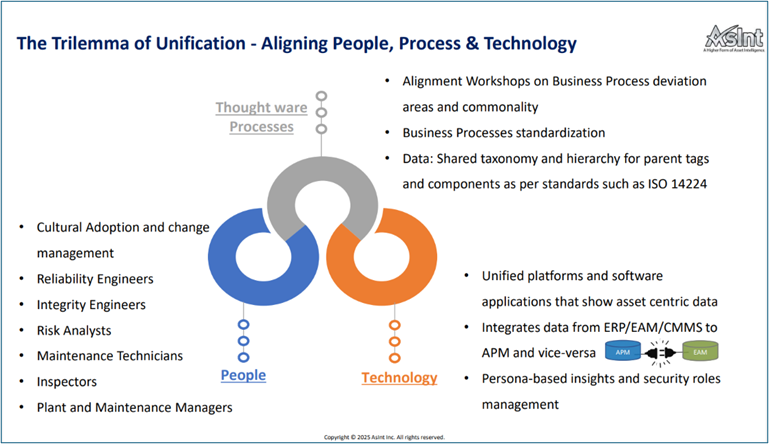
The “trilemma of unification”—people, process, and technology—must be addressed to realize the full potential of this convergence.
A real-world example involves a high-criticality filter asset. By integrating RCM and RBI assessments, the organization:
Analyzed maintenance history and supply chain data
Identified applicable damage mechanisms
Developed risk-based inspection schedules
Optimized maintenance spends and spare part planning
This approach led to smarter decision making and improved asset reliability.
Here’s a general guidance roadmap for organizations looking to unify RCM and RBI:
Conduct Workshops: Define asset management boundaries.
Identify Critical Assets: Focus RCM/RBI on high-impact equipment.
Establish Performance Standards: Define acceptable asset performance.
Implement PM Strategies: Set task frequencies and execution plans.
Run RBI Assessments: Prioritize inspections based on risk.
Monitor and Improve: Use feedback loops for continuous improvement.
The convergence of RCM and RBI is not just a technical integration—it’s a mindset shift. “If RBI and RCM can get along, maybe there’s still hope for pineapple on pizza discussion.” By embracing unified asset strategies, manufacturing leaders can drive digital transformation, reduce downtime, and build resilient operations aligned with Industry 4.0 principles.
Can you share a specific example or a success story where AsInt has supported in an APM initiative that led to improvements in reliability or OPEX or CAPEX cost optimization?
We started by aligning the customer’s business processes, which was the main challenge. Once mapped, we customized solutions to fit their needs, since off-the-shelf software rarely suffices. Our focus began with reliability and integrity, expanding into safety. We also developed a spend planning app, highlighting the importance of planning and budgeting for maintenance activities, which are prioritized using a risk-based approach.
When planning for the next year, how do you decide which activities to fund?
We use risk-based decision making. By plotting risk curves, we determine which activities to fund and which to defer or drop based on risk evaluation. This ensures resources are allocated effectively and activities align with organizational priorities.
Regarding RBI and RCM, do you see a need to integrate more quantitative risk estimation into RCM, perhaps using historical and failure data?
While RBI (Risk-Based Inspection) employs rigorous quantitative and semi-quantitative risk estimation, RCM (Reliability-Centered Maintenance) tends to be more subjective, particularly when estimating the probability and consequence of failure. To improve RCM, integrating historical and failure data could help provide more accurate estimates of likelihood, leading to better-informed maintenance decisions.
With risk becoming more dynamic and the advent of AAML-based solutions, should asset management systems incorporate real-time or near-real-time condition data?
As strategies evolve, ongoing evaluation of risks becomes more important. The integration of advanced analytics and machine learning (AAML) enables continual evaluation of asset conditions and emerging risks. Bringing in real-time or near-real-time data allows for a more accurate understanding and assessment of risk, supporting proactive and responsive asset management.