Representative End User Clients







Representative Automation Clients







Representative Software Clients








India’s pharmaceutical sector is transforming the global health landscape, emerging as a powerhouse of innovation, manufacturing, and strategic partnerships. This comprehensive blog answers the most-searched questions about the Indian pharma industry in 2026, including market size, government policy, export trends, and future outlook.
Global pharmaceutical companies are increasingly choosing Indian partners due to a unique blend of advantages: large-scale manufacturing, world-class regulatory compliance, cost efficiency, and technical expertise. Indian firms are leaders in complex generics, biosimilars, and CRDMO (Contract Research, Development, and Manufacturing Organization) services. Adherence to international standards set by agencies like the US FDA and EMA, combined with highly skilled scientists and advanced infrastructure, ensures that Indian pharma delivers high-quality products at competitive prices. Lower labor and operational costs further enhance India’s position as a preferred partner for research, development, and manufacturing. These factors make India’s pharmaceutical sector indispensable in expanding global access to affordable medicines.
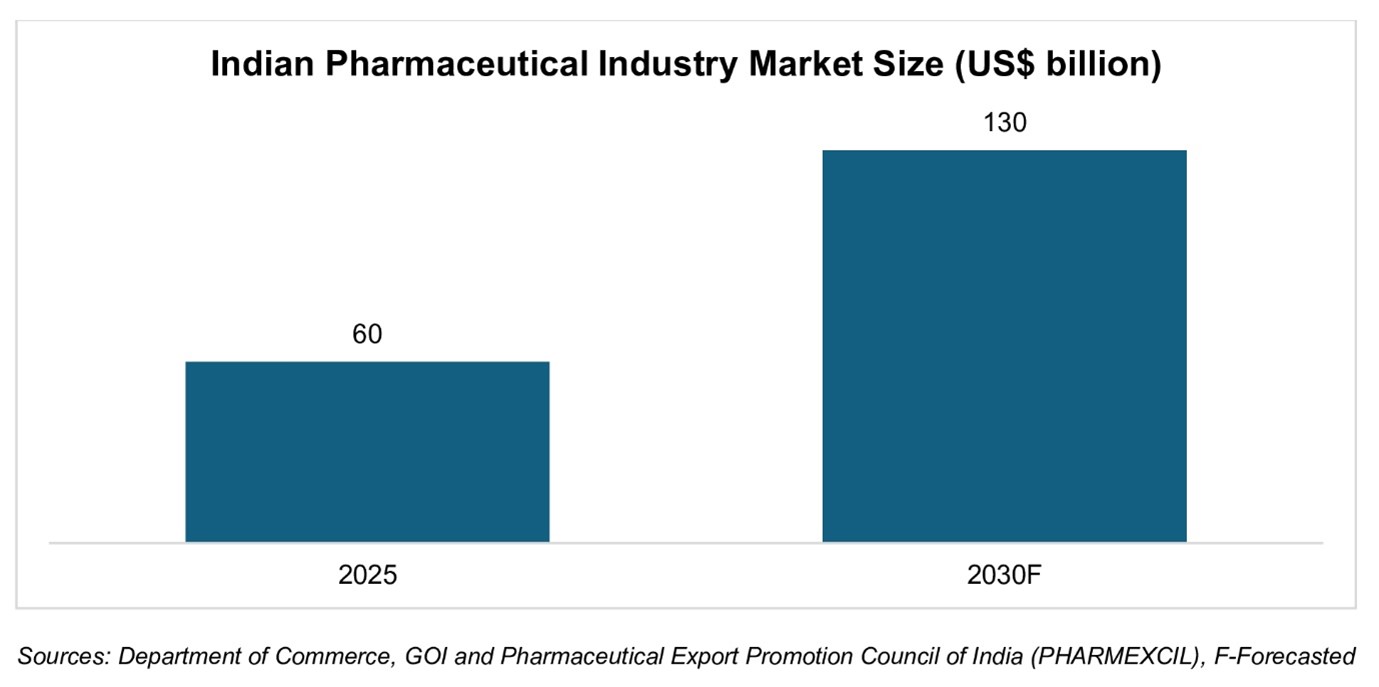
As of 2025, India’s pharmaceutical market is valued at Rs. 5.41 lakh crore (approximately $60 billion), ranking it among the world’s largest pharma producers. This growth is supported by a vast network of manufacturing facilities and a robust supply chain. By 2030, the industry is projected to reach Rs. 11.73 lakh crore ($130 billion), driven by innovation, export expansion, and a shift towards high-value products like biologics and specialty drugs. The sector’s scale and efficiency are underpinned by India’s commitment to quality, affordability, and accessibility, making it a cornerstone of global healthcare.
Government policies and initiatives, notably the Pharmaceuticals Production Linked Incentive (PLI) scheme, play a major role in enhancing India’s global pharma competitiveness. The PLI scheme incentivizes advanced manufacturing, innovation, and world-class infrastructure by providing financial support and regulatory facilitation. Policy measures aim to reduce reliance on imports for critical drugs, promote investment in cutting-edge technologies, and encourage sustainable practices. Upgrading the capacity of the Central Drugs Standard Control Organization (CDSCO) ensures Indian products meet international approval standards. These policies enable Indian pharma companies to compete globally, boosting exports and market penetration.
Regulatory Upgrades: Strengthening CDSCO to match global standards.
Education: Establishing new NIPERs (National Institutes of Pharmaceutical Education and Research) to develop specialized human resources.
India’s innovation ecosystems are anchored by specialized pharmaceutical and biotechnology hubs in cities like Hyderabad, Bengaluru, Pune, Mumbai, and more recently, Vizag. These clusters integrate research, clinical development, and manufacturing, enabling rapid translation of ideas into commercial products. Bengaluru, with over 2,600 biotech start-ups, stands out as a center for life sciences innovation. Programs like the Scheme for Promotion of Bulk Drug Parks provide shared infrastructure, reducing compliance costs and improving operational efficiency. Such initiatives position India to meet international quality benchmarks and support export-driven manufacturing.
Collaborations and technology transfer within these ecosystems foster cross-border research, co-development, and deeper integration with global pharmaceutical value chains.
The outlook for India’s pharmaceutical industry is robust and promising. The sector is moving from a volume-driven generics model to a value-driven approach, focusing on innovation, biosimilars, and complex generics. By end 2026, exports are expected to reach a record $32 billion, with significant growth in medical devices and biopharmaceuticals, fueled by initiatives like Biopharma SHAKTI (Strategy for Healthcare Advancement through Knowledge, Technology & Innovation). Advanced manufacturing, digital transformation, and sustainability will further boost operational efficiency and product quality.
India’s pharmaceutical industry is at a defining inflection point. The reforms of 2025, government support, and early innovation momentum provide a strong foundation for global leadership. To sustain this trajectory, the sector must focus on continued investment, decisive policy execution, and a steadfast commitment to quality and science. If India unites innovation, affordability, and world-class standards at scale, it can transition from being the world’s largest supplier of generics to a leading source of breakthrough therapies and biotech solutions.
For partners, patients, and stakeholders worldwide, the message is clear: India’s pharmaceutical industry is ready to lead the future of global healthcare.
What to watch out for: Four Webinars by ARC that cover all aspects impacting the pharmaceutical sector will be held during the next few months.
ARC Advisory Group India is planning to host a Pharma Summit in Hyderabad later this year. For this we invite participation from key industry players and end users.