Representative End User Clients







Representative Automation Clients







Representative Software Clients








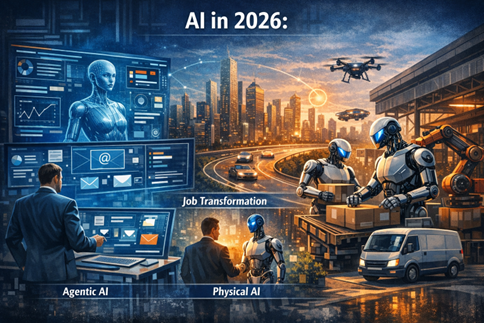
Artificial intelligence is a transformative technology that is driving meaningful and disruptive change in the world as we know it. In time, we may describe history as Before AI and After AI. In 2026, AI is shifting from a passive generative tool to agentic AI, capable of autonomously executing multi-step tasks, such as managing workflows, research, and coding without constant human oversight. At the same time, physical AI is moving intelligence off the screen and into the real world. AI-powered robotics and sensor-driven systems are transforming manufacturing, logistics, and infrastructure by enabling adaptive, non-human-directed decision making. Together, agentic and physical AI are reshaping how work is done, how value is created, and how organizations are structured.
Agentic AI differs fundamentally from earlier generative AI models. Instead of responding to individual prompts, agentic systems:
Execute end‑to‑end workflows independently
Coordinate tasks across tools and platforms
Make decisions based on goals rather than instructions
Operate continuously, without constant human supervision
In practical terms, AI agents can now find sales leads, send emails, schedule meetings, reconcile data, write code, and trigger follow‑up actions automatically. This capability is accelerating AI adoption across knowledge-intensive industries.
AI is fundamentally transforming the global economy by augmenting human capabilities and automating complex tasks at scale.
Healthcare diagnostics and treatment are among the most advanced use cases. AI systems analyze medical imaging, patient records, and genomic data to detect diseases earlier, improve diagnostic accuracy, and support personalized treatment plans. AI is also accelerating biomedical research and drug discovery.
Workforce automation and productivity are accelerating rapidly. In 2024, 65 percent of companies reported using generative AI to improve efficiency. In 2026, that usage has shifted from experimentation to embedded operations, particularly in administration, analysis, and content production.
In personalization and e-commerce, AI analyzes purchase behavior, preferences, and visual inputs to deliver hyper-personalized shopping experiences. Tools like visual search and recommendation engines are redefining how consumers discover products.
AI is also playing a growing role in environmental sustainability. Machine learning models help predict climate patterns, optimize energy grids, improve water usage in agriculture, and model emissions-reduction strategies.
In transportation and smart cities, AI-driven traffic management, predictive maintenance, and autonomous systems are improving safety, reducing congestion, and lowering environmental impact.
Several sectors are experiencing especially rapid AI-driven change:
Manufacturing: AI-powered robotics increase production efficiency, reduce defects, and enable adaptive, real-time decision making on factory floors.
Agriculture: Precision farming tools, including AI-enabled drones and robots, monitor crops, optimize inputs, and assist with harvesting.
Finance and security: AI detects fraud, strengthens cybersecurity, supports regulatory compliance, and enhances national defense strategies.
Across these industries, AI has shifted from a novelty to a mission-critical capability for resilience and competitiveness.
Three developments define AI’s impact in 2026.
First, autonomous agentic workflows mean AI is now achieving goals rather than merely answering questions. Entire business processes can run with limited human involvement.
Second, the rise of physical AI is expanding automation into environments previously considered too complex or unpredictable for machines, such as warehouses, factories, and logistics hubs.
Third, human–AI co-creation has become the dominant creative model. AI handles execution and iteration, while humans focus on strategy, judgment, and high-level design rather than manual production.
As Harvard Business Review observes, “The future is shrouded in an AI fog." AI has introduced uncertainty around skills, careers, and education. If AI systems can think, write, analyze, and strategize at near-zero marginal cost, traditional assumptions about human capital are under pressure.
In 2026, AI is widely perceived as a job threat—not because it replaces everyone at once, but because it has become embedded and agentic. Entry-level roles in marketing, design, and coding are declining as senior professionals use AI to perform work once assigned to juniors, disrupting traditional career ladders. However, the dominant trend is job reshaping rather than job elimination. Skills are evolving faster than the workforce can adapt, creating significant talent gaps.
The defining truth of 2026 is simple: AI won’t take your job - but a human using AI will. The risk is highest for those who fail to adapt. Those who learn to work with AI as a force multiplier—combining human judgment with machine execution—will shape the future of work. Those who don’t may struggle to remain relevant in an increasingly agentic world.