Representative End User Clients







Representative Automation Clients







Representative Software Clients








In an era where industrial automation discussions are often dominated by advanced sensing technologies and digital transformation initiatives, continuous ultrasonic level measurement continues to hold a firmly established position across many process industries. Despite being a mature technology, ultrasonic level measurement remains widely specified, deeply trusted, and operationally relevant, particularly in applications where simplicity, noncontact measurement, and cost-effective reliability matter more than extreme performance capabilities.
Rather than being displaced by newer technologies, continuous ultrasonic level measurement has evolved quietly, adapting to modern operational demands without fundamentally changing the principles that made it successful in the first place.
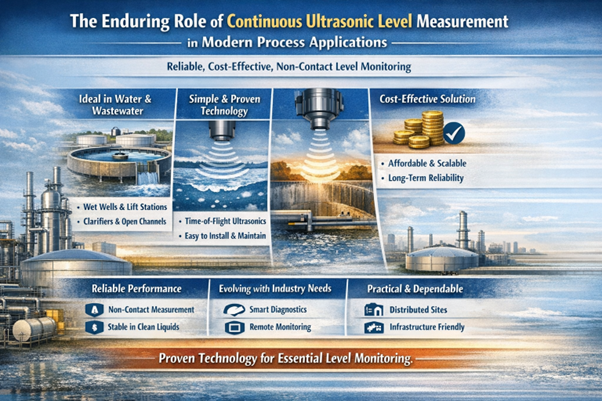
Continuous ultrasonic level measurement is built on a straightforward operating principle: measuring the time it takes for an acoustic signal to travel from the sensor to the material surface and return. This simplicity has long been one of its greatest strengths. With no direct contact with the process medium, ultrasonic level devices avoid many of the mechanical and chemical stresses that affect contact-based technologies.
Over time, this has made ultrasonic level measurement a dependable choice for applications involving clean liquids, open tanks, channels, and vessels where process conditions remain relatively stable. Its value lies not in technological complexity, but in predictable performance and ease of deployment.
One of the most important reasons ultrasonic level measurement continues to be widely used is its strong alignment with specific application requirements. In many process environments, particularly those involving water and wastewater, the operating conditions are well within the optimal range of ultrasonic technology. These environments often require continuous monitoring over large areas, with minimal maintenance and straightforward installation.
Ultrasonic sensors are especially effective where:
The medium is water-based or acoustically reflective.
Tanks or basins are open to the atmosphere.
Extreme temperature or pressure is not present.
Measurement accuracy requirements are moderate.
Installations must remain cost-effective and scalable.
In such cases, the additional complexity and cost associated with alternative technologies may offer limited operational benefit.
Although the underlying measurement principle remains unchanged, modern continuous ultrasonic level devices are not static. Incremental improvements in signal processing, temperature compensation, and echo discrimination have enhanced measurement stability and reduced susceptibility to environmental influences.
Digital filtering algorithms now help isolate true surface echoes from spurious reflections, while built-in compensation techniques improve performance under changing ambient conditions. These refinements have extended the usable range of ultrasonic sensors and improved reliability in applications that were previously considered borderline.
As a result, ultrasonic level measurement has progressed not through dramatic innovation, but through consistent refinement, an approach that aligns well with the pragmatic needs of infrastructure and utility operators.
Perhaps no sector demonstrates the enduring relevance of ultrasonic level measurement more clearly than water and wastewater management. In these applications, reliability, simplicity, and low total cost of ownership often outweigh the need for extreme measurement precision.
Continuous ultrasonic devices are widely used for:
Wet well level monitoring.
Lift station control.
Clarifier and basin level measurement.
Open channel flow calculations.
Chemical storage and dosing tanks.
These environments typically involve changing water levels, moderate turbulence, and occasional exposure to humidity or condensation, conditions where noncontact ultrasonic measurement performs reliably without introducing unnecessary complexity.
Just as important, ultrasonic sensors are well suited for installations in locations where regular maintenance access may be limited. Their ability to operate without direct contact reduces fouling concerns and supports long-term unattended operation.
Another area where ultrasonic level measurement continues to add value is in distributed and remote monitoring applications. Utilities and industrial operators often manage large numbers of tanks, basins, or channels spread across wide geographic areas. In such scenarios, cost per measurement point becomes a critical consideration.
Ultrasonic level devices provide a practical balance between functionality and affordability. Their straightforward commissioning, established performance characteristics, and compatibility with common control systems make them an attractive option for standardized deployments across multiple sites.
This scalability has helped ultrasonic technology remain a backbone measurement solution in infrastructure-heavy industries.
While advanced measurement technologies offer impressive capabilities, they also introduce additional design considerations related to power requirements, installation constraints, and data interpretation. For many applications, these trade-offs are unnecessary.
Continuous ultrasonic level measurement benefits from a relatively simple system design. With fewer variables influencing measurement performance, engineers can more easily predict long-term behavior and integrate these devices into control strategies with confidence.
This simplicity supports operational reliability by reducing:
Calibration dependency.
Sensitivity to process changes.
The need for complex diagnostics.
Risk of overengineering.
In environments where stable and continuous level measurement is sufficient, ultrasonic sensors deliver exactly what is required: no more, no less.
A common misconception is that newer sensing technologies automatically replace older ones. In practice, ultrasonic and radar level measurement technologies often coexist, each serving applications where it delivers the most value.
Radar excels in environments involving extreme pressure, temperature, vapor, or challenging surface conditions. Ultrasonic measurement, by contrast, remains well suited for simpler process conditions where such extremes are absent. Selecting ultrasonic technology in these cases is not a compromise; it is an informed engineering decision.
Understanding where ultrasonic measurement fits best allows engineers to deploy resources efficiently while maintaining operational reliability.
In modern process plants, continuous ultrasonic level measurement plays a stabilizing role. It provides dependable monitoring in applications that demand consistency rather than sophistication. By delivering reliable level data without introducing unnecessary complexity, ultrasonic sensors support efficient operation across a wide range of industries.
Rather than fading into obsolescence, ultrasonic level measurement continues to serve as a foundational technology, one that adapts quietly, performs reliably, and remains aligned with real-world process requirements.
The continued relevance of continuous ultrasonic level measurement demonstrates an important principle in industrial automation: longevity is earned through application fit, not novelty. Ultrasonic technology persists because it solves real problems effectively, economically, and reliably.
As process industries continue to modernize, ultrasonic level measurement will remain an essential part of the instrumentation landscape, not because it is the most advanced option available, but because it consistently delivers the performance that many applications genuinely need.