Representative End User Clients







Representative Automation Clients







Representative Software Clients








In the broader discussion of level measurement technologies, much of the focus tends to revolve around noncontact methods such as radar and ultrasonic sensing. These approaches are often highlighted for their ability to operate without interaction with the process medium. However, this perspective overlooks an equally important reality: in many industrial applications, direct contact with the medium is not a limitation—it is a requirement.
Hydrostatic level measurement remains one of the most dependable and widely used methods in cases where pressure-based sensing provides a more stable and practical solution. Rather than competing with noncontact technologies, hydrostatic measurement fulfills a distinct role, addressing process conditions where alternative approaches may struggle or introduce unnecessary complexity.
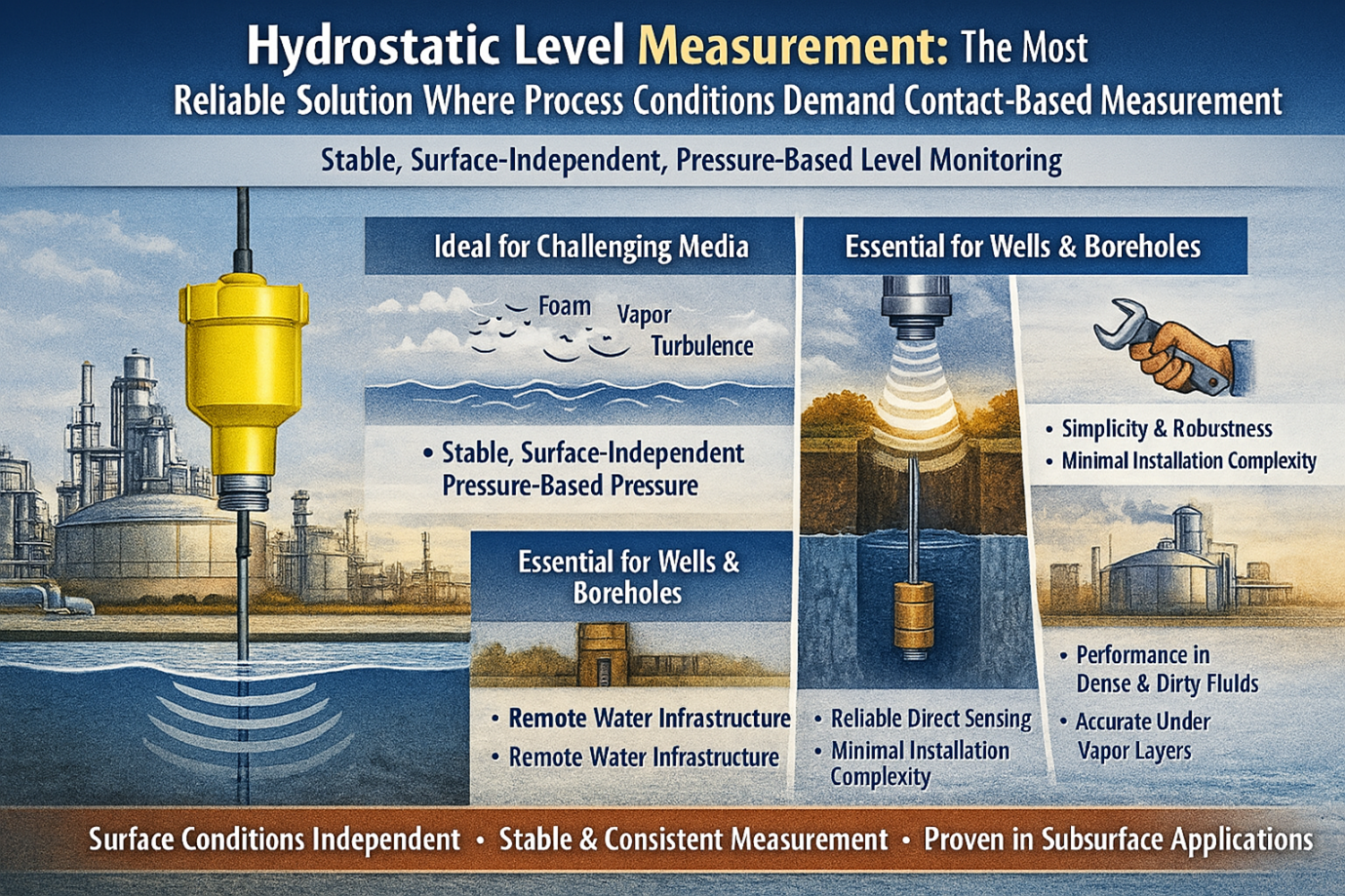
Hydrostatic level measurement is based on a simple and well-understood physical principle: the pressure exerted by a liquid column is directly proportional to its height. By measuring this pressure, the system determines the level within a vessel, tank, or well.
This direct relationship gives hydrostatic measurement a unique advantage. Unlike surface-dependent technologies, which rely on echo reflection or signal propagation, hydrostatic systems measure the mass of the liquid itself. This makes them inherently stable in environments where surface conditions are inconsistent or unpredictable.
The result is a measurement approach that is not only accurate, but also fundamentally resilient to many of the disturbances that challenge noncontact sensors.
One of the defining strengths of hydrostatic level measurement is its ability to perform in environments where surface conditions are not ideal. Foam, vapor, turbulence, condensation, and agitation can interfere with noncontact measurement technologies, leading to signal instability or inconsistent readings.
Hydrostatic measurement, by contrast, operates independently of surface behavior. Because the sensing element is immersed in or exposed directly to the liquid, the measurement remains unaffected by what occurs above the surface. This characteristic makes hydrostatic systems particularly valuable in applications involving:
Wastewater and sludge tanks.
Chemical storage with surface reactions.
Agitated or mixing vessels.
Closed tanks with vapor layers.
Environments with high humidity or condensation.
In such cases, reliance on surface detection can introduce risk, while pressure-based measurement provides consistent and predictable results.
Hydrostatic level measurement is often the preferred—and sometimes the only practical—solution for subsurface and vertical column applications. In deep wells, boreholes, and underground storage tanks, installing noncontact sensors may be impractical or ineffective due to limited access, confined geometry, or environmental exposure.
Submersible hydrostatic sensors are specifically designed for these conditions. Suspended within the liquid column, they measure pressure continuously, providing reliable level data regardless of depth or external environment. This makes them indispensable in applications such as:
Groundwater monitoring.
Raw water extraction.
Borewell and reservoir level measurement.
Underground fuel or chemical tanks.
Remote water infrastructure systems.
These applications highlight the importance of selecting measurement technologies based on physical constraints rather than purely on technological advancement.
Another key advantage of hydrostatic level measurement lies in its mechanical simplicity. With relatively few components and a direct measurement approach, hydrostatic systems are inherently robust. This simplicity translates into predictable performance and ease of integration within process systems.
For engineering teams, this means:
Fewer installation dependencies.
Straightforward configuration.
Clear measurement behavior.
Reduced sensitivity to mounting conditions.
In environments where operational reliability is prioritized over technological sophistication, such characteristics are highly valuable. Hydrostatic measurement supports a design philosophy focused on stability, continuity, and ease of operation.
While hydrostatic level measurement offers clear advantages, it is important to acknowledge its limitations to maintain a balanced perspective.
Because the measurement is based on pressure, it is influenced by the density of the liquid. Variations in density—due to temperature changes, composition differences, or process variability—can affect measurement accuracy if not properly accounted for. Additionally, because the sensor is in contact with the medium, material compatibility must be carefully considered to prevent corrosion, fouling, or buildup over time.
These factors do not diminish the value of hydrostatic measurement, but they require thoughtful application and engineering judgment. In many cases, these considerations are well understood and easily managed within standard design practices.
A common misconception in level measurement is the idea that one technology can universally replace another. In reality, different measurement methods exist because process conditions vary widely across industries and applications.
Hydrostatic level measurement complements noncontact technologies by addressing scenarios where direct sensing provides greater confidence. In stable, open environments, ultrasonic measurement may be ideal. In harsh or complex vapor conditions, radar may be preferred. In submerged or surface-independent measurement scenarios, hydrostatic measurement becomes the most reliable choice.
This complementary relationship highlights the importance of application-driven selection rather than technology-driven preference.
The continued relevance of hydrostatic level measurement is evident across multiple industries. In water and wastewater systems, it provides dependable monitoring for lift stations, wells, and treatment processes. In chemical and process industries, it supports level measurement in tanks where vapor or agitation may interfere with other methods.
In oil and gas applications, hydrostatic measurement is often used in storage and transfer systems where understanding the liquid column is essential. In power generation and utilities, it contributes to stable operation of auxiliary systems and cooling processes.
Across these sectors, the common requirement is not necessarily advanced measurement capability, but consistent and reliable performance under real-world conditions.
Hydrostatic level measurement remains a foundational technology because it addresses a fundamental aspect of level sensing: the physical relationship between pressure and liquid height. Its ability to deliver stable, surface-independent measurements makes it indispensable in applications where noncontact methods may be unsuitable.
Rather than viewing hydrostatic measurement as an older or alternative approach, it should be understood as a dedicated solution for specific process realities. Where contact-based measurement is necessary, hydrostatic systems provide a level of reliability that is both practical and proven.
In modern process plants, the true measure of a technology is not how advanced it appears, but how effectively it performs within its intended application. Hydrostatic level measurement continues to demonstrate its value by doing exactly that—reliably, consistently, and without unnecessary complexity.