Representative End User Clients







Representative Automation Clients







Representative Software Clients








ARC Advisory Group has initiated a new MarketMap research study focused on the global market for photoelectric sensors. The study will evaluate and position leading suppliers based on the breadth of their product portfolios and the effectiveness of their strategic execution in industrial automation applications. The MarketMap is designed to support supplier shortlisting, competitive benchmarking, and technology selection decisions for industrial organizations worldwide.
Photoelectric sensors remain a foundational technology in factory and process automation, enabling reliable object detection, positioning, and measurement across a wide range of industries. As automation architectures become more distributed and data-driven, suppliers are being challenged to deliver not only robust sensing hardware, but also greater flexibility, connectivity, and diagnostic intelligence at the device level.
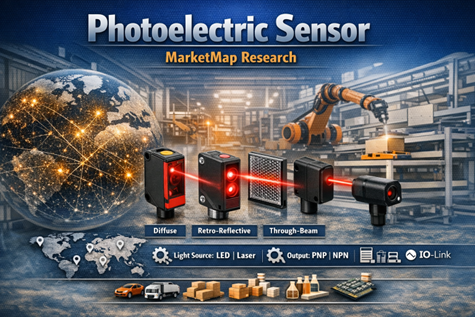
Industrial companies continue to invest in automation to address productivity requirements, labor constraints, quality improvement, and operational resilience. Photoelectric sensors play a critical role in these initiatives by enabling high-speed, non-contact detection in environments where mechanical or alternative sensing approaches are impractical.
Across industries such as automotive, food and beverage, machinery manufacturing, pharmaceuticals, electronics, and semiconductors, photoelectric sensors are increasingly deployed in applications that demand higher precision, longer sensing distances, and reliable performance with transparent, reflective, or fast-moving objects. Regional manufacturing expansion in Asia, combined with modernization and retrofit activity in EMEA and North America, is further shaping supplier strategies and competitive dynamics.
The ARC MarketMap will focus on photoelectric sensors used in industrial automation. Products included in the scope are diffuse photoelectric sensors, such as standard diffuse, contrast scanners, color scanners, and fixed-field or fixed-focus devices, as well as non-safety light barriers, including through-beam, retro-reflective, fork and angle sensors, and light curtain sensors used for detection rather than personnel protection.
The study will also assess fiber optic photoelectric sensors designed for constrained, harsh, or hazardous environments. Safety-rated sensors, safety light curtains, machine vision systems, and non-photoelectric sensing technologies such as inductive, capacitive, ultrasonic, or mechanical sensors are explicitly excluded from the scope.
Several factors are influencing the evolution of the photoelectric sensor market. Advances in electronics and optics are enabling more compact designs, extended sensing ranges, and improved resolution. At the same time, industrial users are demanding greater flexibility in how sensors are configured, integrated, and maintained over their lifecycle.
The adoption of digital communication options such as IO-Link, along with continued demand for traditional digital and analog outputs, reflects the coexistence of legacy automation systems and newer, more connected architectures. Smart sensing features, including diagnostics, parameterization, and basic connectivity, are increasingly important for reducing commissioning time and supporting predictive maintenance strategies.
However, the market remains highly competitive and fragmented, with suppliers differentiating through portfolio completeness, application expertise, regional coverage, and industry-specific execution.
ARC’s MarketMap methodology provides a structured and transparent framework for evaluating suppliers. In this study, ARC will assess suppliers across two primary dimensions: product and technology capabilities, and strategic execution. This includes analysis of portfolio breadth, support for switching and measuring applications, handling of challenging detection scenarios, output and communication options, and readiness for deployment across different industries and regions.
By combining quantitative and qualitative insights, the MarketMap delivers decision-grade intelligence that helps end users, OEMs, and system integrators understand the competitive landscape and align supplier choices with operational and strategic objectives.
“The photoelectric sensor market is mature, but it continues to evolve as industrial customers demand higher performance, greater flexibility, and better integration into modern automation systems,” said Santosh Kumar, Analyst, ARC Advisory Group. “This MarketMap will help clarify how suppliers are differentiating themselves and where they are best positioned to support emerging industrial requirements.”
ARC invites photoelectric sensor suppliers that meet the study scope to participate in the MarketMap. Participation includes structured data submission and the opportunity for analyst briefings to ensure accurate representation of product portfolios, strategies, and regional execution. Suppliers interested in being considered for inclusion are encouraged to engage with ARC during the research process.
ARC Advisory Group is the leading technology research and advisory firm for industry, infrastructure, and cities. ARC analysts have the industry knowledge and firsthand experience to help clients find the best answers to complex business issues. ARC provides technology supplier clients with strategic advice and marketing support to guide product and market development. ARC advises end user clients on technology selection, operational performance, and digital transformation strategies.