Representative End User Clients







Representative Automation Clients







Representative Software Clients








Artificial intelligence is changing how we read, write, and think about language. For many people, this shift feels exciting. AI tools can summarize long documents, complete half-baked ideas, suggest better phrasing, and even draft essays in seconds. But alongside convenience comes a deeper cultural question: if machines can produce smooth, polished language so easily, what happens to the imperfect, original, deeply human qualities of writing?
That concern is not entirely new. In 1953, Roald Dahl imagined something remarkably similar in The Great Automatic Grammatizator, a satirical story about a machine that can mass-produce commercially successful fiction and gradually push human writers aside. More recently, science fiction author Greg Egan said that generative AI in writing is a dehumanizing technology that reduces human intention. He believes that Large Language Models (LLMs) lower societal expectations of both writers and readers, reducing human beings to “generic regurgitators of statistical patterns rather than creators of meaning.” Together, these ideas help explain why the AI writing boom feels both useful and unsettling.
For general readers, the issue is not simply whether AI can write. It is whether society may begin to value fluency over thought, speed over reflection, and polish over authenticity. Language is no longer just a medium for expression; increasingly, it is being treated like a system to be optimized. Words are now filtered through terms such as prompt/output/query/token. In that world, writing risks becoming less about discovery and more about instruction. Instead of asking, “What do I really want to say?” many people are learning to ask, “How do I get the best response?” That may sound like a small shift, but it changes our relationship with language in a profound way.
Writing has historically been messy, slow, and personal. First drafts ramble. Sentences fail. Ideas emerge halfway through the act of writing itself. Those imperfections are not always weaknesses; often, they are signs of thought in motion. They reveal hesitation, individuality, and emotional texture. AI, by contrast, is designed to reduce friction. It predicts the next likely phrase, smooths rough edges, and produces text that appears confident even when the underlying ideas are generic. The result can be efficient, but it can also feel strangely flattened. When everyone has access to the same systems trained on similar patterns, expression may become more uniform, even when it appears highly refined.
This raises a larger concern about knowledge production. If more articles, reports, posts, and emails are created with the help of generative AI, then public language may begin to reflect the biases, assumptions, and stylistic averages embedded in those systems. Human voices, especially unconventional or marginalized ones, could be pushed further to the edges. Not because they disappear completely, but because machine-generated fluency may become the new standard against which all communication is judged. A hesitant sentence, an unusual rhythm, or an unexpected choice of words might increasingly be seen as a flaw rather than a sign of originality. That would be a loss, not just for literature, but for public culture.
At the same time, rejecting AI entirely is neither realistic nor necessary. These tools can be genuinely helpful. They can support brainstorming, translation, accessibility, editing, and everyday communication. For many people, AI reduces barriers and saves time. The real challenge is learning how to use it without letting it define the limits of thought. AI works best as an assistant, not a substitute for judgment, memory, curiosity, or voice. The danger begins when convenience turns into dependence, and when dependence slowly weakens the habits that make writing meaningful in the first place.
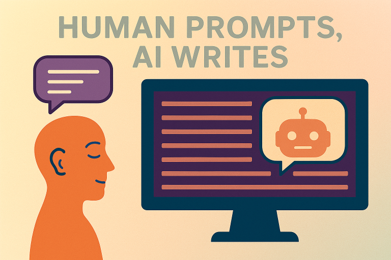
In the end, the most important question is not whether AI can produce language that looks impressive. It can. The more important question is what kind of culture we create when perfection becomes automated. If writing becomes only a matter of efficiency, then something vital may be lost: the friction, uncertainty, and individuality through which people make meaning. Human writing does not matter because it is flawless. It matters because it carries experience, intention, and voice. In the age of generative AI, preserving that voice may become one of the most important cultural tasks of all.