Representative End User Clients







Representative Automation Clients







Representative Software Clients








In Part 1 of this series, we explored why industrial humanoid robots are starting to emerge now, examining how converging advances in robotic intelligence and urgent market pressures have sparked a new wave of interest.
In Part 2, we mapped who is driving this movement, highlighting the early movers, partnerships, and ecosystem taking shape around industrial humanoids.
Now, in Part 3, we turn our focus to where this market is headed and what it will take for humanoid robots to transition from the show floor to the factory floor. We’ll discuss the near-term outlook for industrial humanoid deployment, the strategic choices ahead (for suppliers and buyers alike), and how to navigate this emerging market.
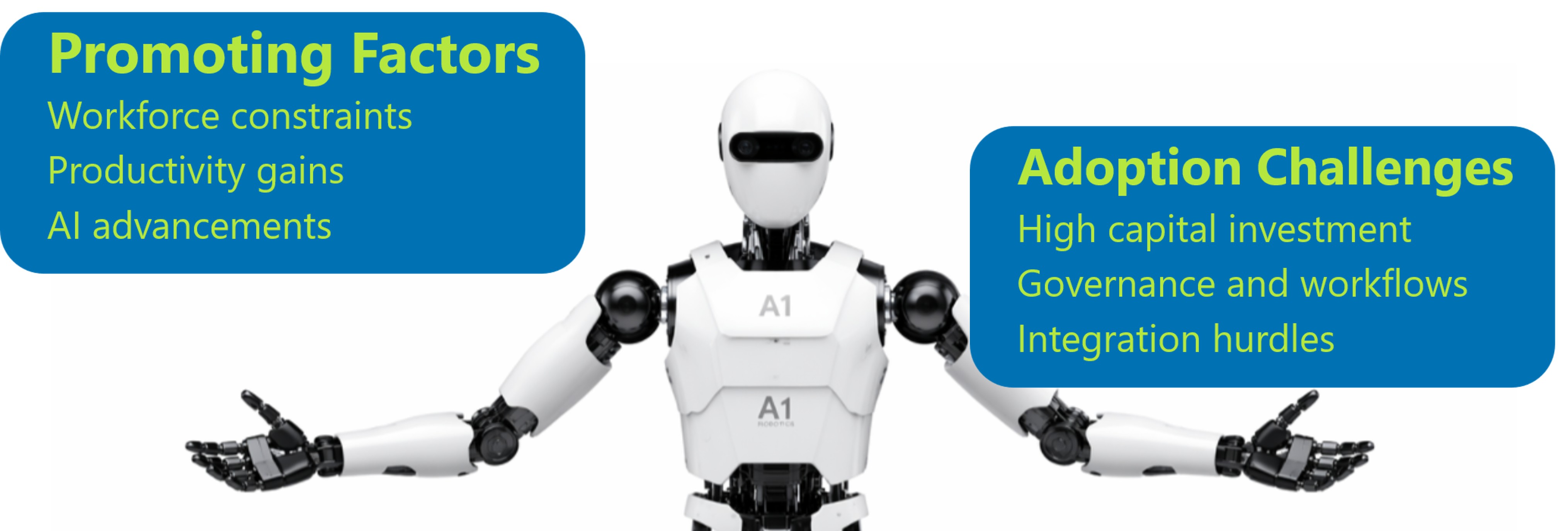
I’m sure we’ve all seen the media presentations over the past year: the awkward, shuffling robots of the past have made way for genuinely compelling tech demonstrations. It feels like a new era of automation is within reach, but humanoids remain in a transitional phase between experimentation and scalable deployment. This dual reality defines today’s moment: there’s tremendous excitement about the convergence of AI and humanoid robotics, yet equally high uncertainty about these machines’ readiness for routine operations.
This is precisely where structured market analysis becomes useful. The industrial humanoid robot landscape is new and fragmented, and ARC’s forthcoming MarketMap for industrial humanoids will bring clarity to this early market.
In the remainder of this blog, we’ll refine the key strategic questions driving the market forward: How close are humanoids to real deployment, not just technical validation? What distinguishes credible industrial approaches? And how should organizations think about system-level value beyond simplistic labor substitution?
Much of the discussion around humanoid robots centers on “going from pilot to scale.” The next step for industrial humanoids is not mass scaling, but bridging the gap between prototypes and a robust, industry-ready solution. Over the next one to two years, we can anticipate:
Continued pilot projects across manufacturing and logistics. Many forward-thinking industrial end users will experiment with humanoid robots in limited trial roles, exploring tasks such as materials handling, machine tending, welding, inspection, or assembly. Other applications will remain niche as the early movers attempt to capture the verticals with the most obvious fit.
Only a few vendors moving into early production deployments. A small number of leading humanoid robot developers will likely begin shipping their first production units to select customers. These will be modest-volume beta deployments numbering dozens to hundreds, not thousands. Remember that industry moves slowly out of necessity, as even small automation initiatives cannot be implemented without the requisite safety policies, change management, and governance models in place.
Most vendors staying in development mode while fundraising from investors, refining their product offerings, and locking in their supply chains. The majority of humanoid robot companies will remain focused on advanced prototypes and iterative hardware development during this period, with limited pilot deployments. Vendors with a more refined scope will see some early deployment, while research toward a “general-purpose” robot continues in the background.
Two to four years out, big investments in production capacity will begin to bear fruit, with many humanoid suppliers projecting units in the hundreds of thousands per year. The big question that remains is whether customer demand can match the capacity.
A critical nuance here is that scaling numbers of robots is only one part of the challenge. Even if a vendor had the capacity to manufacture hundreds of humanoids, and almost all do not have the facilities in place to do so, industrial end users are not yet ready to absorb them at scale. Successful production use of humanoids requires solving a host of integration and operational issues in parallel with the robot’s technical development.

Technology users will demand significant groundwork before widely deploying humanoid robots: robust IT/OT integration so robots can plug into existing factory software systems and automation controls; thorough cybersecurity vetting, workflow redesign to accommodate new robotic team members, and safety certification for working alongside people. These are non-trivial tasks. Early adopters often find that integrating a humanoid into a facility can take months or more, and it frequently requires adapting processes around the robot’s capabilities and limitations.
The bottom line is that industrial humanoids will approach an inflection point in the coming years, but not because the technology suddenly becomes fully mature or ubiquitous. Instead, progress will be measured by how pilot successes translate into increased deployment readiness. The timeline to broad deployment will be gradual and deliberate. Companies that treat 2026–2027 as a period of structured learning and integration groundwork will be best positioned when larger-scale rollouts begin.
As the industrial humanoid market evolves, we see a divergence in design philosophies and deployment strategies among suppliers. Two broad approaches are emerging:
Generalist humanoids aiming for adaptable use across logistics, service, and light industrial settings. These designs prioritize mobility and general dexterity, envisioning robots that can do a variety of moderate-difficulty tasks, such as performing simple pick-and-place work in a warehouse or light manufacturing line. The classic vision here is a human-shaped machine that could flexibly switch between roles much like a human worker would in different environments, emphasizing generalization and versatility.
Task and industry-specific humanoids that focus on a narrower set of use cases in challenging environments, such as construction, heavy industry, or field maintenance. Typically, these robots emphasize robust tool usage and high precision, for instance, the ability to wield power tools, perform welds, or carry heavy parts. This specialized approach recognizes that industrial value often comes from manipulating tools and interacting with machinery, not just moving objects from point A to point B. Vendors with a narrower scope will also be less tied to the development of overarching AI models.
This segmentation in strategies is becoming clearer as companies carve out niches. Many robot suppliers are focusing on logistics-focused humanoids for handling boxes, order picking, or palletizing in warehouses. Others concentrate on light industrial or repetitive tasks like machine tending, and material transfer on factory floors, where a humanoid might be essentially a drop-in replacement for certain manual jobs in existing facilities. Another emerging category is tool-centric humanoids designed to operate power tools or perform tasks like inspection, maintenance, or even construction labor in complex environments.
A key technical differentiator coming into focus is the ability to use tools and manipulate objects with dexterity and force control. In simpler settings like moving boxes or carts, a humanoid’s value proposition does not line up well against a cheaper, more proven technology like an AGV. But in many high-value industrial use cases, the real measure of utility is manipulation: how effectively can the robot use the same tools, interfaces, and equipment that humans use, to perform actual skilled work? Solutions that can operate drills, wrenches, welders, inspection devices, or otherwise interact with the environment like a human technician will stand out for industrial applications.
It is tempting to be impressed by what humanoid robots can do in controlled demonstrations. However, the real hurdle for industrial humanoids is not whether they “can” perform a given task once, but whether they “will” perform it reliably and safely as part of routine operations.
This is an important shift in mindset. Many humanoids today can demonstrate impressive tasks under certain conditions, often with significant behind-the-scenes preparation or human oversight. What’s unproven is their ability to deliver the same results day in and day out with high uptime, low error rates, and minimal intervention, in dynamic industrial settings. Continuous operation remains an open question.
As companies evaluate humanoid solutions, proof of a one-off capability is just the starting line. Robotics vendors and their customers are therefore increasingly focusing on reliability engineering, maintenance strategies, and proving sustained performance in real environments. We need to ground the humanoid conversation in real operational metrics like mean time between failures, battery life across shifts, and integration with existing processes.
For organizations considering pilot projects or future deployments of humanoid robots, it’s crucial to ask the right questions upfront. Industrial buyers should evaluate humanoid solutions not just on novel features, but on their fit for purpose and the practical barriers to adoption. Below is a checklist of considerations that can help frame a decision and avoid common pitfalls:
Capability & Task Fit: What specific jobs or workflows can the robot perform, and do those match our needs? Look beyond single-action demos. Can the humanoid execute multi-step workflows or complete an entire operation cycle? Does it have the dexterity to handle tools or equipment required for the job? Can it operate in our environment, including any unstructured elements such as uneven terrain, narrow passages, or outdoor conditions? Ensuring the robot’s capabilities align with the actual tasks and environment is step one.
Integration and Operational Readiness: How will this robot integrate into our existing operations and IT/OT systems? One emerging lesson in early deployments is that integration can take much longer than expected. Companies should ask how the robot will connect with enterprise systems like ERP, MES, or PLC controls, and whether it can be managed through existing software workflows. What new infrastructure is needed such as charging stations, network availability, monitoring systems? Will processes or floor layouts need to be redesigned to accommodate the robot? Many automation failures trace not to the technology itself, but to the misfit of the solution to the process, insufficient training for staff, or certification hurdles that weren’t properly addressed.
Supplier and Ecosystem Maturity: Beyond the robot’s capabilities, what support and approach does the supplier offer for deployment? Buyers should vet how experienced and prepared a vendor is to actually implement its solution at a customer’s site. Does the provider offer structured deployment programs, on-site engineering support, or partnerships with systems integrators or other solution providers to tailor the robot to your facility? Is the vendor realistic about timelines, acknowledging that it may take multiple years and multiple hardware iterations to reach broad scale? Vendors who are upfront about the need for pilot phases, customization, and integration, and who have an ecosystem of partners, will show greater credibility to a historically conservative market. It’s wise to favor suppliers with a thoughtful deployment strategy and the resources to stick with a customer through the learning curve.
ROI and Business Case Evolution: How will success be measured, and what value could this robot actually deliver? Traditional ROI thinking that replaces a worker’s hourly wage with a robot’s cost is too narrow for humanoids. Early industrial humanoids are expensive and not as fast or flexible as humans for many tasks, so straightforward labor substitution doesn’t make financial sense. Instead, organizations should consider broader value drivers that humanoids might unlock. For example, can a robot relieve production bottlenecks or enable extra shifts to boost output? Can it reduce downtime? Can it improve safety and reduce risk in hazardous environments? Can it address several types of tasks, and switch flexibly between them? Organizations should frame ROI in terms of overall operational impact and strategic value.
Industrial humanoid robots are not yet a scaled, mainstream reality, but early pilot use cases are beginning to demonstrate value. Models for deploying humanoids are becoming clearer through trial and error: they will likely be introduced slowly, in carefully scoped roles where they add meaningful productivity or safety benefits.
The near-term reality is that adoption will be slow and structured, not a sudden explosion of robots across every factory floor. Over the next few years, we should expect deliberate, incremental progress: a handful of well-supported deployments, significant integration efforts, and iterative improvements in both technology and operations strategy. Companies should remain realistically optimistic, with a clear eye on the obstacles.
When full-scale deployment does arrive, the winners in the humanoid space will be those suppliers that focus on specific, high-value use cases first, build strong deployment ecosystems and partnerships, and ensure their robots align with real industrial workflows and constraints. Pragmatic preparation and pilot learning now will pay off later.
It took decades for earlier automation technologies like traditional industrial robots to become ubiquitous, and humanoid robots will follow a similar trajectory on an accelerated timeline. Organizations that engage early with clear objectives will be best positioned to capture the eventual value, help shape industry standards, and influence vendors’ development directions. We are in an exciting time for industrial robotics, and those who treat it as a journey of learning and careful iteration will lead the way to a productive reality.
For discussions on physical intelligence and the new wave of industrial robotics, or to offer feedback on this article, contact Patrick Arnold at [email protected].
Set up a meeting with me and the analysts at ARC Advisory Group to find out more about our Executive Insights Service for industrial organizations, MarketMap efforts, and more.