Representative End User Clients







Representative Automation Clients







Representative Software Clients








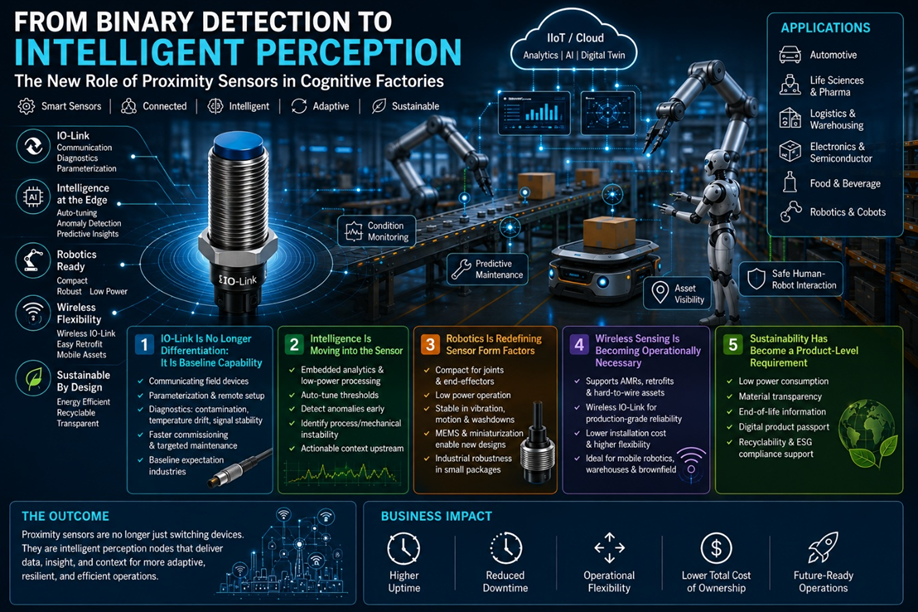
Industrial proximity sensors are entering a new phase. As factories become data-driven, model-based, and adaptive, binary presence detection is no longer enough—sensors are expected to contribute diagnostics, context, and connectivity that improve uptime, flexibility, and lifecycle performance. With advancements such as digital twins, AI-enabled operations, and the emergence of collaborative and humanoid robots, the demands placed on the sensing layer have increased. Proximity sensors that offer only a switching output have become bottlenecks in many applications. Users now require richer data, seamless integration, and smarter device-level behavior.
ARC Advisory Group identifies five key technology trends shaping the next generation of industrial proximity sensors:
IO-Link-enabled smart sensing.
AI-assisted sensing and adaptive detection.
Industry 4.0 and digital factory integration.
Growth in logistics and warehouse automation.
Miniaturization.
These trends are redefining both supplier strategies and end-user expectations.
IO-Link has moved from being a differentiator to a baseline requirement. End users expect proximity sensors to function as communicating field devices, supporting parameterization, diagnostics, and status data accessible to control and IIoT layers. In practice, IO-Link sensors facilitate faster commissioning and targeted maintenance by providing indicators such as contamination, temperature drift, and signal stability. As a result, IO-Link is increasingly specified in RFIs and plant standards across industries like automotive, life sciences, and logistics. The competitive focus now centers on portfolio consistency, diagnostic depth, and interoperability among vendors and platforms.
Edge intelligence is being integrated directly into sensors. Advances in low-power processing and embedded analytics enable proximity sensors to interpret patterns locally, rather than simply acting as passive signal generators. These smart sensors can auto-tune thresholds, flag abnormal detection behavior, and identify early signs of mechanical or process instability. This reduces latency and network load while providing actionable context upstream.
The development of collaborative and humanoid robots is driving changes in sensor form factors. Proximity sensors must now fit into compact joints and end effectors, operate efficiently at low power, and remain stable under continuous motion, vibration, and frequent washdowns. Miniaturization, including MEMS-based approaches, aids this process, but suppliers must ensure detection range and industrial robustness in smaller packages—often a critical factor for robotics platform inclusion.
Wireless proximity sensing is increasingly required as plants deploy autonomous mobile robots, retrofit legacy assets, and extend sensing to rotating or moving equipment. In these scenarios, cabling increases costs and reduces flexibility. With advancements in industrial wireless networks, including wireless IO-Link options, reliability and latency concerns are diminishing, allowing production-grade monitoring without complex wiring. This is particularly valuable in mobile robotics, warehouse automation, and brownfield retrofits.
Sustainability is now assessed alongside technical performance. Buyers often request data on power consumption, material composition, and end-of-life information, expecting transparency throughout the product lifecycle to support corporate ESG and compliance requirements. Digital product passports and evidence of recyclability are becoming procurement prerequisites for many global accounts.
Connectivity, embedded intelligence, robotics-ready packaging, wireless deployment, and sustainability transparency are converging into a new baseline for proximity sensing. For manufacturers and end users, proximity sensors are becoming perception nodes that must deliver usable data—not just a switching signal—to support more adaptive, resilient production systems.
For Strategic Insights for Buyers and Suppliers: Read ARC’s MarketMap blog for strategic insights on supplier positioning, buyer evaluation, and competitive differentiation in the proximity sensor market.
For Market Size, Forecast, and Technology Trends: Visit ARC’s proximity sensors market analysis page for market sizing, five-year forecasts, smart sensing trends, and sensor-to-cloud developments.
https://www.arcweb.com/market-analysis/proximity-sensors
For MarketMap: See ARC’s MarketMap research announcement for the study scope, market context, and supplier positioning and evaluation for proximity sensors.
https://www.arcweb.com/blog/arc-initiates-marketmap-research-proximity-sensors