Representative End User Clients







Representative Automation Clients







Representative Software Clients










At Automate 2026, one of the most compelling discussions was at the Standard Bots booth, where a new generation of industrial robotics was on display, defined by lower cost, AI-native design, and US-based manufacturing.
The conversation highlighted a fundamental shift in the robotics market:
Industrial automation is moving from complex, high-cost systems to accessible, intelligent tools that can scale across a much broader range of manufacturers.
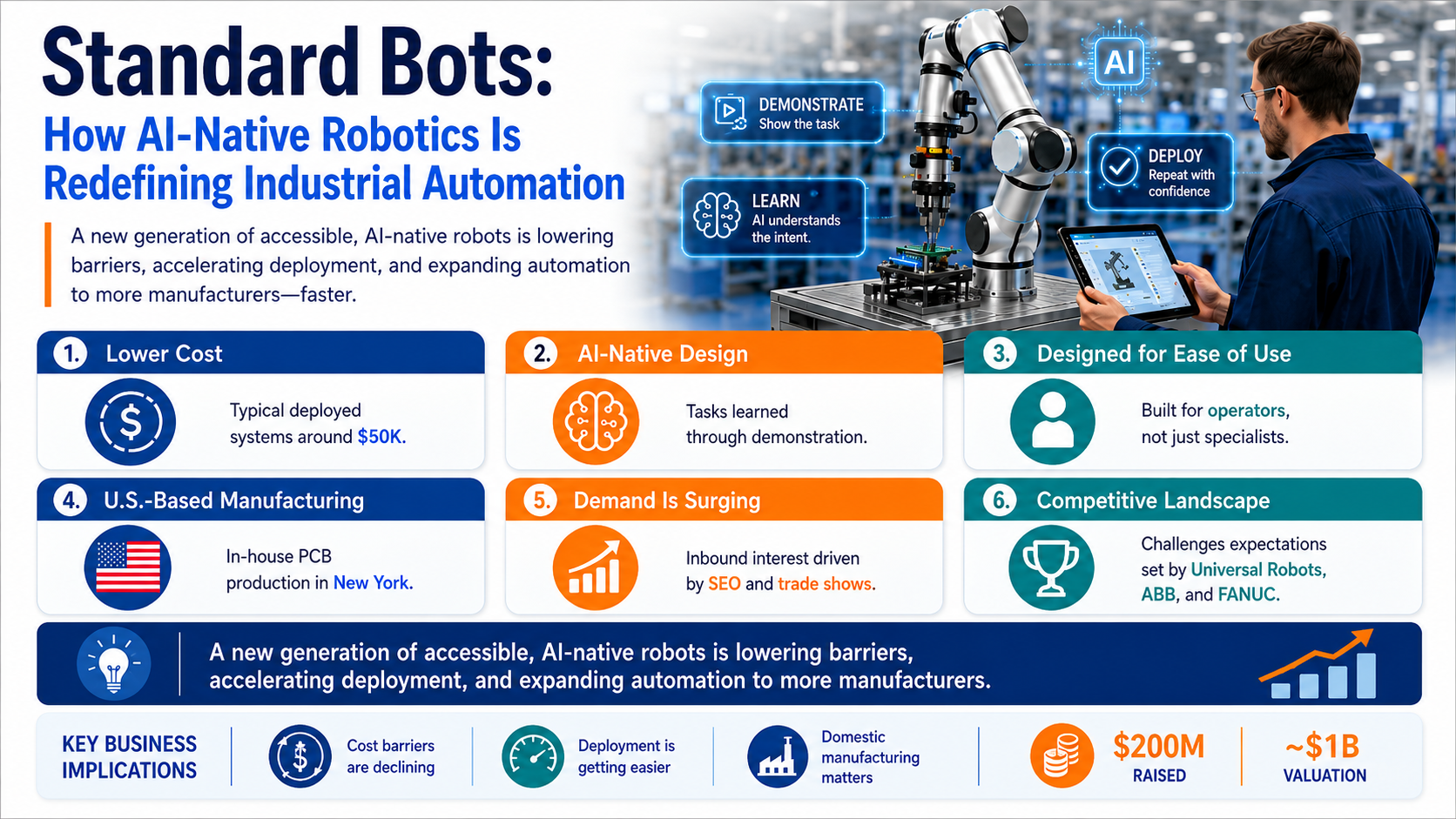
Standard Bots is aggressively targeting one of the biggest constraints in industrial automation: cost.
Typical deployed systems are now in the range of $50K.
This is significantly lower than traditional industrial robot deployments.
Support and service are based in the US, improving responsiveness and reliability.
For many manufacturers, especially small and mid-sized firms, this changes the equation entirely.
Robotics is no longer reserved for large enterprises; it is becoming practical at scale.
A key differentiator for Standard Bots is its approach to vertical integration.
Core components are designed in-house.
Printed circuit boards (PCBs) are already manufactured internally in New York.
The company is steadily expanding its US manufacturing footprint.
At the same time:
Certain components, such as motors and metal fabrication, are outsourced.
However, the long-term objective is clear: increase internal manufacturing as volumes scale.
This hybrid model provides:
Greater control over product performance.
Supply chain resilience.
A path to cost reduction over time.
Standard Bots represents a broader shift toward AI-first industrial robots.
Traditionally, deploying robots required:
Specialized programming.
Robotics engineers.
Long integration cycles.
Now, the model is evolving:
Robots can learn tasks through demonstration.
AI handles much of the complexity behind the scenes.
Systems are designed for ease of use by operators, not specialists.
This dramatically lowers the barrier to adoption.
The goal is to make industrial robots as easy to use as power tools.
The competitive benchmark remains clear, with companies such as:
However, Standard Bots is not competing directly on traditional terms. Instead, it is redefining the value proposition:
Lower cost of entry.
Faster deployment.
AI-enabled capabilities out of the box.
Focus on under-automated segments of manufacturing.
Rather than displacing incumbents, this model expands the addressable market.
One of the most telling insights from the discussion:
Demand is currently outpacing supply.
Minimal marketing effort is required:
SEO and trade shows generate sufficient inbound interest.
The company is selective about projects to ensure successful deployment.
This reflects a broader industry dynamic:
Manufacturers are ready for automation but have been waiting for solutions that are affordable, simple, and flexible.
Standard Bots’ trajectory is representative of many AI-driven robotics companies:
About 10 years in operation.
First several years focused on R&D.
Commercial deployments began only in the last three to four years.
Now entering a rapid scaling phase.
This phase is being fueled by significant investment:
Recently raised $200 million.
Valued at approximately $1 billion.
This level of backing signals strong confidence in:
AI-native robotics.
Domestic manufacturing.
Scalable automation platforms.
Unlike earlier waves of industrial robotics, this shift is being driven by end user demand.
Companies are actively seeking automation.
Adoption is not being forced; it is being requested.
The challenge is no longer awareness but execution capacity.
This is a classic market pull dynamic, indicating real maturity in the sector.
For organizations evaluating automation, several key takeaways emerge:
Robotics is becoming viable for a far wider range of applications and industries.
AI-driven systems reduce reliance on specialized programming and integration.
Faster support.
Greater supply chain resilience.
Alignment with industrial policy trends.
New entrants like Standard Bots are reshaping expectations around:
Price.
Usability.
Deployment speed.
The conversation at the Standard Bots booth reinforces a critical point:
The next wave of industrial automation is not about incremental improvements; it is about making robotics fundamentally more accessible.
As AI simplifies deployment and costs decline, robotics is transitioning from:
Complex, bespoke systems → widely deployable industrial tools.
For manufacturers, the question is no longer whether to automate, but:
How quickly can they adopt this new generation of AI-native robotics?