Representative End User Clients







Representative Automation Clients







Representative Software Clients








Continuous ultrasonic level measurement is a staple of the process industries. As discussed in our previous examination of the enduring role of continuous ultrasonic level measurement, its noncontact acoustic principles have long made it a preferred solution for monitoring applications ranging from wastewater to bulk solids.
However, as industry moves further into the era of Industry 4.0, the conversation around ultrasonic technology is shifting. The foundational physics remain the same, but the latest continuous ultrasonic level transmitters are evolving into increasingly intelligent, connected edge devices.
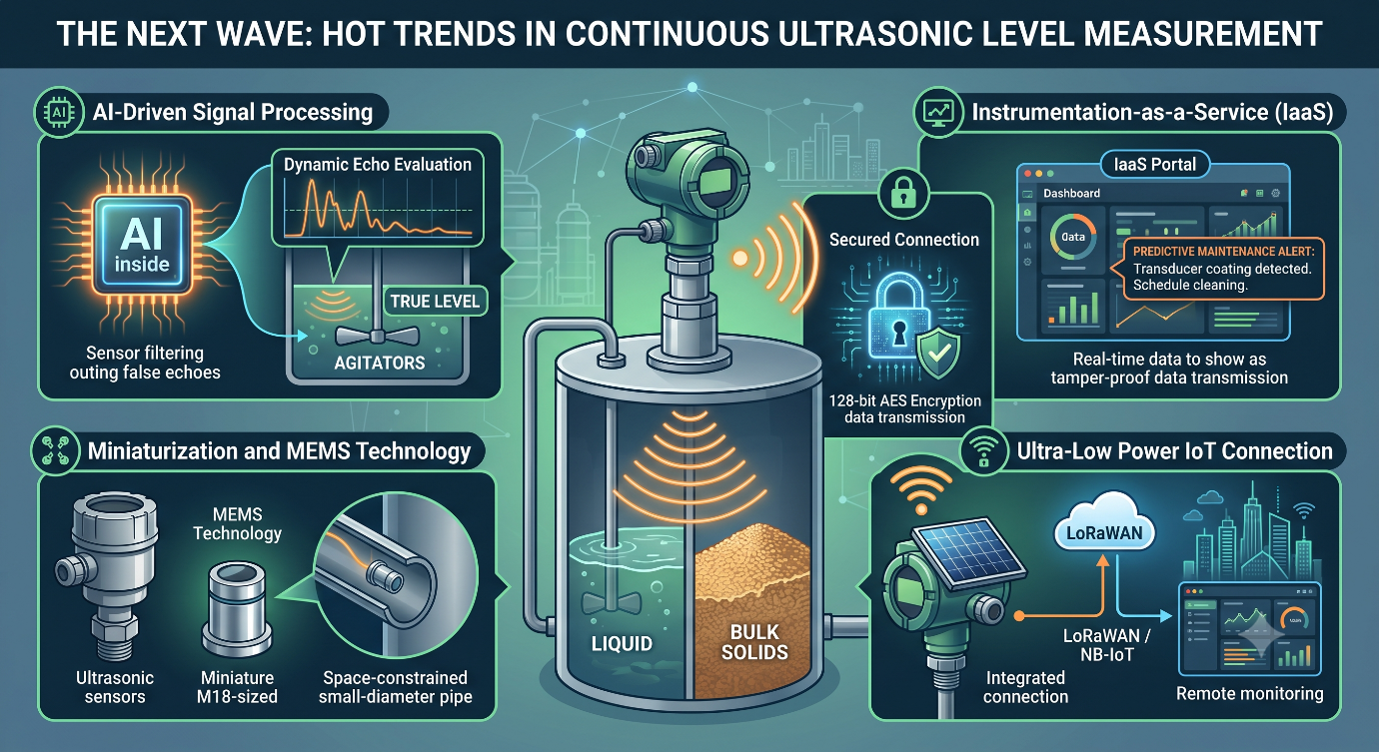
Several key trends are transforming continuous ultrasonic level measurement.
Traditionally, one of the biggest challenges for ultrasonic sensors has been managing false echoes caused by tank walls, internal agitators, or variations in vapor conditions. Today, the integration of advanced edge computing and artificial intelligence is helping address these challenges.
Modern ultrasonic transmitters increasingly feature adaptive beam shaping and intelligent filtering algorithms. By learning the unique acoustic characteristics of a specific tank environment, these sensors can dynamically suppress false echoes. Advanced digital signal processing also enables devices to compensate automatically for rapid temperature and gas-density variations in real time, improving measurement reliability in harsh environments.
As continuous ultrasonic sensors become smarter, manufacturers are changing how they deliver value. Instead of supplying only hardware, some vendors are moving toward instrumentation-as-a-service models.
Modern smart transmitters are increasingly paired with cloud-based analytics that provide plant managers with predictive maintenance alerts, remote calibration capabilities, and performance optimization tools. Rather than waiting for a sensor to fail, these systems can identify anomalies—such as transducer coating, condensation buildup, or signal degradation—and alert maintenance teams before they cause unplanned downtime.
While large silos require traditional heavy-duty transmitters, demand is growing for compact sensors used in OEM machinery, robotics, and small-scale automation.
Advances in micromachined ultrasonic transducers and microelectromechanical systems (MEMS) technology are enabling greater miniaturization. Today’s high-precision continuous ultrasonic sensors can be housed in compact M18 or M30 cylindrical enclosures. This brings reliable, continuous noncontact measurement to space-constrained piping systems and compact process equipment where older, bulkier instruments could not be installed.
As the global focus on sustainability, flood prevention, and resource management grows, continuous ultrasonic level sensors are increasingly being deployed in remote, off-grid locations.
A key trend involves pairing high-efficiency ultrasonic probes with ultra-low-power IoT protocols such as LoRaWAN, NB-IoT, and Bluetooth Low Energy (BLE). These sensors can operate for years using small solar panels or batteries while continuously monitoring municipal reservoirs, river levels, and wastewater lift stations.
By transmitting real-time data directly to centralized cloud dashboards, these systems reduce the need for manual field inspections and support more responsive smart city infrastructure.
Continuous level transmitters are no longer isolated analog instruments. As they increasingly connect to cloud platforms and wireless plant networks, they can become potential targets for cyber threats.
An emerging trend is the integration of IT-grade cybersecurity capabilities at the sensor level. Modern continuous ultrasonic devices increasingly incorporate security features such as 128-bit Advanced Encryption Standard (AES) encryption, secure wireless pairing, and role-based access controls.
For critical infrastructure sectors such as water treatment and energy, these capabilities help protect level measurement data from tampering and unauthorized access.
The role of the continuous ultrasonic level sensor remains secure, but its capabilities are expanding significantly. By moving beyond its legacy as a simple analog instrument and incorporating AI-based signal processing, IoT connectivity, remote diagnostics, and embedded cybersecurity, the modern continuous ultrasonic transmitter demonstrates how established measurement technologies can continue to support industrial digital transformation.
As these capabilities mature, continuous ultrasonic level measurement will increasingly serve not only as a source of process data but also as a connected component of predictive maintenance, smart water management, and broader operational intelligence strategies.
These ARC insights provide additional perspectives on continuous level measurement, intelligent instrumentation, Industrial IoT connectivity, predictive maintenance, and sensor-level cybersecurity.
The Enduring Role of Continuous Ultrasonic Level Measurement in Modern Process Applications
The Evolution of Liquid Level Sensing: Trends, Technologies, and the Road Ahead
Cybersecurity Threats to Smart Flowmeters: Is Your Flow Data Safe?
Together, these ARC insights illustrate how connected sensors, advanced analytics, predictive maintenance, and cybersecurity are changing the role of field instrumentation across process and infrastructure applications.