Representative End User Clients







Representative Automation Clients







Representative Software Clients









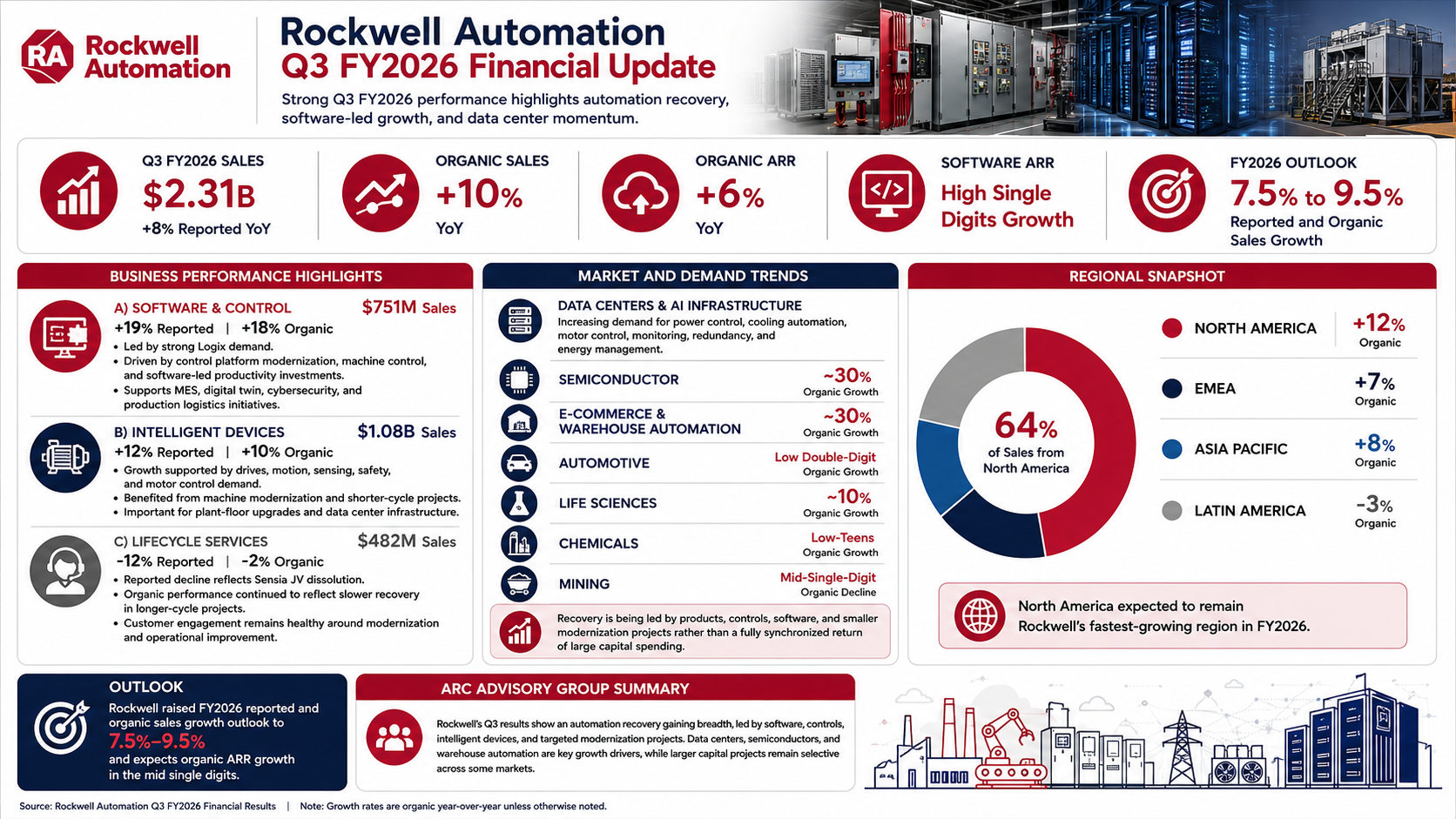
Rockwell Automation reported third-quarter fiscal 2026 sales of $2.31 billion, up 8 percent year over year, while organic sales increased 10 percent. Organic annual recurring revenue increased 6 percent, with software ARR growing in the high single digits. The company also raised its full-year fiscal 2026 reported and organic sales growth outlook to a range of 7.5 percent to 9.5 percent.
The results point to a strengthening, although still uneven, automation recovery. Product sales and smaller modernization projects continued to outperform longer-cycle investments, while semiconductor, data center, and e-commerce and warehouse automation demand remained particularly strong. Automotive and life sciences also improved, while larger capital projects in food and beverage and parts of the process industries continued to recover more slowly.
Software & Control was Rockwell’s fastest-growing segment in the quarter, with sales increasing 19 percent year over year to $751 million. Organic sales increased 18 percent, led by strong Logix demand.
The performance reflects continued customer investment in control platform modernization, machine control, automation standardization, and software-led productivity improvements. Rockwell’s software portfolio, including MES, digital twin, cybersecurity, and production logistics capabilities, also supports manufacturers seeking greater operational visibility, faster commissioning, improved asset utilization, and more resilient production environments.
Software ARR increased in the high single digits during the quarter, reinforcing the growing role of recurring software revenue within Rockwell’s portfolio.
Intelligent Devices generated sales of approximately $1.08 billion, up 12 percent year over year, while organic sales increased 10 percent.
The segment includes drives, motion, sensing, safety, motor control, and other connected automation technologies that form the physical layer of industrial control architectures. Growth in the segment reflects continued investment in machine modernization, plant-floor upgrades, and shorter-cycle automation projects.
These technologies also play an important role in data center infrastructure, where power control, motor control, cooling systems, and other mission-critical equipment increasingly require industrial-grade automation and monitoring.
Data centers remain an important growth area for Rockwell as investment in AI infrastructure increases power density, cooling requirements, uptime expectations, and operational complexity.
These facilities require increasingly sophisticated automation for power distribution, cooling, chiller systems, emergency power, central utility plants, and energy management. Rockwell participates through a combination of controllers, motor control, drives, software, and supporting services.
The opportunity also reflects the increasing industrialization of data center infrastructure. In some applications, industrial controllers can augment or replace traditional building automation technologies when operators require higher levels of redundancy, reliability, cybersecurity, and integration across power and cooling systems.
Strong semiconductor demand during the quarter was also supported by continued investment in AI-related infrastructure.
Demand improved across discrete, hybrid, and process industries, although growth remained uneven by end market and project type.
Discrete industries were the strongest, with organic sales increasing in the high teens. Semiconductor and e-commerce and warehouse automation each grew approximately 30 percent, while automotive increased in the low double digits.
Hybrid industries grew in the mid single digits. Life sciences increased approximately 10 percent, supported by demand for integrated control and software technologies, while food and beverage activity remained more dependent on modernization and smaller projects than on large capital investments.
Process industries increased in the high single digits. Chemicals grew in the low teens, while mining declined in the mid single digits.
The mix suggests that manufacturers remain willing to invest in automation projects with clear productivity, modernization, resilience, or capacity benefits, even as some larger greenfield and longer-cycle investments remain delayed.
Lifecycle Services sales declined 12 percent year over year to $482 million, while organic sales declined 2 percent.
Reported performance was affected by the dissolution of the Sensia joint venture, while organic results continued to reflect slower recovery in longer-cycle capital projects, particularly in food and beverage and certain process industries.
Despite the near-term weakness, Lifecycle Services remains an important part of Rockwell’s broader automation portfolio, supporting consulting, engineering, systems integration, cybersecurity, modernization, workforce services, and ongoing lifecycle support.
Customer engagement around modernization and operational improvement remains healthy, but the timing of larger projects continues to lag the stronger recovery seen in products and shorter-cycle automation investments.
North America remained Rockwell’s strongest region, representing approximately 64 percent of reported sales and delivering organic growth of 12 percent.
EMEA organic sales increased 7 percent, while Asia Pacific increased 8 percent as manufacturers continued selective investment in modernization and infrastructure-related automation. Latin America declined 3 percent.
Rockwell expects North America to remain its fastest-growing region for fiscal 2026, supported by continued investment across semiconductor, data center, logistics, manufacturing modernization, and other automation-intensive markets.
Rockwell raised its fiscal 2026 reported and organic sales growth outlook to a range of 7.5 percent to 9.5 percent. The company also expects organic ARR growth to remain in the mid single digits.
The revised outlook reflects improving demand across several industrial markets, particularly in discrete automation, while also recognizing that the recovery in larger capital projects remains less consistent.
Component inflation, particularly in electronics and memory-related products affected by data center demand, remains a supply-chain consideration. However, the broader demand environment continues to support automation investment focused on modernization, productivity, and operational resilience.
Rockwell Automation’s third-quarter results reinforce the view that the industrial automation recovery is gaining breadth, but it is not yet a synchronized return of large capital spending across all industries.
The strongest growth is coming from products, control platforms, software, and smaller modernization projects. Semiconductor, data center, warehouse automation, and improving automotive demand are providing strong momentum, while longer-cycle projects remain more cautious in some hybrid and process markets.
Software & Control stands out as Rockwell’s strongest growth engine, while Intelligent Devices continues to benefit from demand for connected automation hardware and modernization. Together, these businesses demonstrate how customers are increasingly combining physical automation, control, and software rather than treating them as separate investment categories.
The data center opportunity is especially notable. As AI infrastructure becomes more power-intensive and operationally complex, data centers increasingly resemble mission-critical industrial environments that require high levels of automation, redundancy, monitoring, and control. This creates opportunities for industrial automation suppliers whose technologies span power, cooling, control, software, and lifecycle support.
For manufacturers more broadly, the quarter suggests that modernization remains a practical investment priority. Controls upgrades, connected devices, MES, digital twins, cybersecurity, production logistics, and lifecycle services can deliver incremental productivity and resilience benefits without requiring customers to commit immediately to large greenfield projects.
Rockwell’s results therefore point to an automation market recovering through targeted modernization first, with broader capital investment likely to follow as customer confidence and project visibility improve.