Representative End User Clients







Representative Automation Clients







Representative Software Clients








KEYWORDS: Autonomous Operations, Alarm Management, Industrial AI, Process Industries, Operator Effectiveness, Abnormal Situation Management
Alarm management is an underappreciated foundation for autonomous operations. Process industry organizations are investing in AI, advanced analytics, remote operations centers, digital twins, and agentic workflows, yet many still rely on alarm systems designed mainly for local operator notification. That gap matters because poor alarm performance degrades signal quality, burdens operators, and makes it harder to distinguish true exceptions from routine noise.
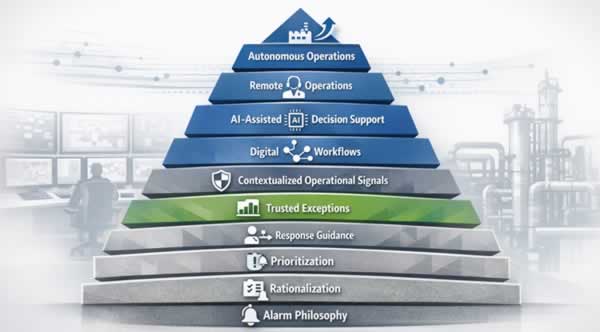
Autonomous operations depend on high-quality exceptions that clearly distinguish conditions requiring action from routine operational noise. Effective alarm management provides those reliable, prioritized, contextualized signals, enabling operators, workflows, and AI systems to respond with confidence. Without disciplined alarm rationalization, lifecycle control, and integration with governed response processes, AI may amplify confusion rather than advance autonomy.
This article continues ARC’s “Road to Autonomous Operations” series. The first article argued that autonomy is not about removing people but about applying scarce human expertise where it creates the most value. The second explained why most plants are more automated than autonomous, emphasizing decision authority, controlled execution, actionable context, and the quality of the operational signals that guide action. This article takes the next step by focusing on one of the most practical and often underestimated of those signals: the alarm.
For process industry leaders, alarm management should no longer be viewed only as compliance, control room improvement, or operator effectiveness. It is increasingly a gating capability for autonomy. If an alarm system floods operators with nuisance alarms, misclassifies alerts as alarms, lacks response guidance, or fails to reflect the plant’s actual state, adding AI may expose or accelerate existing confusion.
Before manufacturers authorize AI-enabled systems to recommend, initiate, or execute actions, they must ensure that the alarm environment produces meaningful, prioritized, contextualized, and reliable signals. On the road to autonomous operations, alarm management is not a side issue. It is part of the operating foundation.
Alarm systems exist to support action. ARC’s alarm management work has long emphasized that effective alarms alert the operator to a potential problem, explain the condition, and guide corrective action. Alerts may notify; alarms should require operator action.
That distinction becomes more important as operations become more automated and data-driven. In autonomous operations, the issue is whether a condition represents a high-quality exception that should trigger a decision, workflow, escalation, or bounded automated response.
ARC’s 2024 alarm management research reinforces the point: properly designed and maintained alarm systems reduce risk to people, equipment, and the environment, while poorly designed systems can contribute to abnormal situations rather than help resolve them.
Autonomous operations depend on accurate exception detection. A system cannot move from monitoring to action unless the signal reliably indicates that action is needed. Too many alarms, stale alarms, duplicate alarms, standing alarms, poor prioritization, or missing response guidance leave people and machines with the same problem: first determine which signals matter.
Experienced operators often compensate through judgment and local knowledge. That becomes harder as organizations move toward centralized teams, remote operations centers, and AI-enabled systems spanning multiple assets.
ARC Advisory Group clients can view the complete report at the ARC Client Portal.
Contact Us if you would like to speak with the author.
Obtain more ARC In-depth Research Market Analysis.