Representative End User Clients







Representative Automation Clients







Representative Software Clients








Autonomous mobile robots are becoming an increasingly important component of warehouse and intralogistics automation. ARC’s MarketMap provides technology buyers with a structured view of the supplier landscape, helping organizations compare solution capabilities, strategic direction, and market position when evaluating AMR investments.
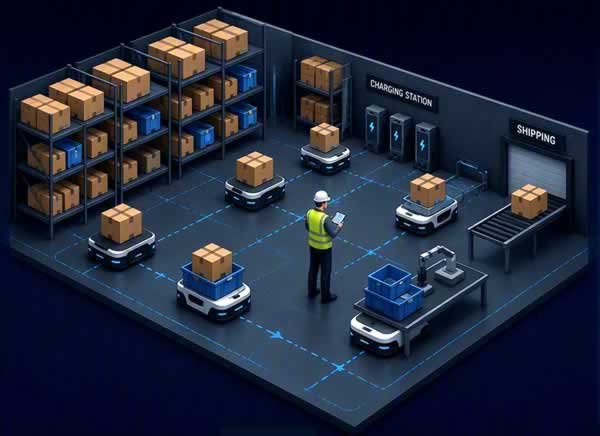
Warehouses are under pressure to increase throughput, respond to changing fulfillment requirements, and address labor constraints while maintaining operational flexibility. Autonomous mobile robots can support these objectives by automating intralogistics movement without requiring the same level of fixed infrastructure associated with traditional automation.
The challenge is that the AMR market is developing quickly. Suppliers differ significantly in robot form factors, navigation approaches, fleet orchestration, warehouse software integration, geographic presence, implementation capabilities, and commercial models. Rapid technology diffusion is also shifting differentiation away from hardware alone toward software intelligence, AI, interoperability, and orchestration.
ARC’s research identifies additional forces reshaping buyer requirements, including brownfield automation, heterogeneous robot fleets, mobile manipulation, AI-enabled navigation, e-commerce fulfillment requirements, and growing demand for interoperability between automation systems.
Warehouse operators can choose among established industrial automation companies, specialized robotics suppliers, warehouse automation providers, and rapidly expanding emerging competitors. ARC's 2026 assessment evaluates 20 suppliers, ranging from diversified automation organizations to specialists focused on particular AMR workflows.
Mobile robotics technology is diffusing rapidly across the market. As individual hardware capabilities become easier for competitors to replicate, factors such as fleet intelligence, orchestration software, interoperability, integration capabilities, and execution support increasingly influence long-term differentiation.
Goods-to-person fulfillment, person-to-goods picking, pallet transport, autonomous forklifts, line-side delivery, and other intralogistics processes impose different requirements. Buyers need to match robot architectures and operating models to specific workflows rather than treating AMRs as a single technology category.
Suppliers vary in geographic penetration, partner ecosystems, implementation resources, service infrastructure, and customer experience. Buyers planning multi-site programs need to evaluate whether solution and support capabilities can scale consistently across regions.
ARC recommends evaluating the system that manages and optimizes work, not simply the robot. Warehouse management and execution capabilities can become central to coordinating automated and manual processes, interleaving tasks, identifying bottlenecks, and managing increasingly heterogeneous automation environments.

The ARC MarketMap is designed as a decision-support resource for organizations evaluating warehouse robotics suppliers. It provides a comparative visual framework supported by detailed analysis of supplier capabilities, strategic direction, market presence, and individual solution strengths.
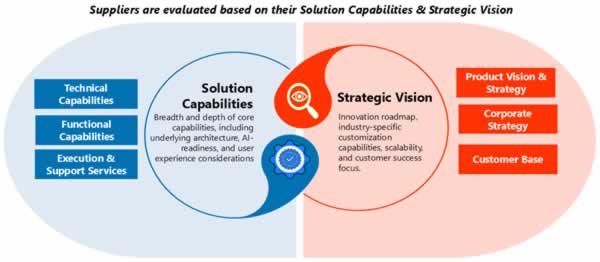
The MarketMap assesses suppliers across two principal dimensions: Solution Capabilities and Strategic Vision. The research examines technical capabilities, functional capabilities, execution and support, product vision and strategy, corporate strategy, and customer base.
The visual MarketMap groups suppliers into Leaders, Major Players, Challengers, and Contenders, helping buyers understand relative positioning while preserving the more important question: which supplier is best aligned with the buyer's particular operational requirements and automation strategy?
Beyond positioning, the report includes:
The research is global in scope and defines AMRs as autonomous load-carrying vehicles used for intralogistics goods movement in warehouses or between warehouses and adjacent facilities. Robotic AS/RS systems and conventional AGVs are excluded from this MarketMap's scope.
Suppliers evaluated in the Autonomous Mobile Robots MarketMap include:
The MarketMap is intended to help organizations move from a broad market scan toward a more defensible supplier shortlist and evaluation strategy.
Technology suppliers can license the ARC MarketMap to help:
Choosing an Autonomous Mobile Robots supplier requires more than comparing payload, speed, or navigation technology. Buyers should consider implementation and ramp-up requirements, integration, operator training, maintenance and reliability, scalability, software intelligence, commercial models, and the cost and complexity of adapting the system as operational requirements evolve.
The ARC MarketMap for Autonomous Mobile Robots in Warehousing gives decision makers an independent framework for understanding those tradeoffs and building a more focused supplier evaluation.
Request access to the ARC MarketMap for Autonomous Mobile Robots in Warehousing or speak with Alex Chatha, Senior Analyst, to discuss the research and how its findings relate to your warehouse automation strategy.
To view a sample MarketMap, please complete the form below.