Representative End User Clients







Representative Automation Clients







Representative Software Clients








Cobots and other industrial assist robots (IARs) are piquing manufacturers' interest as they continue their quest to improve operating efficiencies and productivity. This is particularly so with smaller-to-mid-sized organizations, who are too often looking for ways to compete effectively with limited resources.
In many cases, IARs, which can include collaborative robots (cobots), exoskeletons, automated guided vehicles (AGVs), delivery robots (and delivery drones in some cases), can be appropriate choices to consider in industrial settings. Other variants, such as surgical, educational, or retail inventory discovery robots, can be used in medical and commercial roles.
Many of today's progressive manufacturing organizations are leveraging the power of robotics – both literally and figuratively -- with the acquired knowledge and insight of humans with IARs. This convergence of touch and technology offers greater productivity and efficiencies than would otherwise be available
There is a growing need for a variety of IARs that are used in plants, warehouses, and commercial settings to assist in tasks previously done solely by humans, to make the process more efficient and productive, or to add precision to the underlying processes.
With manufacturers of all types looking for ways to boost efficiencies and productivity, various types of robots are being used to increase productivity and add flexibility in today’s production systems. These choices, which include both traditional high-speed, heavy-duty, independently-operated, industrial robots and collaborative robots (cobots), are increasingly part of organizations’ operational strategy discussions.
IARs, can also be a good way to introduce robotics into their manufacturing and assembly operations. Such a strategy can also demonstrate to workers that not all industrial robots are replacements for humans – some are designed to work-side-by side with humans and make their work easier.
Many line workers realize that while high-volume industrial robots can be a substitute for humans, IARs (led by cobots and exoskeletons) work with, and alongside, humans.
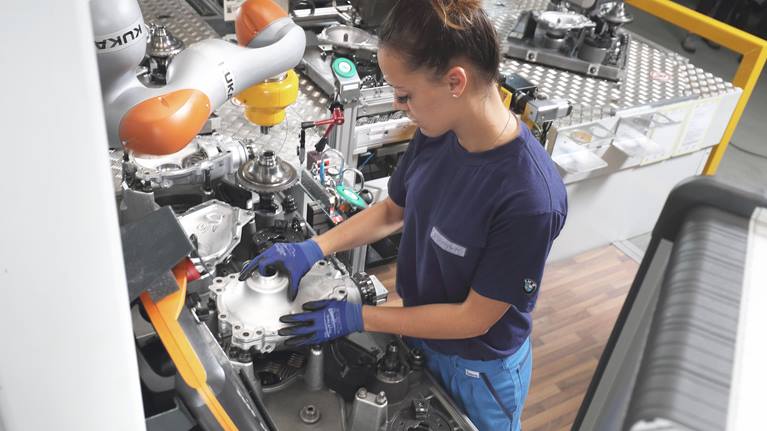
Some of the key industries for cobots include automotive, electronics and electrical, food and beverage, semiconductors, machinery manufacturing, plastic and rubber, and pharmaceutical and biotech.
In order to make the human-robotic experience seem as natural as possible, cobot speeds are generally proportional to that of humans, with some variation, and human-cobot control is always present. Cobots are also equipped with sensors to detect impending contact or near-contact with humans, so it can take appropriate actions, as needed.
While IARs, and particularly cobots, can perform a wide range of tasks, ideal applications are those that remove humans from tedious or unsafe tasks. Examples can range from mundane tasks that do not require critical thinking, to undesirable and burdensome tasks that require human interaction with dangerous machinery, to jobs that require high levels of precision.
Cobots are typically used where low-to-mid-level payloads are encountered, as opposed to the higher loads often encountered in heavy-duty industrial applications that require separation from human workers. The combination of human-like operation and the use of torque sensors for force limiting to actively protect human workers create a non-threatening environment that helps to make cobots a logical choice for many manufacturing and production lines.
The cobot market is currently dominated by larger companies. For example, a recent ARC Advisory Group market study on collaborative robots noted that the top four suppliers in this space are Teradyne (Universal Robots), ABB, FANUC, and Kawasaki Robotics. Still, with a wide variety of applications and possible use cases under consideration by the user community, there will likely be an increase in the number and variety of IARs in the market from suppliers of all sizes.