


New ARC Advisory Group research on the digital twin software market reveals that several drivers are converging to drive growth. Infusion of industrial AI in the industry continues to improve business processes, simplify work processes, and scale technology. Industrial AI is being applied across engineering simulation, product design, and asset management, improving performance and decision making throughout the asset lifecycle. Competitive pressures are pushing organizations to refine engineering design and operations to maximize equipment performance. Companies are focused on simplifying supply chains, reducing downtime, cutting operational costs, optimizing energy use, and delivering greater value to remain competitive.
"With the development of digital twin technologies and the industry‘s shift toward the Industrial Metaverse, there are opportunities to incorporate a variety of data types into simulation models, ensuring a more realistic representation and outcomes consistent with reality. Digital twins are pushing the boundaries of existing assets to increase uptime through design optimization to create new limits and to push operations targets closer to limits. Today’s AI-powered digital twins enable owner-operators and service providers to achieve transformative improvements across design, operations, and maintenance—boosting overall business performance. By integrating design and operation simulation models, they also enhance planning accuracy and positively impact profit margins,” according to Peter Reynolds, Industry Advisor and key author of ARC's Digital Twin Software Market Research.
Digital Twin Software Market Trends
In addition to providing detailed competitive market share data, the research also addresses key market trends as follows:
Augmented Reality, Virtual Reality, Extended Reality
In manufacturing plants, AR information is typically accessed through smartphones, tablets, and dedicated AR glasses or headsets. For some applications, users can point the AR device at the area or equipment, and the device reads information (barcode, proximity sensor, location camera, etc.), enabling the worker to see the relevant information on the screen. The system instantly correlates the information to the data in the system based on the situation and configuration. The trend is for AR to interact with digital twins, simulation and speech recognition, and bots. Combining Industrial IoT and these technologies will further enable MES users, increasing productivity and accelerating improvement and worker response.
Real-Time Digital Twins and Simulations
Some digital twins are being used for processes and combined with simulation or real-time data to determine potential bottlenecks or inefficiencies in the process. Although definitions vary considerably, many offer digital twins for production. Other types of digital twins are used for products to determine the best manufacturing processes. Newer technologies now support the scanning of operations to create a digital model or virtual twin of brownfield sites, enabling companies to transform and augment production and product efficiencies, enhance visualization, and even improve workforce training.
Leading Suppliers to the Digital Twin Software Market Identified
In addition to providing specific market data and industry trends, this ARC market research also identifies and positions the leading suppliers to this market and provides and summarizes their relevant offerings. An alphabetical list of key suppliers covered in this analysis includes: Aspen Technology, AVEVA, Bentley Systems, Hexagon, Siemens.
About the Digital Twin Software Research
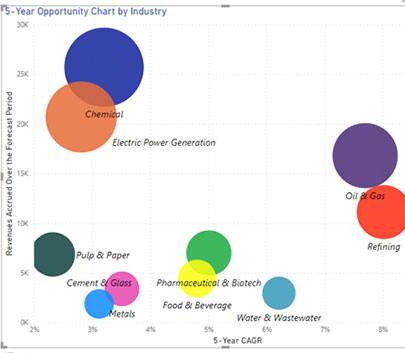
The Digital Twin Software research explores the current and future market performance and related technology and business trends and identifies leading technology suppliers. This new research is based on ARC’s industry-leading market research database, extensive primary and secondary research, and proprietary economic modelling techniques. The research includes competitive analysis, five-year market forecasts, and two years of historical analysis. The research segmentation includes World Region, Revenue Category, Function, Industry, Customer Size, Sales Channel.
This new research is available in a variety of formats to meet the specific research and budgetary requirements of a wide variety of organizations. ARC's Market Data Service (MDS) is an annual subscription service that provides a unique online environment to each customer, together with all the necessary user interface apps and datasets. MDS unlocks the full benefits of ARC’s time-tested market intelligence by leveraging the latest analytical tools and technologies to allow you to make more actionable, real-time business decisions. Interactive access to ARC’s qualitative analysis is displayed in context with up-to-date market data, allowing clients to develop customized views of the market to best suit their needs. ARC continues to offer our traditional static Market Reports as a PDF.
ARC provides several types of market data services. The most common are Market Growth Outlook and Competitive Analysis Services. These services provide detailed market analysis of a single or multiple products or software applications. Please visit Market Data Services page for more details on these services.