Representative End User Clients







Representative Automation Clients







Representative Software Clients








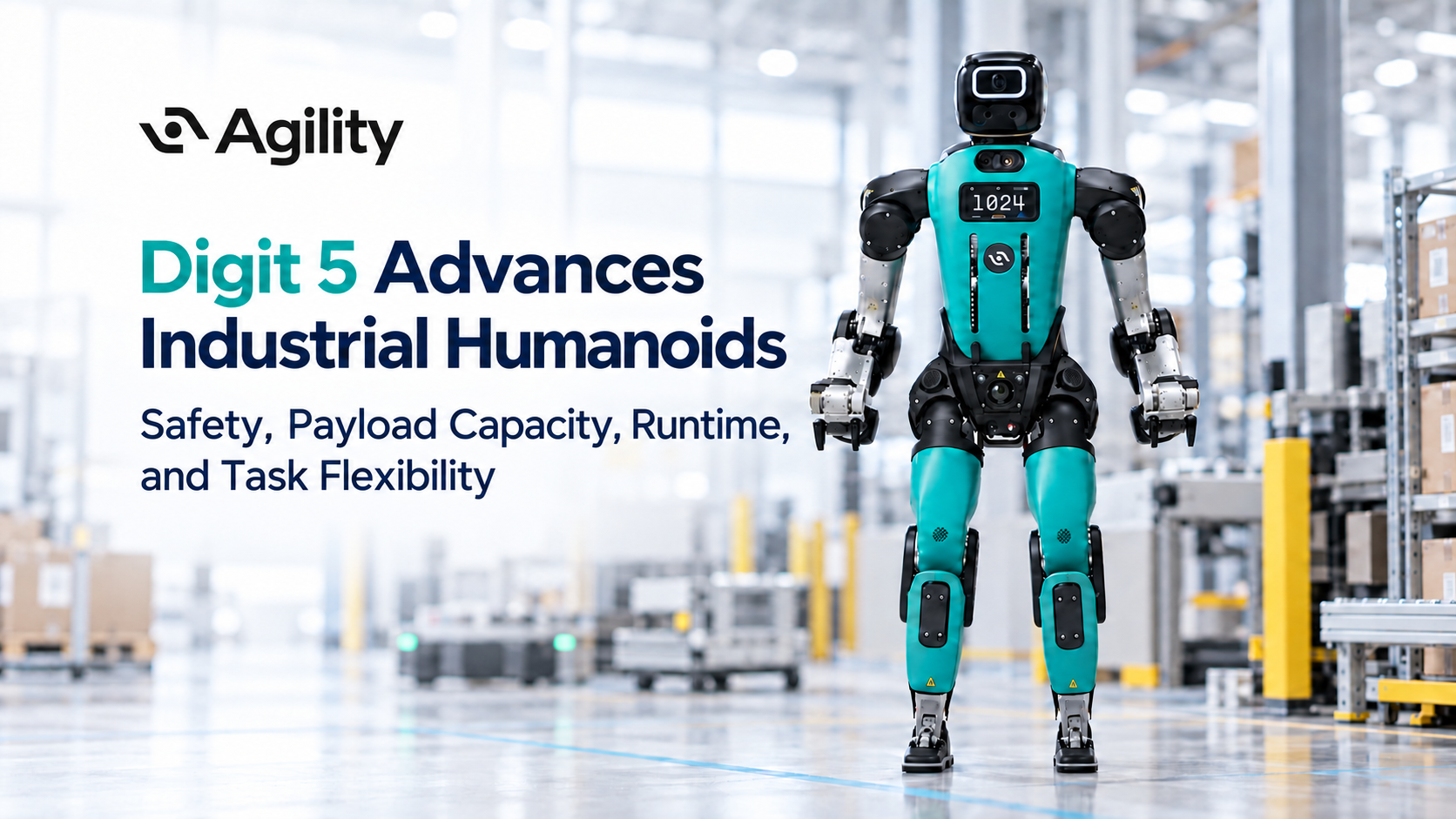
Agility Robotics has unveiled Digit 5, the latest generation of its humanoid robot platform, introducing significant advances in safety, payload capacity, runtime, and task flexibility. The most significant aspect of Digit 5 is not any individual hardware specification, but rather it is Agility's focus on solving some of the largest barriers to industrial adoption: enabling humanoids to work safely alongside people while delivering enough operational value to justify deployment at scale.
For much of the humanoid robotics industry, discussions have focused on dexterity, AI models, or human-like motion. In industrial environments, however, safety and compliance have remained significant gatekeepers to adoption.
Digit 5 introduces a new safety architecture designed for what Agility calls "cooperatively safe" operation. The system combines human detection capabilities, visual and auditory safety cues, and an independent safety controller that can slow, stop, avoid, or safely position the robot when people enter its operating space.
This is an important development because traditional industrial robots typically require physical barriers or restricted work zones. If humanoid robots are to operate in facilities alongside human workers, they must coexist safely within these workspaces rather than forcing facilities to adapt around them.
According to Agility, Digit robots have accumulated more than 65,000 hours of work across commercial customer sites, including deployments with GXO, Schaeffler, Amazon, and Toyota Motor Manufacturing Canada. Promotional demonstrations can be impressive, but reliability, uptime, maintainability, and safety matter most when it comes to actually performing the work. Companies that can translate lessons from production environments into product improvements are likely to have an advantage as the market matures.
Digit 5 appears to reflect that learning process, with many of its upgrades stemming directly from customer feedback gathered during three years of commercial deployment.
Historically, Digit deployments have focused primarily on tote handling and material movement tasks. Digit 5 is intended to support a much broader set of workflows.
Agility envisions the robot performing activities that span an entire facility workflow, including:
Depalletizing inbound materials.
Machine tending.
Kitting and sequencing.
Quality inspection.
Palletizing outbound shipments.
Most vendors recognize that long-term success requires moving beyond single-task automation. The ultimate objective is a versatile worker that can perform multiple activities within environments designed around human labor.
Whether current physical AI systems and expansive AI models can reliably support that level of versatility remains an open question, but the industry's direction is becoming increasingly clear. The real long-term differentiator may not be the robot itself, but the software ecosystem that allows hundreds or thousands of robots to be managed and monitored across facilities.
Agility has also emphasized its physical AI development strategy, which focuses on training new behaviors and skills that can be deployed across fleets. Across the robotics industry, the combination of physical AI, simulation, fleet management, and operational data is increasingly viewed as the foundation for scalable humanoid deployments.
Early deployments from humanoid robot vendors have largely answered the questions of capability. The next challenge is demonstrating that they can scale economically, safely, and reliably across thousands of facilities.
What I saw at Automate 2026, Part 1: The US Manufacturing Renaissance
What I saw at Automate 2026, Part 2: The Future is Humanoid?
Humanoids for Industry Blog Part 1: Why Humanoids? Why Now?
Humanoids for Industry Blog Part 2: Navigating the Ecosystem
Humanoids for Industry Blog Part 3: A New Market on the Horizon
For discussions on physical intelligence and the new wave of industrial robotics, or to offer feedback on this article, contact Patrick Arnold at [email protected].
Set up a meeting with me and the analysts at ARC Advisory Group to find out more about our Executive Insights Service for industrial organizations, MarketMap efforts, and more.