Representative End User Clients







Representative Automation Clients







Representative Software Clients









The third ARC Industry Leadership Forum Singapore brought together more than 200 industry professionals on August 27, 2026, under the theme, “How AI Is Driving the Future of Industrial Operations and Supply Chain.” The OPC Foundation participated as a Platinum Sponsor. William Tanuwijaya of OPC Hub ASEAN delivered a presentation titled “OPC UA: The Foundation for Industrial Digitalization.”
OPC UA is often seen as a standard for exchanging data between operational technology (OT) and information technology (IT) systems. The OPC Foundation’s new slogan, “The Secure, Semantic Standard for Interoperable Industrial Digitalization,” points to a broader role. William’s presentation explored how OPC UA information models are being used across equipment, control systems, cloud applications, digital product passports, and AI.
Watch the full presentation here or on YouTube.
Moving a measurement from one system to another does not necessarily tell the receiving system what was measured or how the value relates to the equipment that produced it. As William explained:
We need the semantic data. We need the information surrounding the data.
OPC UA information models provide a structured way to describe industrial assets and their data. The OPC Foundation works with industry organizations to develop models for different equipment and applications, with more than 450 models available in both human-readable and machine-readable forms. To illustrate their value, William pointed to the OPC UA for Robotics model: if a factory replaces a robot with one from another supplier and both implement the model, the aim is for existing edge and cloud applications to continue working without changes for the new robot.
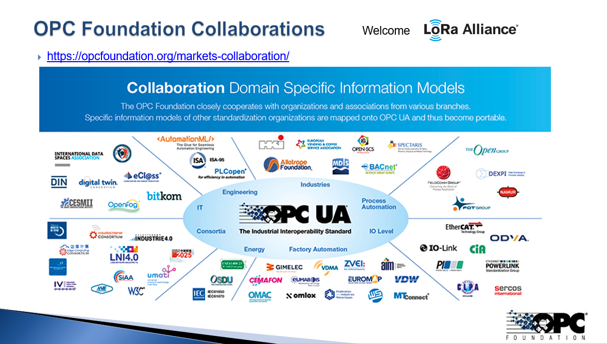
The OPC Foundation continues to expand its information models through collaborations with other organizations. A new collaboration with the LoRa Alliance includes work toward a Companion Specification for LoRaWAN data and profiles. The OPC Foundation’s Energy Initiative also includes work to make information associated with IEC 61850, a standard for power systems, available through OPC UA.
OPC UA Field eXchange, or OPC UA FX, is extending OPC UA to controllers and field devices, along with information models for these systems. Its working group completed a first specification for controller-to-controller communication in 2025 and is now working on controller-to-device and device-to-device communication.
The OPC Foundation is also extending its work into the IT environment through its cloud initiative. A central goal is to make OPC UA information models used on the factory floor usable in the cloud as well.
As William illustrated with the robot example, the information model used to describe a robot in the factory should also be usable when its data moves to the cloud. Cloud applications could then use the same structured description to understand the robot’s data.
Keeping manufacturing information usable outside the factory also matters after a product is sold. A digital product passport is intended to make information about a product available throughout its life, including to organizations that did not manufacture it. William illustrated the need using the example of a car made in Singapore and later sent to a scrapyard in Spain, where details about its components could help guide recycling.
The OPC Foundation has worked with CENELEC on digital product passports and applied OPC UA to a battery passport. In the example presented, information about the battery’s manufacture and materials is stored in the cloud. Usage data from the electric vehicle can then be connected to the passport over the battery’s lifetime. Bringing together information from these stages helps keep production details useful after the battery leaves the factory. William said the OPC UA work on this battery passport took about a day, illustrating the ease of applying it in this case.
The OPC Foundation is also working on ways for AI to use OPC UA. Its specifications and Companion Specifications have been made available in formats suited to AI applications, including Markdown and content prepared for retrieval-augmented generation.
The OPC UA for AI working group aims to standardize how generative AI interacts with OPC UA using the Model Context Protocol (MCP). The OPC Foundation has also made an open-source MCP server available.
A demonstration described by William shows what such an interaction can look like. A user typed a prompt asking an AI application to find a pH meter on the network and return ten measurements, five seconds apart. The AI application located the OPC UA server and displayed readings from a meter connected to a controller. When lemon juice was added to the water, the pH values fell, showing that the readings were live.
The demonstration showed how a user could locate the meter and retrieve its readings through a natural-language request. William also cited Philip Morris as an early end-user example of using OPC UA to support AI.
The OPC Foundation provides open-source technology stacks, an Industrial IoT Starter Kit, and a Cloud Library for organizations developing OPC UA applications. William also highlighted two free tools that address different tasks.
CTT Lite lets developers check an OPC UA server against selected specification requirements. The OPC UA NodeSet Editor supports the creation of information models. Although existing models cover many types of equipment, a factory may have a machine with requirements that are not covered by one. The editor provides a way to create a model for that machine.
The developments in the presentation show why OPC UA’s role now extends beyond exchanging data between OT and IT systems. Information models help define what the data represents, whether the data is used by an application in the factory, in the cloud, or later in a product’s life. The work on AI adds another way for users to find and access that information.
OPC UA supports several transport methods, including TCP/IP, UDP, and MQTT, with security built into its design. Alongside those communication capabilities, its information models give applications a common way to understand the data being exchanged. That combination underpins the wider role described throughout the presentation.