Representative End User Clients







Representative Automation Clients







Representative Software Clients








Engineering design tools (EDT) and building information modeling (BIM) are evolving from design authoring and project coordination tools into a strategic digital backbone for connected infrastructure delivery, lifecycle collaboration, and asset performance intelligence.
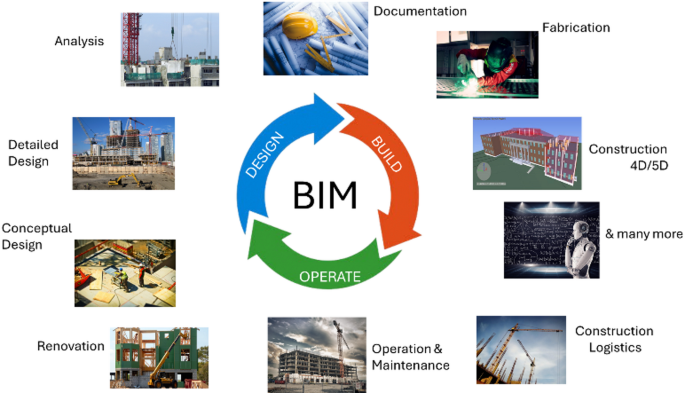
As infrastructure projects grow more complex and owners demand data continuity from planning through operations, organizations are shifting their focus from creating models and drawings to managing reusable lifecycle information.
BIM is increasingly positioned as a collaborative information framework that gives architects, engineers, contractors, owners, and operators a consistent digital view of an asset, reducing fragmentation across project delivery and operations.
For owners, BIM's strategic value now extends beyond project delivery by preserving engineering context for digital twins, connected asset management, predictive maintenance, and portfolio-level visibility.
Engineering design software is evolving from discrete CAD tools into integrated platforms that support multidisciplinary design, coordination, simulation, reality capture, and lifecycle information management.
Cloud-based collaboration and Common Data Environments (CDEs) help teams centralize information, improve version control, and govern model data across distributed project environments.
This shift requires vendors to support open, interoperable platforms while engineering firms strengthen data governance, model standards, and change management to realize maximum value.
BIM helps manage complex infrastructure assets by organizing design intent, engineering decisions, construction information, and asset data within a structured digital environment.
Its business case becomes even stronger when data extends beyond design and construction to support commissioning, maintenance, renovations, sustainability reporting, and operational decision-making.
This value depends on data quality, interoperability, governance, and integration with operational systems.
AI-Assisted Workflows: Improve productivity through model validation, documentation support, clash prioritization, and risk identification.
Digital Twins: Extend BIM's value by connecting models with operational systems, sensor data, and analytics.
Cloud Collaboration: Support distributed teams through centralized information access, version control, and data governance.
Interoperability: Reduce data silos through OpenBIM principles and open data standards across the asset lifecycle.
Sustainability: Enable earlier evaluation of carbon emissions, energy use, material efficiency, and lifecycle impacts during design.
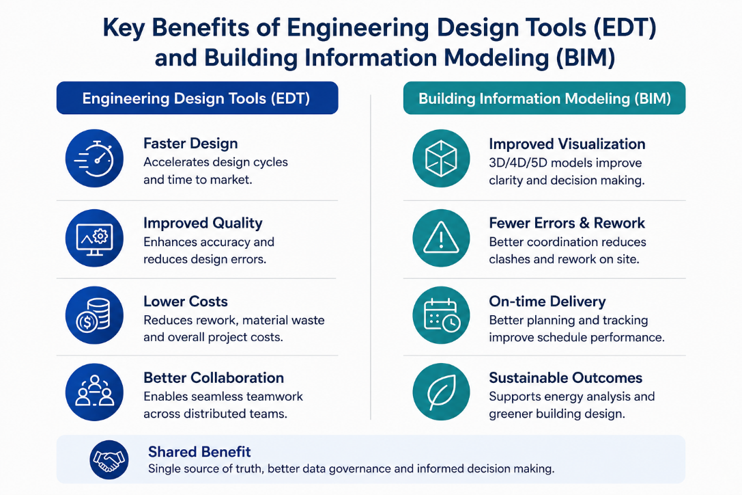
The future of EDT and BIM centers on creating a connected digital ecosystem that spans the entire lifecycle of infrastructure assets—from planning and design to construction, operations, maintenance, and eventual decommissioning. Rather than functioning as standalone design applications, EDT and BIM platforms are evolving into collaborative, cloud-native environments that integrate engineering data, project information, and operational insights.
ARC believes Engineering Design Tools and BIM are becoming core components of the digital thread for infrastructure. Their value is expanding from design productivity and project coordination to lifecycle information management, operational insight, and asset performance improvement.
As architecture, engineering, construction, and operations (AECO) organizations continue to mature digitally, BIM should be viewed not simply as a modeling capability but as an information strategy. Organizations that realize the greatest value will be those that connect engineering data with construction processes, operational systems, and enterprise asset management. In this context, Engineering Design Tools and BIM will continue to provide an important foundation for intelligent, resilient, and sustainable infrastructure development.
These ARC insights provide additional perspectives on Engineering Design Tools, BIM, digital twins, and lifecycle information management.
Understanding Engineering Design Software, Building Information Modeling & Digital Twins
Sustainable Building Practices Drive the Market for Engineering Design Software and BIM
Harnessing AI in Engineering: A Strategic Imperative for Modern Infrastructure
Distinct Digital Twins Have Emerged for Discrete & Process Industries
Together, these ARC insights illustrate how Engineering Design Tools, BIM, AI, digital twins, and the digital thread are converging to create a connected information foundation that supports infrastructure throughout its lifecycle—from engineering and construction to operations, maintenance, and long-term asset performance.