Representative End User Clients







Representative Automation Clients







Representative Software Clients








As industries accelerate their digital transformation journeys, the demand for seamless, high-speed, and reliable communication between field devices and control systems continues to grow. Process industries such as oil & gas, chemicals, pharmaceuticals, food & beverage, water & wastewater, and power generation increasingly rely on real-time data to optimize operations, improve asset reliability, and enable predictive maintenance.
Traditional field communication technologies have served industrial plants well for decades, but they often face limitations related to bandwidth, interoperability, and support for modern Industrial IoT applications. Ethernet-Advanced Physical Layer (Ethernet-APL) addresses these challenges by extending standard Ethernet directly to field-level instruments operating in hazardous environments.
Ethernet-APL supports communication distances of up to 1,000 meters over a single twisted-pair cable without requiring repeaters. This capability makes it well suited for large industrial facilities such as refineries, chemical plants, offshore platforms, and power stations.
One of the primary advantages of Ethernet-APL is its ability to transmit both electrical power and Ethernet data over the same cable. This reduces installation complexity, lowers infrastructure costs, and simplifies plant expansion.
Process industries frequently operate in hazardous environments where flammable gases or vapors may be present. Ethernet-APL incorporates intrinsic safety concepts that enable safe installation in hazardous locations without compromising communication performance.
Ethernet-APL delivers communication speeds of 10 Mbps, significantly higher than those offered by many traditional fieldbus technologies. This higher bandwidth supports richer diagnostic information, faster device configuration, firmware updates, and real-time monitoring.
Ethernet-APL supports major industrial communication protocols, including:
PROFINET.
EtherNet/IP.
HART-IP.
OPC UA.
Modbus TCP.
This interoperability allows plants to integrate equipment from multiple vendors while maintaining standardized communication across the automation architecture.
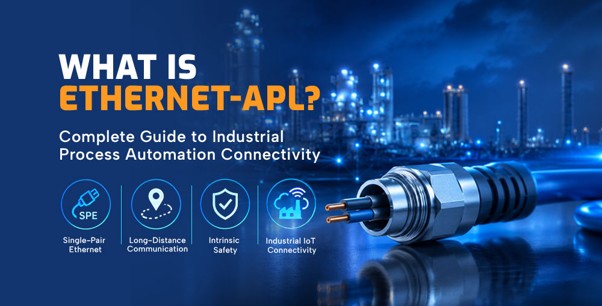
Modern industrial plants generate enormous volumes of operational data. However, conventional field communication systems often create bottlenecks because they cannot efficiently transport high-frequency diagnostic information.
Ethernet-APL addresses this limitation by providing direct Ethernet connectivity from field devices to higher-level systems. The result is faster access to operational insights, enabling organizations to:
Improve process visibility.
Enhance equipment reliability.
Reduce maintenance costs.
Increase plant availability.
Support predictive maintenance initiatives.
Accelerate digital transformation.
Ethernet-APL is positioned to become one of the foundational technologies supporting smart process plants. As industrial organizations continue investing in automation, digitalization, Industrial IoT, and predictive maintenance, demand for field-level Ethernet connectivity will continue to grow.
The increasing deployment of AI-powered analytics, cloud-based asset management, edge computing, and digital twin technologies will further accelerate Ethernet-APL adoption across the oil & gas, chemical, pharmaceutical, food processing, water treatment, mining, and power generation industries.
Ethernet-APL represents a significant advancement in industrial networking by extending standard Ethernet directly to field devices in demanding process environments. By combining long-distance communication, intrinsic safety, simultaneous power and data transmission, and open interoperability, Ethernet-APL enables organizations to modernize their automation infrastructure while supporting Industry 4.0 initiatives.
As industries prioritize operational excellence, predictive maintenance, and digital transformation, Ethernet-APL is positioned to become a preferred communication technology for next-generation process automation systems, delivering greater efficiency, improved reliability, and enhanced operational visibility.
These ARC insights provide additional perspectives on industrial Ethernet adoption, field-level digitalization, Industrial IoT connectivity, and network modernization across the process industries:
From Spec to Site: Where Ethernet‑APL Adoption Stands in 2026
ABB Completes Integration of Ethernet-APL Connectivity to Flowmeter Portfolio
Together, these resources highlight the growing role of modern industrial networks in connecting field assets, improving access to operational data, and supporting the continued digitalization of process operations.