Representative End User Clients







Representative Automation Clients







Representative Software Clients








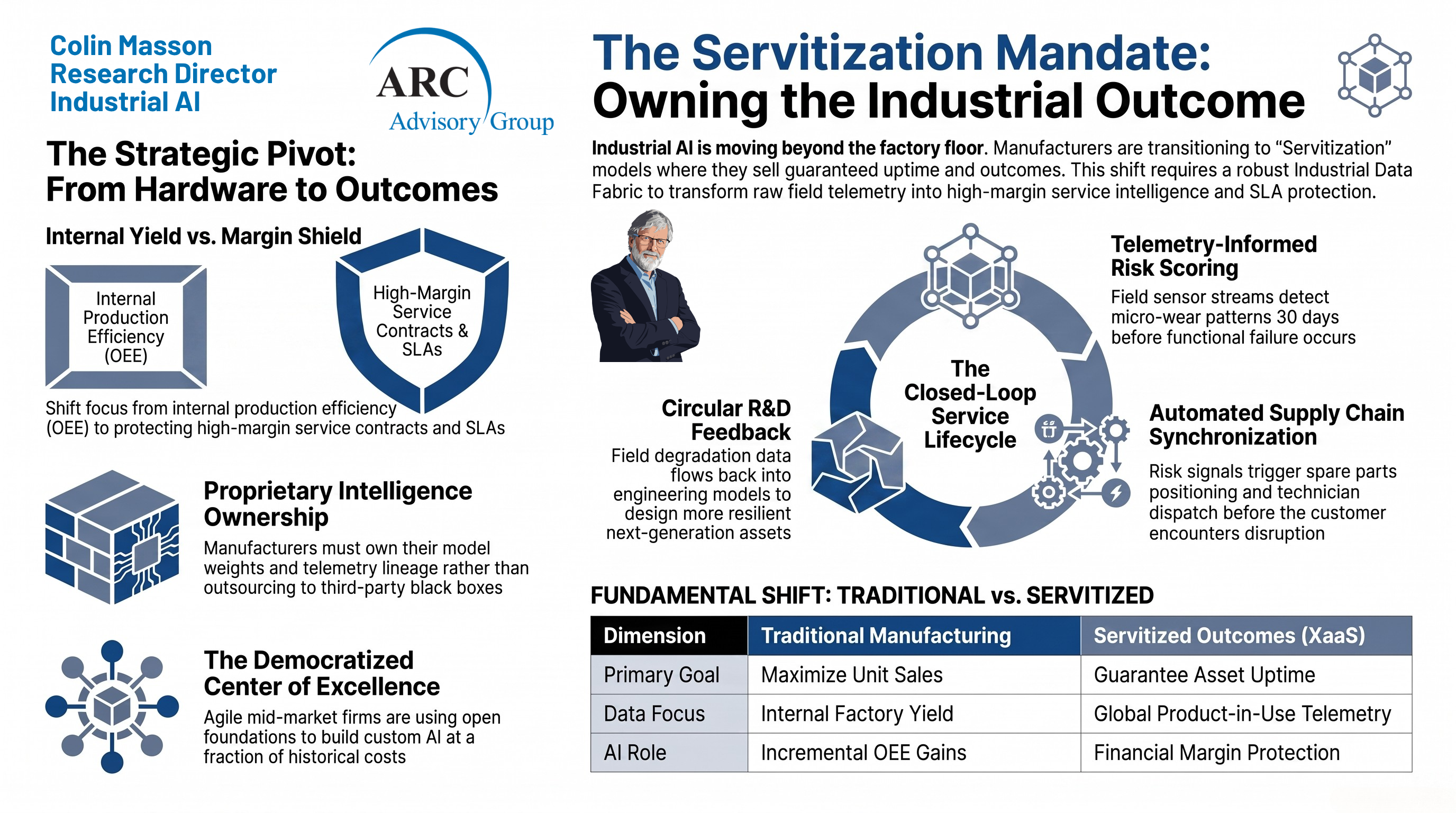
Industrial AI is rapidly outgrowing the four walls of the plant floor. While factory-level optimization drives vital operational gains, the true commercial inflection point lies in servitization and Equipment-as-a-Service (XaaS). When equipment manufacturers contractually guarantee operational outcomes and uptime SLAs, real-time product-in-use telemetry becomes the financial ledger of the balance sheet. Because machine failures trigger direct contractual penalties, equipment builders cannot outsource their core asset algorithms or operational data lineage to third-party SaaS black boxes. Instead, by anchoring multi-site field telemetry to an Industrial-Grade Data Fabric (IDF) and open lakehouse architecture, manufacturers—especially agile mid-market leaders ($100M–$2B)—are establishing lean, cross-functional Data & AI Centers of Excellence (CoEs) to own their proprietary model weights, orchestrate closed-loop service supply chains, and transform from commodity hardware makers into custom AI software builders.
In our companion piece, (Beyond the Single "North Star": Are Native Apps or Enterprise Alliances the True Core of the Industrial Data Fabric?) we examined how technology leaders are assembling Industrial Data Fabrics across three distinct layers: enterprise domain alliances, edge DataOps platforms, and lakehouse-native applications.
Whenever I discuss Industrial AI with executive teams, however, I notice a persistent and dangerous tendency to pigeon-hole AI as a tool used exclusively on the factory floor to optimize internal production metrics—improving Overall Equipment Effectiveness (OEE), predicting machine failure, or automating visual quality inspection.
While essential, this narrow view fundamentally misses three critical realities reshaping the industrial sector:
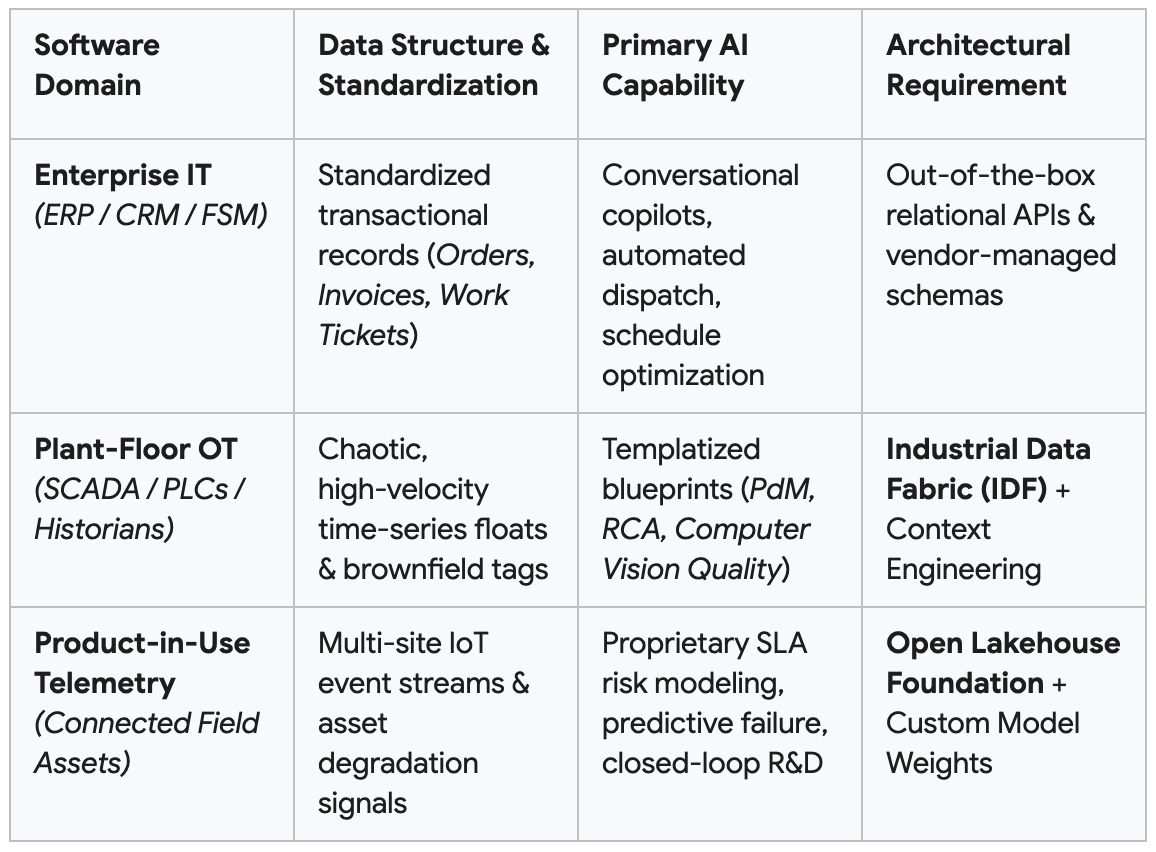
Templatized Blueprints vs. Chaotic OT Data: Common industrial AI use cases—such as Predictive Maintenance (PdM), Golden Batch, Causal Root Cause Analysis (RCA), Computer Vision Quality, and Safety Monitoring—are increasingly available as reusable application blueprints. However, unlike ERP or CRM, shop-floor OT data has no out-of-the-box standardization. Feeding these templatized AI patterns requires the disciplined assembly of an Industrial Data Fabric (IDF) to solve decades-old data quality and contextualization challenges.
The Servitization Imperative (Product-in-Use IP): Beyond factory walls, manufacturers are aggressively pursuing Servitization and X-as-a-Service (Equipment-as-a-Service) models to capture high-margin recurring revenue. Because product-in-use telemetry streaming from connected assets directly governs contractual uptime SLAs, manufacturers cannot outsource their core asset algorithms to a third-party SaaS black box. Servitization provides the direct economic justification for companies to fund and scale internal data science and Data CoE teams.
The Democratized CoE: Is custom AI development really destined to remain the exclusive domain of tier-1 mega-enterprises with multi-million-dollar IT departments? We challenge that assumption. Driven by XaaS revenue goals, mid-market manufacturers ($100M to $2B) are building lean Data & AI Centers of Excellence (CoEs) on open Lakehouse foundations (such as Databricks with Unity Catalog, Snowflake Horizon, Microsoft Fabric, AWS DataZone, Google Cloud BigLake). By pairing low-code Industrial DataOps with domain engineering expertise, these nimble firms are building proprietary AI solutions at a fraction of historical costs.
As I’ve argued in my ongoing series on "The Industrial Copilot R(E)volution," the world doesn't need another generic conversational chat widget tacked onto a field service application. What an industrial technician or a reliability engineer actually needs is an AI assistant grounded in hard operational reality—one that understands the physics of the machine, the specific maintenance history, the operating limits, and the exact terms of the customer SLA. You cannot get there with prompt engineering alone. You get there by anchoring your AI to an Industrial Data Fabric.
In discussions around Industrial AI, it is easy to fall into a seductive trap: assuming that factory-floor AI will quickly become as plug-and-play as enterprise IT software.
To anyone who has spent time on the "uncarpeted floor" with grease under their fingernails, that assertion is demonstrably false. Enterprise IT software—such as ERP (SAP) or CRM/FSM (Salesforce, IFS)—operates on highly standardized, transactional data models (invoices, purchase orders, customer work tickets) that look remarkably similar whether you make breakfast cereal or diesel locomotives.
In stark contrast, the industrial plant floor is an inherently heterogeneous, brownfield mosaic built on 20-year-old machinery, proprietary fieldbus protocols, and uncontextualized sensor tag streams (such as "TAG_1042 = 45.2").
As outlined in my 25-Year Echo and Draining the Swamp research series, the industrial sector is making meaningful progress toward semantic interoperability through emerging open standards:
CESMII i3X & Smart Manufacturing Profiles: Standardizing baseline OT interfaces and JSON schemas.
Model Context Protocol (MCP): Acting as the universal connector for AI agents to interface with external tools.
Agent-to-Agent (A2A) Protocols: Enabling peer-to-peer collaboration between specialized AI agents across domain boundaries.
However, having standardized communication pipes is not the same as having standardized operational data. What is actually being templatized across the industry are the AI use case application blueprints—prepackaged algorithmic frameworks for specific operational problems.
Drawing from ARC Advisory Group's extensive 3-Axis Industrial AI Models Research, we see a rich spectrum of prepackaged AI use cases emerging across the market:
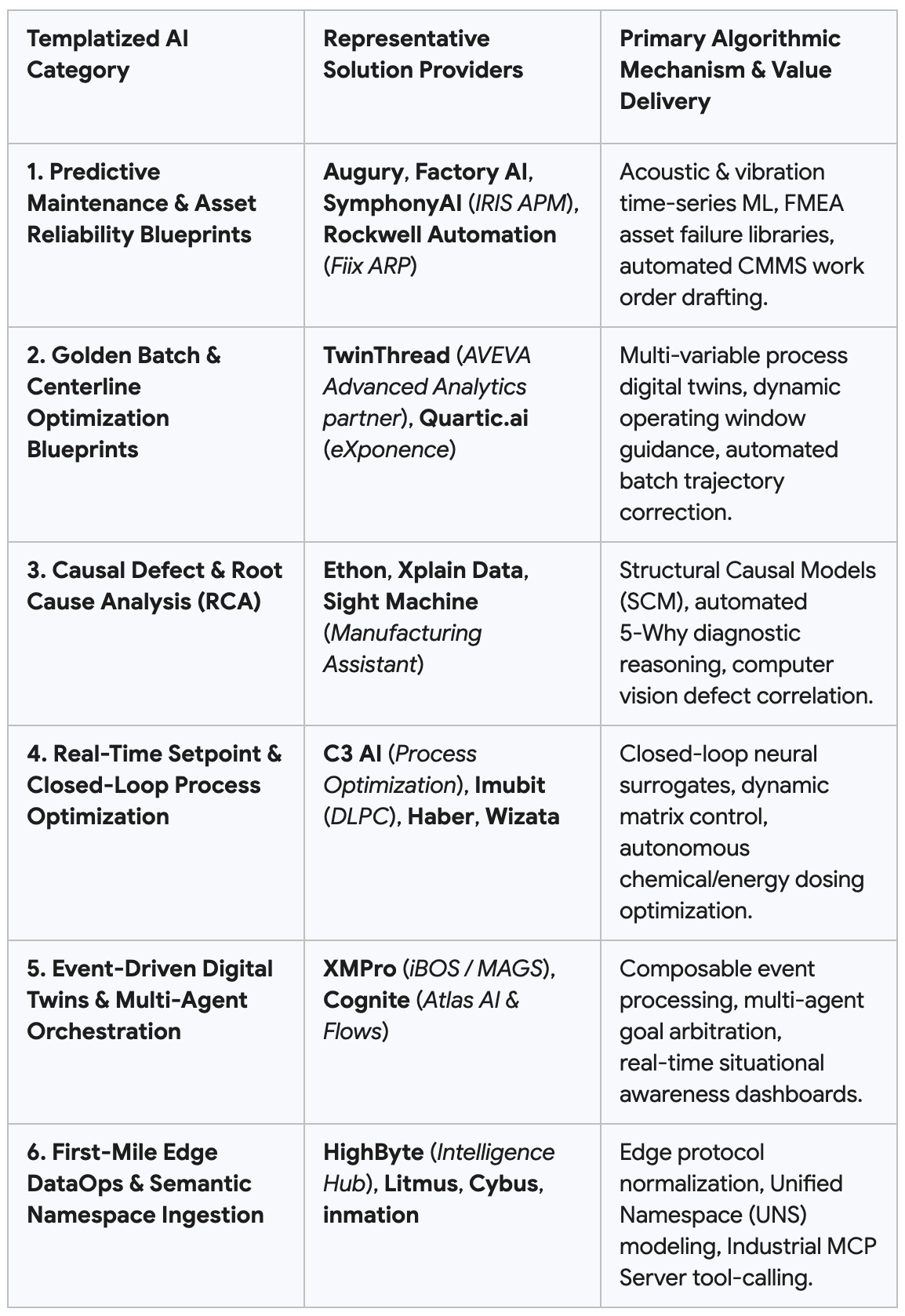
The application blueprint is templatized; the underlying OT data engineering is not. To make these use cases work, industrial organizations must assemble an Industrial Data Fabric (IDF) that ingests, cleanses, and contextualizes raw plant signals into trusted, reusable data products.
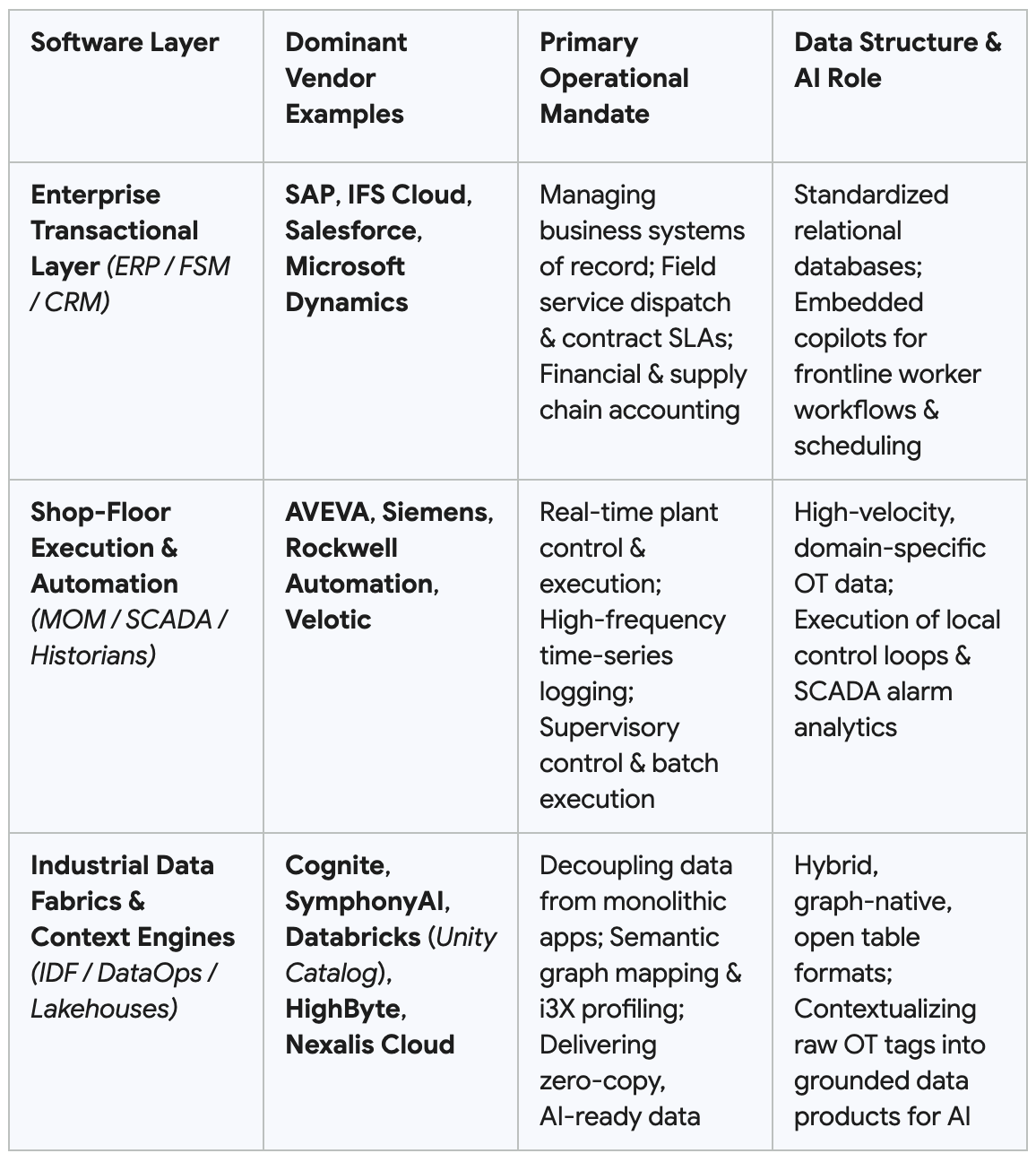
To evaluate how software aligns with ARC's frameworks, we must cleanly separate enterprise transactional software, shop-floor OT execution tools, and underlying Data Fabrics:
When an industrial manufacturer shifts from selling capital equipment to selling guaranteed operational outcomes, the entire purpose of the data architecture evolves.
Inside the plant, the Industrial Data Fabric primarily serves internal efficiency: Improving OEE, reducing scrap, and minimizing local downtime. In the field, that same data fabric becomes the financial ledger of the commercial contract.
Context is Non-Negotiable: Raw telemetry streaming from a servitized pump or turbine is useless in isolation. To evaluate SLA risk, that signal must be instantly linked to its physical asset hierarchy, maintenance history, current operating state, regional weather patterns, and contractual uptime guarantees.
Service Contracts Demand Auditable Data: If a machine unexpectedly fails at a customer site and triggers financial SLA penalties, the manufacturer must prove whether the failure was caused by mechanical defect or customer misuse. Data lineage, tamper-proof audit trails, and strict data governance become legal necessities.
AI Models Need Governed Data Products: AI models cannot learn directly from messy, unvetted IoT streams. They require cleansed, feature-engineered data products fed continuously through a governed Industrial Data Fabric.
Servitization directly accelerates enterprise investment in Industrial Data Fabrics, asset knowledge graphs, feature stores, and MLOps governance.
When building predictive maintenance and degradation models for servitized assets, industrial executives face a critical strategic choice regarding intellectual property:
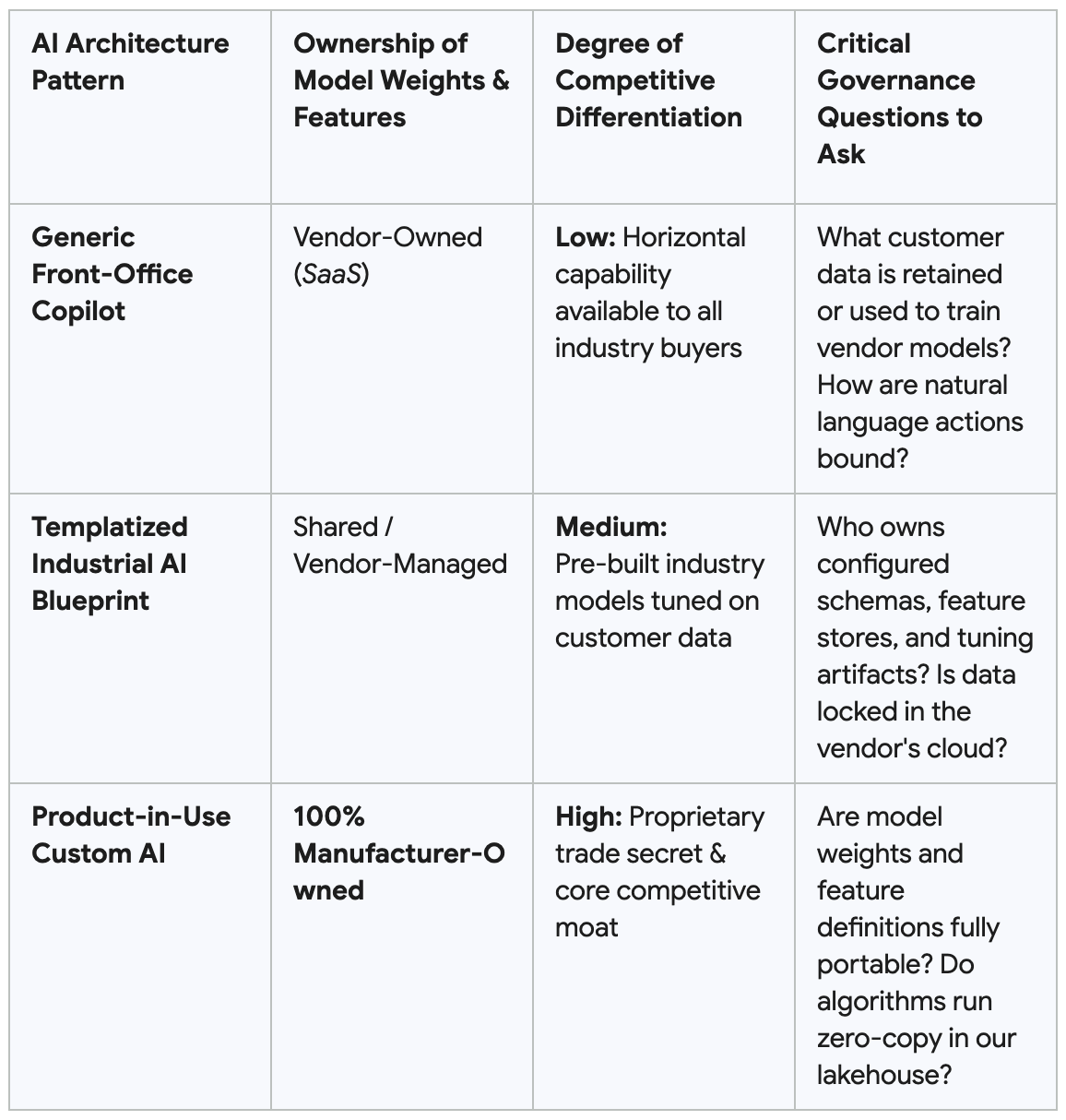
We see this dynamic playing out across global industrial leaders:
Kaeser Compressors (SIGMA AIR UTILITY): Kaeser sells compressed air as a utility. Customers pay per cubic meter of certified air rather than buying compressors. Kaeser builds, operates, and maintains the entire system based on real-time field telemetry streaming into proprietary predictive models.
Atlas Copco: Offers compressed-air-as-a-service, utilizing connected asset telemetry to manage energy efficiency and prevent unscheduled downtime.
Rolls-Royce (Power-by-the-Hour): The pioneer of servitization in jet engines, where commercial airlines pay per engine operating hour, powered by deep thermodynamic degradation models.
KONE (24/7 Connected Services): Uses connected elevator telemetry and custom predictive algorithms to guarantee vertical transport availability.
Historically, mid-market manufacturers struggled to justify the ROI of building an internal data science team. When AI was framed solely as a tool to shave 1 percent off shop-floor scrap rates, CFOs viewed data science as an expensive, unproven luxury.
Servitization completely flips that economic equation. When an industrial equipment maker guarantees 99.9 percent availability, unexpected machine failure directly triggers financial SLA penalty payouts. Predictive failure modeling becomes a top-line margin shield.
The recurring revenue generated by XaaS contracts provides the explicit financial justification to fund, recruit, and scale internal data science and Data CoE teams.
When an industrial manufacturer pivots to X-as-a-Service, the supply chain undergoes a radical transformation. You are no longer just shipping finished iron out the factory door; you are managing a continuous, circular flow of parts, consumables, field technicians, and remanufactured cores:
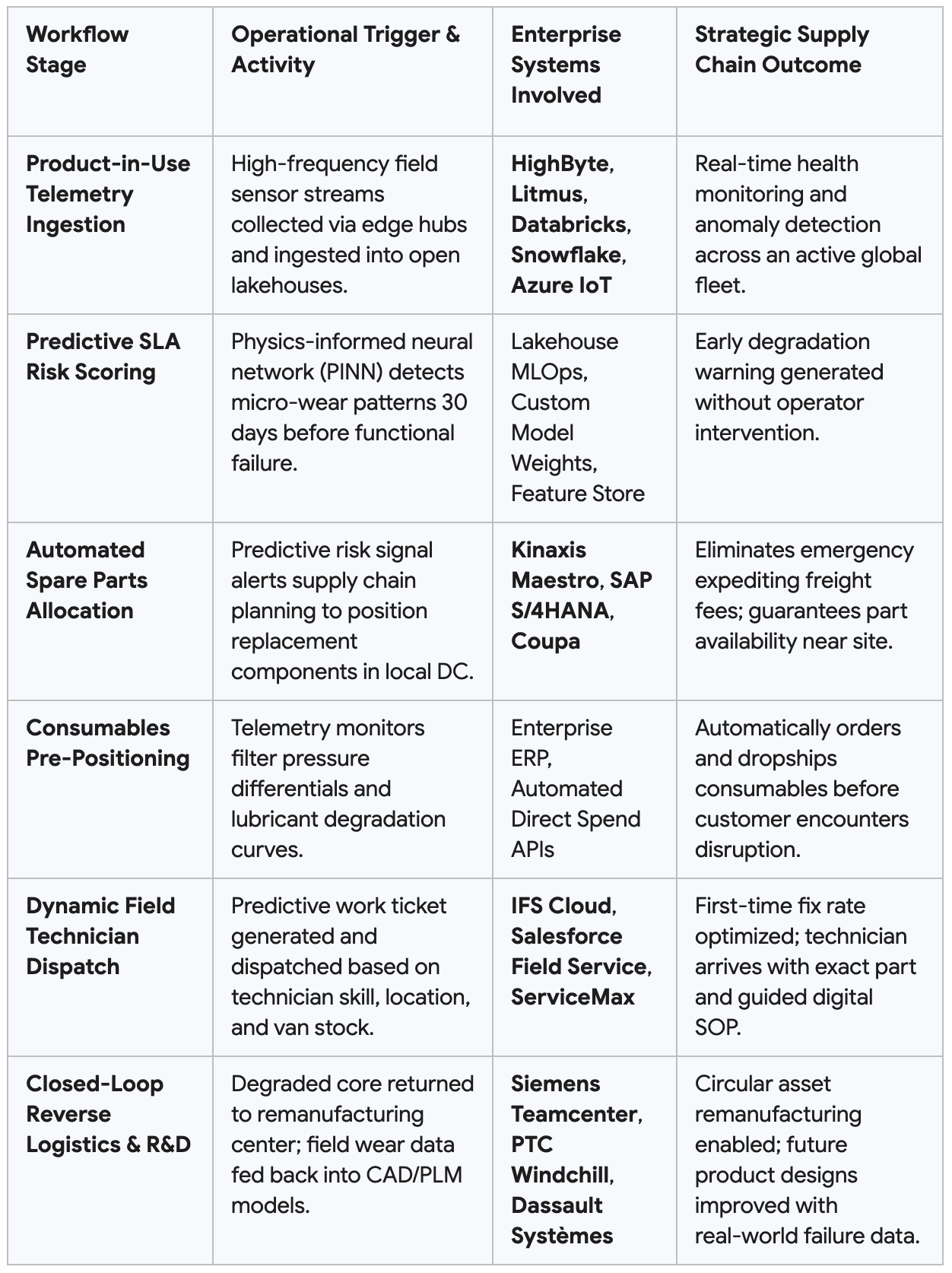
1. From Reactive Safety Stock to Telemetry-Informed Positioning
Historically, service supply chains relied on buffer stock—over-allocating expensive spare parts across regional warehouses to meet emergency break-fix SLAs. Under XaaS, could product-in-use telemetry serve as an early demand signal for supply chain planning?
When a predictive degradation model detects bearing micro-wear 30 days before expected failure, it can automatically signal supply chain orchestration tools (Kinaxis Maestro, SAP S/4HANA, Coupa) to move replacement parts to the local distribution center closest to the asset, eliminating emergency expedite shipping costs.
2. Synchronizing Field Service, Logistics, and Direct Spend
A predictive alert is useless if the required replacement part is out of stock or the field technician arrives without the correct specialized tool. Servitization links Field Service Management (IFS Cloud, Salesforce) directly with procurement and inventory management:
Technician Routing & Skill Matching: Optimization engines route field personnel based not just on location, but on current van stock, certifications, and asset history.
Automated Direct Spend & Consumables: Telemetry triggers automated replenishment of specialized lubricants, filters, and chemical consumables before customer depletion occurs.
Closed-Loop Reverse Logistics: Servitization emphasizes asset circularity. Used components are returned to remanufacturing hubs, where custom AI vision and diagnostic tools evaluate component health for rebuilding.
Closed-Loop R&D: Real-world field degradation patterns feed directly back into engineering CAD/PLM models to design more resilient next-generation assets.
A persistent myth in the industrial software sector is that only tier-1 global conglomerates (the top 5 percent with multimillion-dollar IT budgets) have the appetite or bandwidth to build custom AI solutions.
Our research and interactions at ARC Advisory Group suggest a more nuanced hypothesis: mid-market industrial enterprises ($100M to $2B in revenue) specializing in highly engineered machinery may actually have the most urgent mandate to become custom AI builders.
Faced with severe price pressure from low-cost overseas hardware competitors, how will these mid-market leaders avoid commoditization? Many are realizing they must pivot from selling commodity iron to selling smart, servitized outcomes.
To get there, they aren't hiring dozens of data science PhDs to write algorithms from scratch. Instead, they pair domain engineering experts with open lakehouse foundations (such as Databricks with Unity Catalog, Snowflake Horizon, Microsoft Fabric, AWS DataZone, or Google Cloud BigLake):
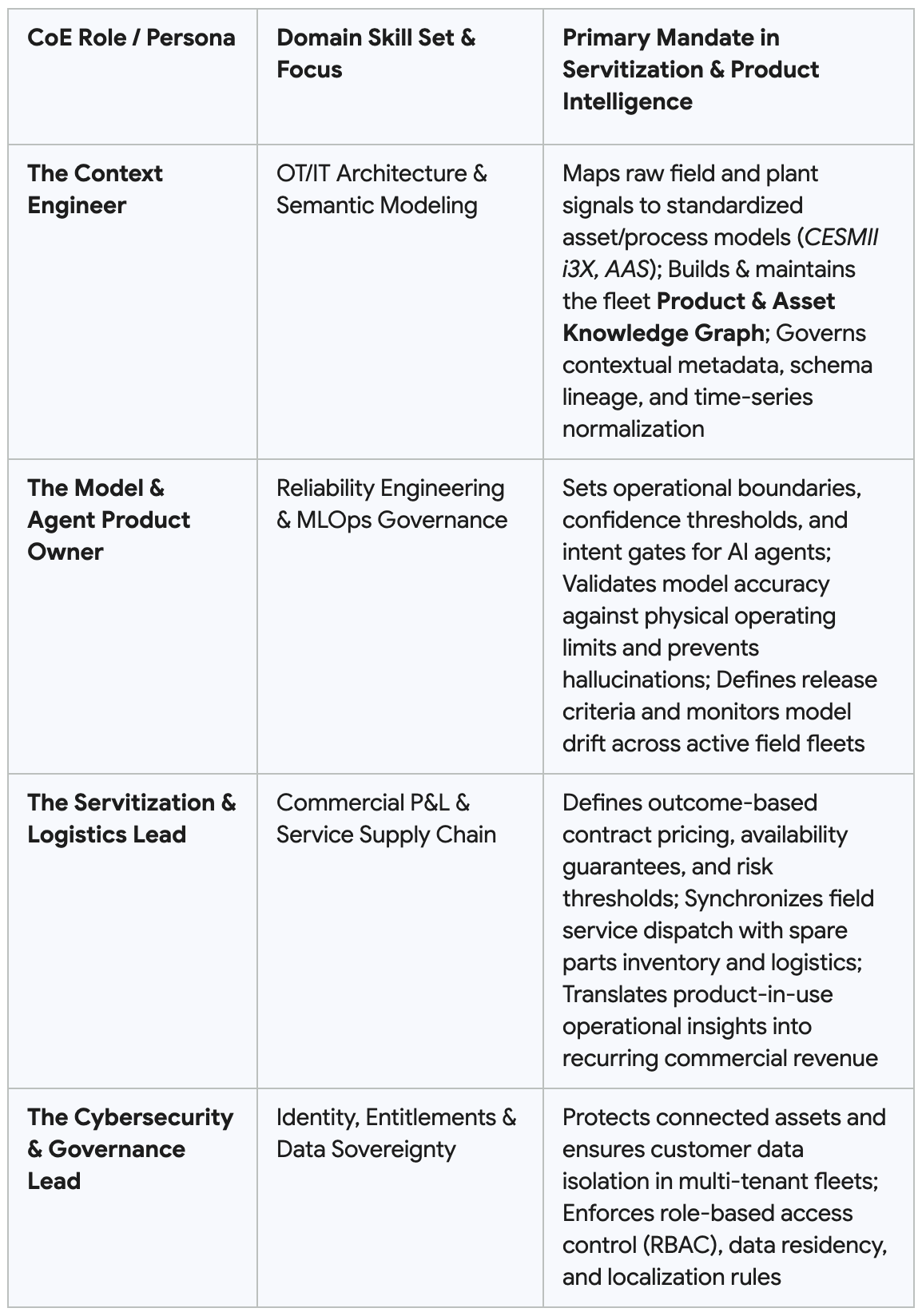
By combining an IDF with an open Lakehouse runtime, can a mid-market manufacturer's Data CoE ingest billions of product-in-use events daily, train proprietary predictive models, and maintain 100 percent control over their intellectual property without a mega-enterprise IT budget?
To evaluate how your organization can successfully bridge CRM/FSM/SCM software with product-in-use telemetry, map your initiatives against the ARC 3-Axis Industrial AI Models Taxonomy:
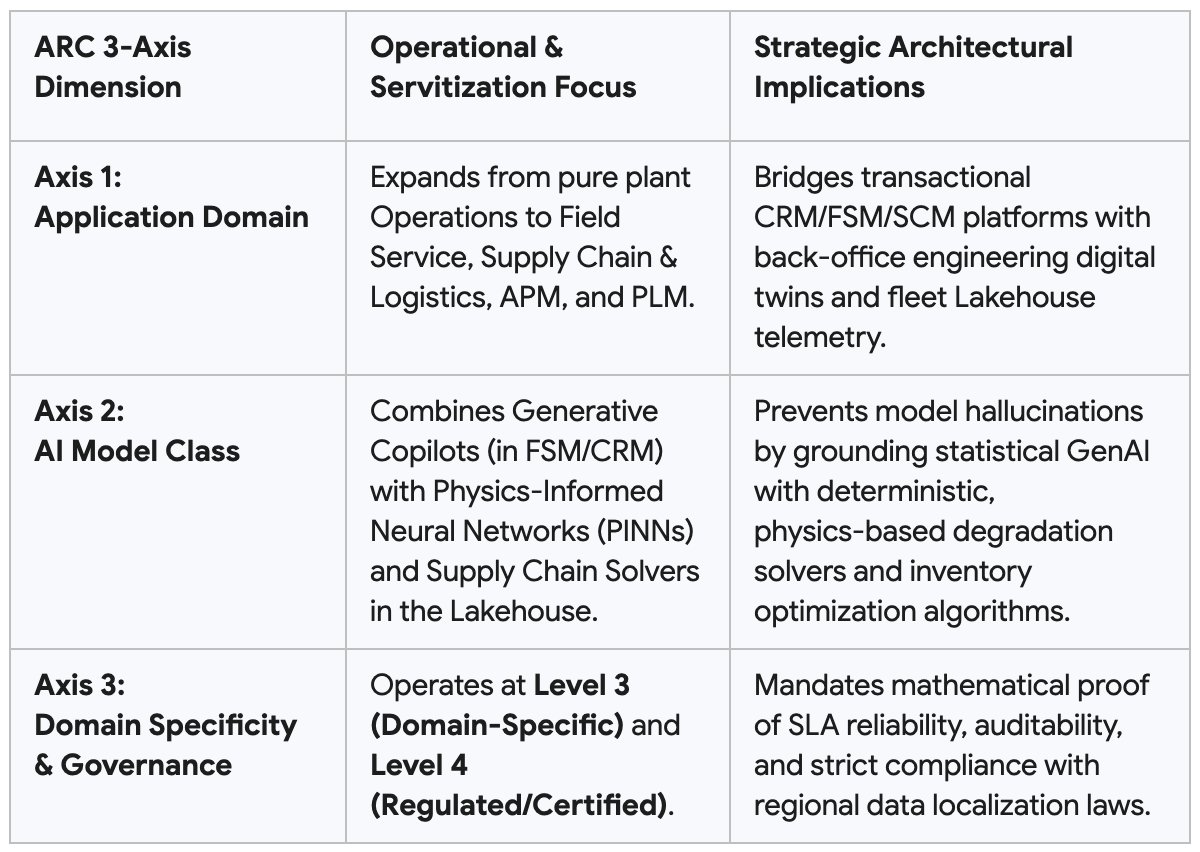
While every industrial organization—regardless of revenue scale—must confront the servitization imperative, the strategic choices differ depending on where you sit in the market. As executive teams evaluate their Data & AI roadmap, consider these six probing questions:
OT Data Engineering vs. Application Blueprints: Do we recognize that while AI use case patterns (PdM, Golden Batch, Causal RCA, Vision Quality) are templatized, our shop-floor OT data requires an Industrial Data Fabric to become AI-ready?
The Large Enterprise Reality Check: To our tier-1 mega-enterprise clients: Is your massive IT spend and multi-cloud infrastructure actually building a defensible competitive advantage—or are you simply accumulating costly integration debt while nimble competitors pass you by?
The Mid-Market Agile Opportunity: To our mid-market manufacturing clients: How aggressively are you leveraging your lack of legacy IT technical debt and monolithic enterprise software to build lean Data & AI CoEs and outpace slower, bureaucratic incumbents?
IP & SLA Margin Protection: When we build predictive failure models for our servitized equipment, do we retain 100 percent ownership of our algorithms and training weights, or is our core product IP locked inside a SaaS vendor's black box?
Telemetry, FSM & Supply Chain Synchronization: How cleanly does our product-in-use telemetry stream from our central lakehouse (Databricks, Snowflake, Fabric, AWS, Google Cloud) into our transactional FSM/CRM (IFS, Salesforce, SAP) and service supply chain planning engines (Kinaxis, Coupa)?
CoE Funding & Closed-Loop R&D: Are we using our top-line XaaS revenue goals to justify and fund a cross-functional Data & AI CoE that bridges product R&D, field service, supply chain logistics, and data engineering?
The window for tentative experimentation and passive pilot projects in Industrial AI has officially closed. Across ARC Advisory Group's global research and executive advisory engagements, the strategic direction is unambiguous: the divide between industrial market leaders and laggards will be defined by outcome ownership.
The legacy assumption that Industrial AI belongs solely on the factory floor to squeeze fractional percentage gains out of internal production is obsolete. Servitization, Equipment-as-a-Service, and product-in-use telemetry are redefining the economic gravity of industrial manufacturing. When you guarantee performance, uptime, and availability to your customers, your predictive failure algorithms are no longer software accessories—they are the margin protectors of your balance sheet.
Across both documents in this strategic series, the core lesson for leadership is consistent:
Stop searching for a single software savior: The Industrial Data Fabric is an architectural composition across enterprise domain alliances, edge DataOps hubs, and lakehouse-native applications.
Control your first mile: Without edge contextualization and semantic grounding, cloud lakehouses become expensive data swamps.
Refuse the black box: Outsource generic transactional workflows, but protect and internalize your proprietary product intelligence.
Whether you are a global conglomerate re-evaluating decades of enterprise IT integration debt or an agile mid-market specialist protecting your margins against commodity clones, the mandate is identical: Do not settle for remaining a traditional maker of physical hardware. Build the data fabric, deploy the telemetry, and command the high-margin frontier of outcome-based industrial intelligence.
The Industrial AI (R)Evolution is moving faster than ever. To dive deeper into the frameworks and data shaping the future of the industrial sector, explore my latest research:
Navigating the AI Wars and the escalating Industrial Robot Wars
Closing the Digital Divide by Embracing Industrial AI
Assembling your Industrial-Grade Data Fabric
Charting the new frontier of Physical Intelligence and transitioning to a Cyber-Physical Industrial Architecture (CPIA)
Mapping your maturity and strategy with ARC's 3-Axis Industrial AI Models Taxonomy
Surviving the SaaSpocalypse and Taming the Tokenpocalypse by Mastering Multi-Agent Industrial Governance
Organizational Design and the Future of Industrial Work in the era of Agentic AI
Where do you Stand in the Industrial AI (R)Evolution?
Take our Industrial AI Assessment to benchmark your organization's maturity, identify critical gaps in your IT/OT/ET convergence, and get actionable recommendations to accelerate your path to becoming an Industrial AI Pacesetter (and download the 2026 Report). If you think you’re already a Pacesetter, nominate your team for the ARC Industrial Pacesetters Awards!
Don't guess what your global operations or prospective customers need. Use empirical data to align your stakeholders and de-hype the market with ARC Advisory Group's Voice of Market Service.
For tailored recommendations on governing and guiding major people, process, and technology decisions across the enterprise, cloud, industrial edge, and AI, please contact Colin Masson at [email protected].
Or, set up a meeting with my fellow Analysts and I at ARC Advisory Group to find out more about our Executive Insights Service for Industrial organizations and our Industrial AI Insights Service for Vendors.