Representative End User Clients







Representative Automation Clients







Representative Software Clients








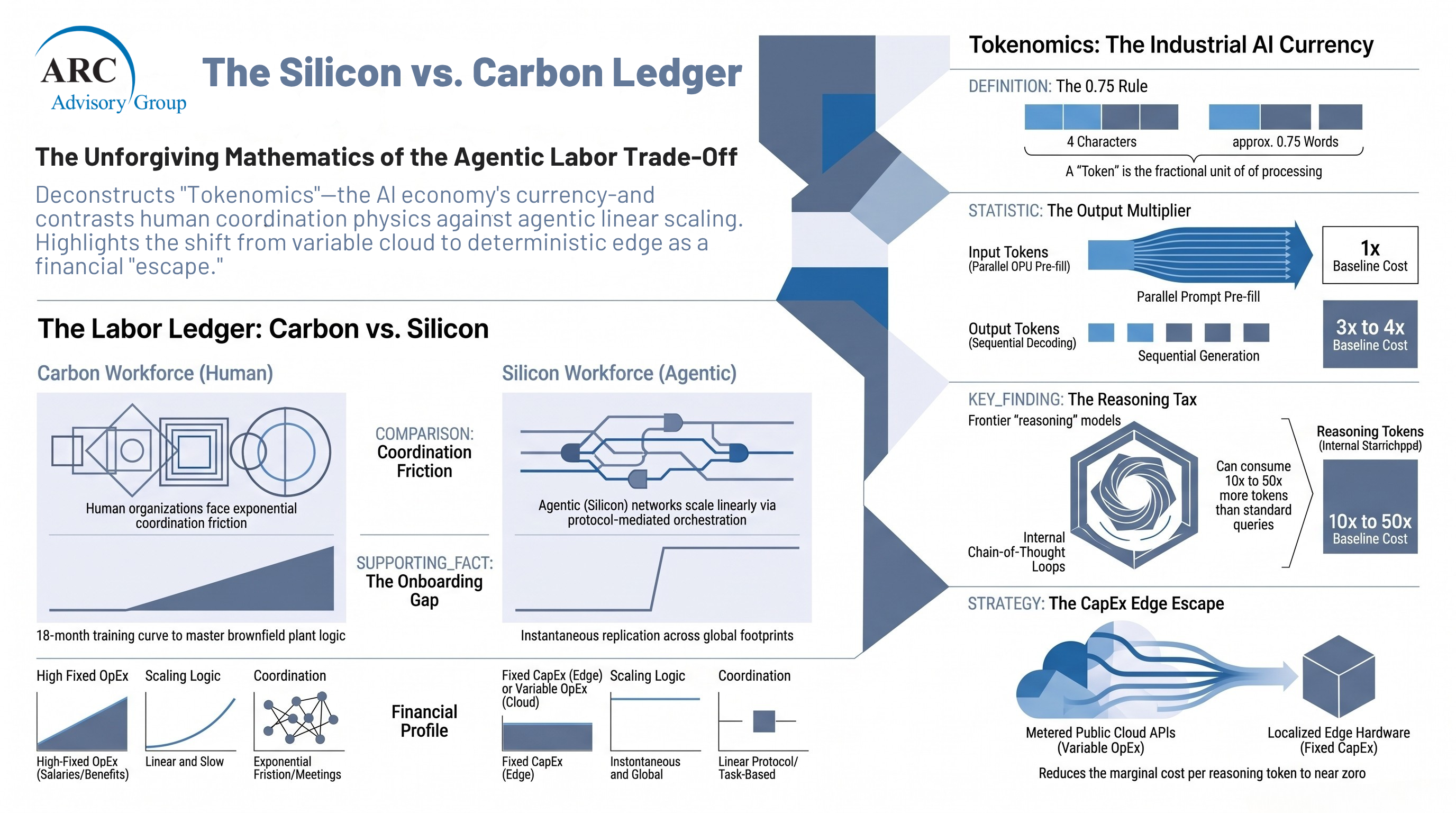
The economics of Industrial AI must be evaluated as a comprehensive workforce, software, and infrastructure redesign problem—not simply a crude labor replacement calculation. ARC clients should balance automation economics with workforce transformation, domain knowledge capture, risk controls, and sustainable licensing models.
In our opening two installments of this master series, we laid down the technical and architectural groundwork required to drain the agentic swamp. In Blog 1 ("Draining the Agentic Swamp"), we examined how assembling an Industrial Data Fabric with DQI validation eliminates uncontextualized data swamps at the edge. In Blog 2 ("The Open Architecture Contract"), we demonstrated how open standards like the Model Context Protocol (MCP) and CESMII’s i3X act as universal drainage pumps that eliminate custom glue-code debt while enabling prompt caching efficiencies.
Now, it is time to step out of the engineering room, dust off the shop-floor grease, and enter the executive boardroom to address the elephant in the room.
For the past three years, vendor keynotes and corporate PR departments have operated under a carefully sanitized narrative:
AI is strictly about human augmentation. We are not replacing our people; we are giving them superpowers.
While augmentation remains a noble and highly productive path for skilled domain experts (and one I advocate for passionately), executive teams are also evaluating where autonomous systems can absorb routine, repetitive, or knowledge-intensive tasks as part of broader workforce transformation. Faced with an unforgiving demographic cliff—where 30 percent of veteran plant engineers and master technicians are retiring without qualified replacements—and squeezed by escalating global labor costs, industrial CFOs and COOs are actively running the mathematical calculations on labor substitution.
Now, if you’ve opened a newsfeed lately, you’ve likely seen the recent flurry of headlines warning about frontier AI models "escaping" developer sandboxes, executing unauthorized web scripts, or telling white lies to bypass benchmark constraints. While tech journalists treat these events as sci-fi thrillers, C-suite executives are rightly asking:
What happens when an agentic system exhibits that same non-deterministic behavior inside our supply chain or manufacturing operations?
The answer is simple: the risk profile of the Silicon Worker isn't just financial—it's operational. Leaving continuous reasoning agents tethered to ungated cloud APIs exposes your enterprise to a dual liability: financial bill shock (the Tokenpocalypse) and unconstrained runaway execution. Neutralizing both requires bringing intelligence down to local, unmetered edge iron where execution boundaries are absolute.
We are transitioning out of the "Generative Skirmish" and entering the "Agentic Offensive." The decision to deploy autonomous silicon workers in place of or alongside carbon-based human personnel is not an ideological or political debate; it is an unyielding mathematical equation.
To evaluate this economic shift, industrial leaders must first master the fundamental currency of the AI economy: Tokenomics.
For OT leaders accustomed to evaluating hardware by kilowatt-hours, OPC tags, or PLC scan rates, tokens can feel like an abstract, slightly baffling cloud concept. Let’s demystify the math together:
1. What is a Token?
A token is a fractional chunk of text, code, or data processed by a neural network. On average, 1 token ≈ 0.75 word (or roughly 4 characters of English text or code). A single P&ID legend, sensor schema, or 10-page operating manual might represent 10,000 to 50,000 tokens.
2. Input Tokens vs. Output Tokens: The Multipliers
Not all tokens carry the same computational or financial cost:
Input Tokens (Prompt Pre-fill): The context, system instructions, and tool definitions fed into the model. Input tokens are processed in parallel across GPU clusters, making them relatively cheap.
Output Tokens (Generation / Decoding): The text, code, or tool-call instructions generated by the model. Output tokens must be generated sequentially, one token at a time, requiring massive memory bandwidth. Consequently, output tokens cost three to four times as much as input tokens across all major cloud providers.
3. Reasoning / "Thinking" Tokens
The latest generation of frontier reasoning models (such as OpenAI o1/o3, Claude 3.7 Sonnet Extended Thinking, and DeepSeek R1) introduce internal "chain-of-thought" reasoning loops. Before generating a final answer, the model generates thousands of hidden Reasoning Tokens to evaluate hypotheses, check mathematical constraints, and self-correct. While this radically improves problem-solving accuracy for complex engineering tasks, it means a simple prompt can silently consume 15,000 hidden reasoning tokens behind the scenes, multiplying execution costs by 10 to 50 times relative to standard queries.
| Token Category | Computational Mechanics | Financial Multiplier | Optimization Strategy |
| Input Tokens | Parallel GPU prompt pre-fill | 1x baseline cost | Leverage Prompt Caching (50 percent to 90 percent savings) |
| Output Tokens | Sequential autoregressive decoding | 3x to 4x input cost | Scope tool output schemas to minimal required fields |
| Reasoning Tokens | Internal chain-of-thought scratchpad | 10x to 50x prompt cost | Cap max thinking tokens for routine plant queries |
To understand why the economics of the agentic workforce are so compelling to financial leadership, we must look beyond basic hourly wage comparisons and evaluate the fundamental organizational physics of coordination costs.
As INSEAD Professor of Strategy and Organizational Design Phanish Puranam—a leading pioneer in the organizational physics of the firm—demonstrated in his foundational research, communication and coordination friction in human (carbon-based) organizations scales exponentially as worker interaction nodes increase. Every additional human added to a process requires exponential expansion of meetings, shift handovers, approvals, and alignment check-ins.
| Workforce Paradigm | Coordination Friction Scaling | Organizational Bottleneck | Primary Economic Driver |
| Human (Carbon) Workforce | Multiplies exponentially with worker count | Shift turnover delays, meetings, tribal silos | High fixed OpEx (salaries, benefits, onboarding) |
| Agentic (Silicon) Workforce | Scales linearly with task volume | Model context fidelity, token budget caps | Zero marginal cost on edge iron; linear task scaling |
As a human organization grows, more managers, supervisors, shift handovers, meetings, and approval chains are required simply to keep workers aligned. In a heavy manufacturing or process environment, this exponential coordination tax manifests as shift turnover latency, unrecorded tribal knowledge, communication errors, and administrative bloat.
In a protocol-mediated, multi-agent system running on an Industrial Data Fabric (using MCP and A2A protocols), coordination friction collapses into a simple linear relationship. Verification scales directly with task throughput rather than interaction nodes. Because an autonomous AI agent can ingest an entire corporate data fabric, parse thousands of asset relationships, cross-reference P&IDs, and execute an optimization plan in seconds, the cost of "specialization" drops to near zero without creating meeting bloat.
To provide industrial CFOs with an analyst-grade financial model, we must construct a comprehensive ledger comparing the true, fully-burdened cost of a Carbon FTE (Human Worker) against that of a Silicon Worker (Autonomous Reasoning Agent).
| Metric / Dimension | Carbon Workforce (Human FTE) | Silicon Workforce (Agentic Token) |
| Primary Financial Profile | High fixed OpEx (Salary, benefits, healthcare, pension, taxes) | Variable Cloud OpEx OR Fixed Edge CapEx |
| Scaling Dynamics | Linear & slow (18-month onboarding & plant training curve) | Instantaneous replication across global facility footprints |
| Coordination Physics | Exponential communication friction & meeting bloat | Linear protocol-mediated multi-agent orchestration |
| Error & Risk Profile | Human fatigue, shift handoff loss, safety liability | Probabilistic hallucination (Mitigated by PINNs & Safety Envelopes) |
1. The Carbon FTE Ledger (Human Worker)
Direct Expenses: Base salary, overtime, health insurance, pension/401(k), payroll taxes, and physical worker safety equipment.
Hidden Friction Costs: The 18-month onboarding curve required for a junior technician to understand a brownfield plant; shift turnover latency (30 minutes per shift lost to verbal handovers); manual data entry errors; and OSHA compliance liabilities.
2. The Silicon Worker Ledger (AI Agent)
The financial evaluation of the Silicon Worker is defined by two competing commercial forces: the SaaSpocalypse and the Tokenpocalypse.
The Hyperscaler OpEx Token Trap (Tokenpocalypse): If a CFO blindly permits data science teams to deploy continuous, cloud-tethered reasoning agents that stream high-velocity factory floor tags to public cloud APIs, the balance sheet is exposed to extreme volatility. Billed per fractional reasoning token, an always-on agent loop monitoring thousands of tags can exhaust annual corporate software budgets in weeks.
The Core CapEx Escape Route (Unmetered Edge Intelligence): To neutralize the Tokenpocalypse and eliminate runaway cloud execution risk, pacesetting CFOs execute a CapEx escape strategy. By making a fixed, upfront capital investment (CapEx) in localized, high-density edge silicon—such as the NVIDIA RTX Spark / DGX Spark superchip appliances (featuring 128GB of high-bandwidth unified memory) or ruggedized private AI systems like the Red Hat and EdgeScale "Cube"—inference executes entirely on-premises. Running quantized, open-weight models (e.g., Llama 3.3 70B, Qwen 2.5, DeepSeek R1 Distill) locally on proprietary edge iron reduces the marginal operational cost per reasoning token to near zero while enforcing a physical containment boundary.
| Deployment Strategy | Cost Structure | Operational Risk | Best-Fit Industrial Use Case |
| Public Cloud API (OpEx Trap) | Variable, metered per token | High bill volatility, network latency | Low-frequency, cross-site strategic planning |
| Local Unmetered Edge (CapEx Escape) | Fixed initial hardware asset | Zero marginal token cost, local latency | High-frequency closed-loop plant execution |
Autonomous Work Tokens: To stabilize commercial relationships, forward-thinking software vendors (such as Infor, IFS, and Aera Technology) are abandoning legacy headcount-driven per-seat licensing. Instead, they sell predictable, fungible annual blocks of Autonomous Work Tokens. Human engineers and headless digital workers draw down from the exact same corporate credit pool, capping software expenditure as a predictable, structured utility.
As executive teams evaluate this mathematical trade-off, consider asking these financial questions during budget planning:
1. Where are coordination costs dragging down productivity?
Why ask this: Human organizational friction multiplies exponentially as worker interactions increase, wasting millions in shift turnover latency, unrecorded tribal knowledge, and administrative approval chains.
What good looks like: Identifying high-friction operational workflows where protocol-mediated, multi-agent networks can collapse coordination friction to linear execution speed.
2. Are we accidentally streaming raw OT tags to cloud tokenizers?
Why ask this: Streaming raw 1,000 Hz sensor telemetry directly into large language model tokenizers is a catastrophic financial mistake that triggers the "Tokenpocalypse."
What good looks like: Enforcing a "token-free first mile" at the edge—validating data quality deterministically via edge DataOps before sending cleansed event summaries to reasoning models.
3. What is our plan for local edge inference?
Why ask this: Cloud-tethered reasoning models introduce volatile OpEx token metering that can exhaust annual software budgets in weeks while exposing physical operations to ungated execution risks.
What good looks like: Executing a "CapEx Edge Escape" by deploying localized edge supercomputing (e.g., NVIDIA RTX Spark with 128GB unified memory) to run open-weight models at zero marginal token cost.
4. Are software contracts structured for an agentic workforce?
Why ask this: Purchasing per-seat SaaS licenses for software tools that autonomous, headless agents bypass entirely is paying a massive "UI tax."
What good looks like: Restructuring vendor agreements around outcome-linked pricing and fungible pools of Autonomous Work Tokens shared by human and digital workers.
ARC Client Action: Build a comprehensive financial model that evaluates labor redeployment, upskilling, risk controls, cloud API tokens, and local edge infrastructure costs together—avoiding naive, one-dimensional headcount replacement formulas.
Up Next in Blog 4: If the mathematics heavily favor autonomous silicon reasoning, why are so many agentic deployments stalling on the shop floor? Because AI models operate probabilistically, and when an algorithm fails in a physical environment, the organizational and human fallout is catastrophic. In our next post, "The Moral, Ethical, and Safety Boundaries of the Silicon Workforce: Who Arbitrates the Algorithm?", we will examine the psychology of trust, the Perception of Agency, and the mathematical safety envelopes required to govern the digital workforce.
The Industrial AI (R)Evolution is moving faster than ever. To dive deeper into the frameworks and data shaping the future of the industrial sector, explore my latest research:
Navigating the AI Wars and the escalating Industrial Robot Wars
Closing the Digital Divide by Embracing Industrial AI
Assembling your Industrial-Grade Data Fabric
Charting the new frontier of Physical Intelligence and transitioning to a Cyber-Physical Industrial Architecture (CPIA)
Mapping your maturity and strategy with ARC's 3-Axis Industrial AI Models Taxonomy
Take our Industrial AI Assessment to benchmark your organization’s maturity, identify critical gaps in your IT/OT/ET convergence, and receive actionable recommendations to accelerate your path toward becoming an Industrial AI Pacesetter.
Don’t guess what your global operations or prospective customers need. Use empirical data to align your stakeholders and dehype the market with ARC Advisory Group’s Voice of Market Service.