Representative End User Clients







Representative Automation Clients







Representative Software Clients









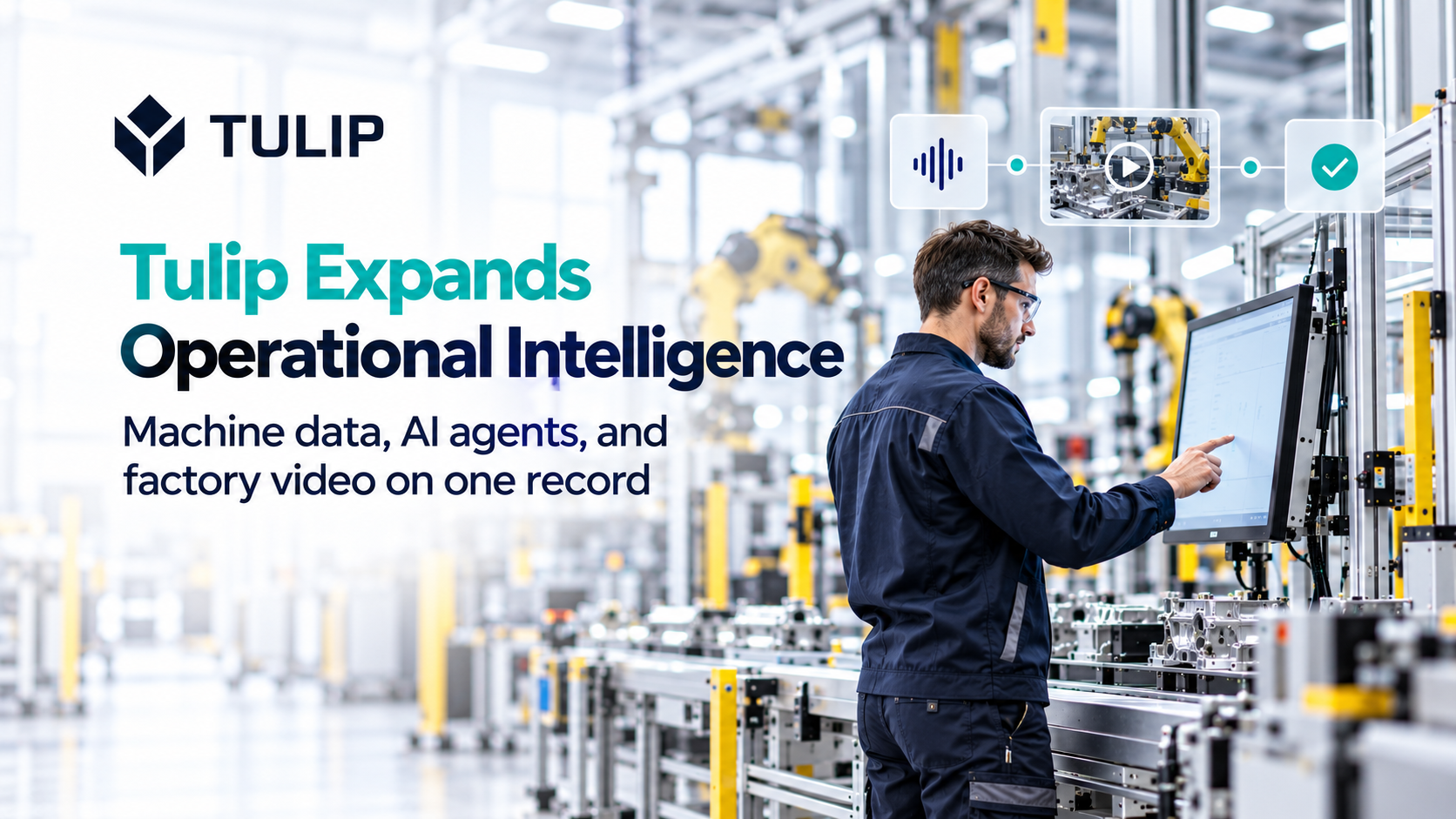
Tulip has announced a set of operational intelligence capabilities intended to help manufacturers run production and orchestrate people, machines, and AI agents from a common operational record. The additions include Industrial Connectivity, Native MCP Connectors, Composable AI Agents, and expanded Factory Playback capabilities.
The announcements address a persistent challenge in manufacturing operations. Machine data, work instructions, order information, operator actions, video, and enterprise-system records are often distributed across separate systems. As a result, investigating a quality issue or production interruption can require teams to assemble evidence manually before they can determine what happened and what action should follow.
Tulip’s Industrial Connectivity offering is designed to bring machine data from existing drivers, historians, and unified namespace environments into the platform. The company said the capability can normalize incoming data, convert units, derive machine states from signals, and map equipment to common data types.
The more significant element is the operational context added around that machine information. Rather than treating machine signals as isolated time-series data, Tulip connects them to the associated order, process step, station, and operator. This can help teams understand not only what a machine reported, but what work was taking place, what decision was made, and what occurred next.
For manufacturers with equipment from multiple vendors and generations, this type of contextualization is essential. Bringing data into a common namespace alone does not guarantee that the information is usable for analysis, workflow execution, or AI-assisted decision-making.
Tulip also previewed Native MCP Connectors, which use Model Context Protocol (MCP) to enable two-way data exchange between the Tulip platform, enterprise systems, and AI tools that support the protocol.
Under this approach, Tulip agents can retrieve and use information from connected systems, while external AI assistants and coding tools can access Tulip data through its MCP server. The company said these interactions operate under the permissions established in Tulip, allowing organizations to control whether a connected tool can view information or make changes to the record.
This is particularly relevant as manufacturers move beyond stand-alone AI pilots. An AI agent can only support a production workflow effectively when it has access to the right operational context and operates within defined permissions, approval requirements, and audit trails.
Tulip has also expanded Factory Playback, which places video from existing factory cameras on the same timeline as machine and order data. Engineers can examine what was happening on the line at the time of an event, rather than relying solely on system records or later recollections.
New human activity detection capabilities are intended to support process analysis by identifying how time is spent at a workstation, whether a procedure was followed, and whether an assembly activity occurred as expected. Tulip said Factory Playback can also initiate work based on detected events, creating a link between observation, analysis, workflow execution, and documentation.
Together, these capabilities are intended to reduce the need for teams to piece together evidence from separate systems during root-cause analysis. They also provide a more complete record for testing changes, confirming outcomes, and tracing decisions made by people or AI agents back to the relevant machine data, video, and order information.
Tulip’s operational intelligence updates reflect the broader industrial requirement for AI systems to be grounded in contextualized operational data. As manufacturers connect AI agents to frontline workflows, the ability to combine data, execution context, permissions, and traceability will be as important as the AI model itself.
Read ARC’s perspectives on:
For manufacturers, the potential value lies in creating a shared operational record that supports both real-time execution and retrospective analysis. This can give frontline teams and AI-enabled systems a common basis for understanding production events, acting within defined controls, and improving operations over time.