Representative End User Clients







Representative Automation Clients







Representative Software Clients








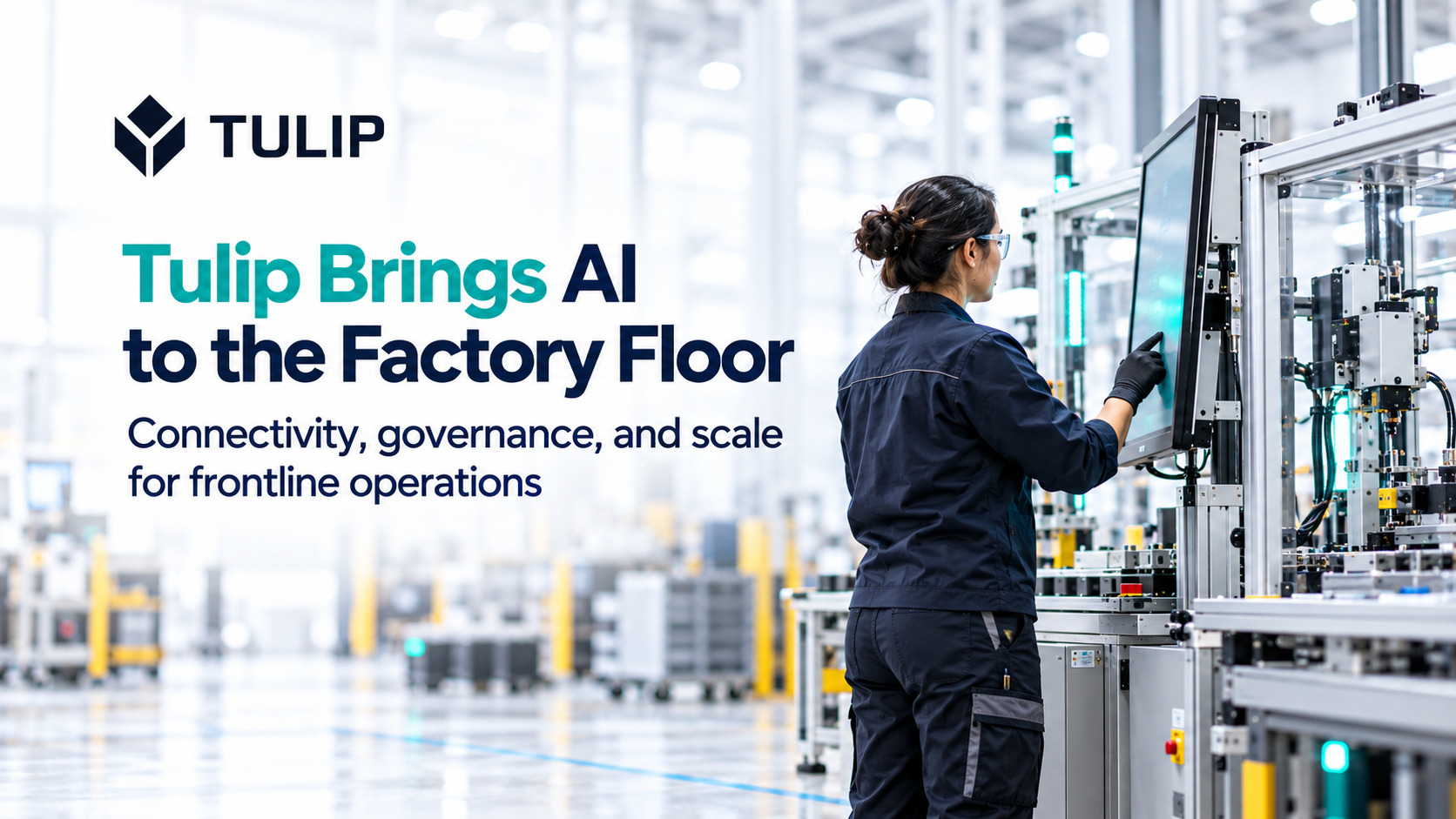
Tulip has announced a set of additions to its Frontline Operations platform at Operations Calling 2026. The announcements span application development, industrial data connectivity, AI-assisted workflows, visual operational analysis, and enterprise governance.
The release reflects a growing requirement for manufacturers to put AI tools into operational use without disconnecting them from the people, processes, and data that shape day-to-day production work. Rather than positioning AI as a separate layer, Tulip is extending the platform used to build and run frontline applications with capabilities intended to connect machine information, operator context, workflows, and audit records.
Tulip introduced Projects, a visual workspace for planning and connecting applications, automations, agents, data tables, and connectors within a production system. The company said Projects is entering customer testing, alongside its Authoring Agent, which is intended to help engineers draft applications using the context of existing applications, data, and standard operating procedures.
The company also previewed code-based applications, allowing developers to create custom frontline applications using their own integrated development environments and AI coding tools. Tulip stated that the capability will apply platform controls for portability, operator attribution, zero-trust security, and auditable versioning as applications move from development into plant operations.
This combination is notable because industrial organizations rarely have one uniform development model. Some sites depend on no-code tools to enable operations and engineering teams, while others require conventional software development practices for specialized applications. A platform that can support both approaches while maintaining governance could help organizations avoid creating separate application environments for different user groups.
Tulip also announced Industrial Connectivity, a data layer designed to bring machine data from existing drivers, historians, and unified namespace (UNS) environments into the Tulip platform. The company said the capability connects machine information with operational context, including the relevant order, step, station, and operator.
That context will be critical as industrial organizations move from experimenting with AI assistants to deploying AI agents that can support real operational workflows. An AI system may be able to interpret signals from a machine or historian, but its usefulness depends on understanding what operation was underway, what procedures applied, who made a decision, and what occurred next.
Tulip is also extending its Factory Playback capability, which uses edge-based camera streams and vision-language models to create a replayable record of factory-floor activity. New human activity detection capabilities are intended to help manufacturers investigate procedural adherence, identify where time is being spent, and support root-cause analysis. The company also said it will introduce native support for Model Context Protocol (MCP) connectors, enabling Tulip applications and agents to interact with external AI tools and systems under the platform’s permissions and audit trail. Industrial Connectivity and native MCP connectors are in preview.
For enterprise deployments, Tulip announced an Enterprise Library for centrally publishing applications and related assets to sites. The capability is expected later this year. Tulip also expanded OpsMoto with an AI chat interface for querying operational data across sites using natural language.
These capabilities address a familiar issue in multi-site manufacturing programs: a successful use case often remains isolated at one plant because it cannot be shared, adapted, validated, and governed efficiently elsewhere. Central libraries and common operational data models can make it easier to scale applications while leaving room for site-level adaptation.
Tulip also introduced Frontline Deployed Engineers, Validation Accelerator services for life sciences organizations, AI adoption workshops, and Tulip Federal, a practice focused on the US defense industrial base and federal production and sustainment operations. The company’s emphasis on deployment and validation services recognizes that industrial AI adoption involves process design, change management, compliance, and workforce engagement, not only software configuration.
The announcements align with a broader industrial shift toward AI systems that are grounded in contextualized operational data rather than disconnected from it. As AI is introduced into quality, maintenance, production, and engineering workflows, manufacturers will need to ensure that systems can interpret industrial information in the context of real operating conditions and retain an appropriate audit trail.
Read ARC’s perspective on Taming Industrial AI Starts with Great Data.
Tulip’s latest platform updates show how frontline operations software is evolving beyond digital work instructions and isolated applications. The opportunity lies in connecting people, applications, machines, and AI-enabled workflows through an operational record that can support both local execution and enterprise-scale governance.