Representative End User Clients







Representative Automation Clients







Representative Software Clients









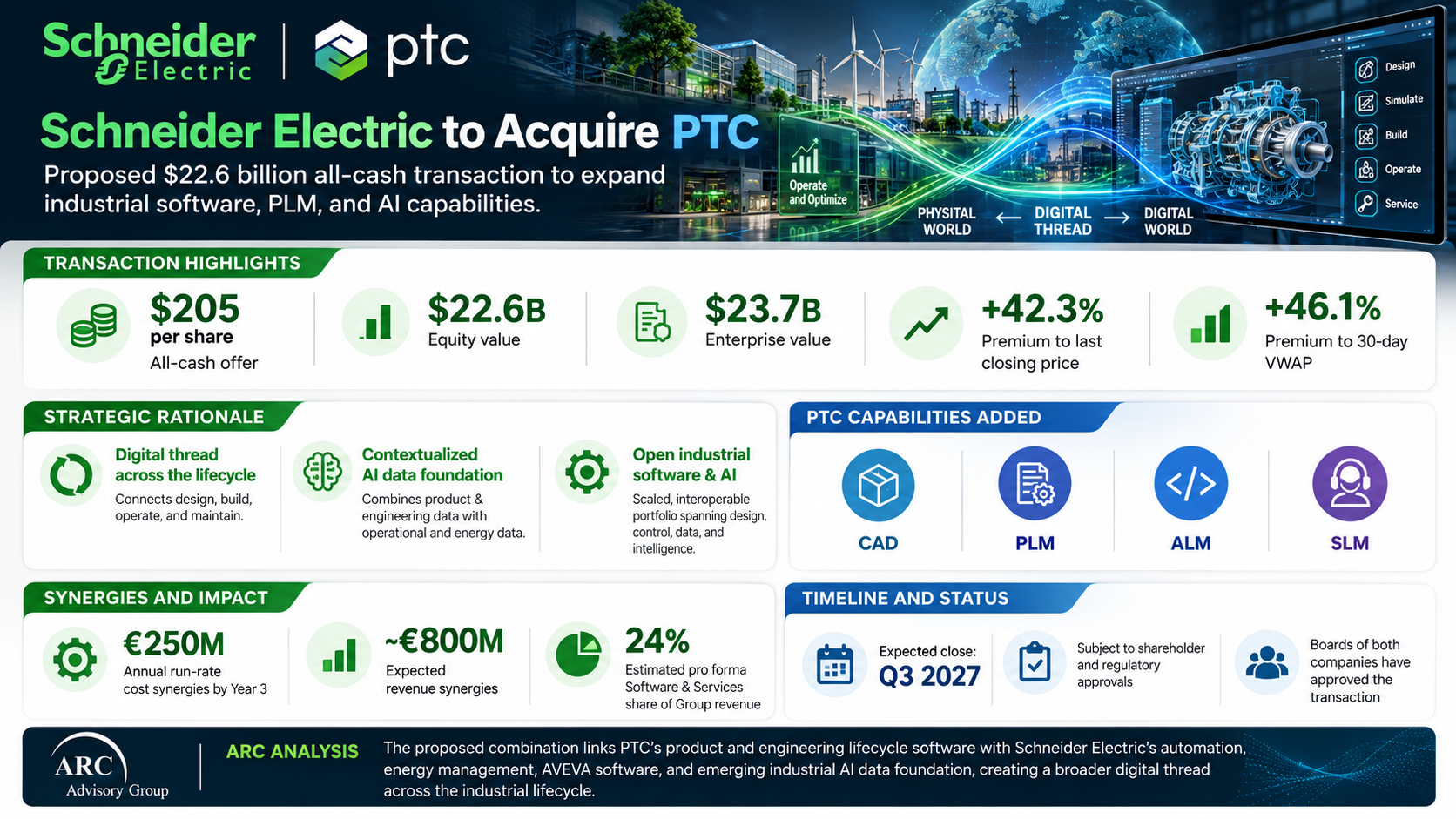
Schneider Electric and PTC have signed a definitive agreement under which Schneider Electric would acquire PTC for $205 per share in cash. The offer values PTC’s equity at approximately $22.6 billion and implies an enterprise value of $23.7 billion. The companies expect the transaction to close by the third quarter of 2027, subject to PTC shareholder approval, regulatory clearances, and other customary conditions.
PTC would add a substantial portfolio spanning computer-aided design (CAD), product lifecycle management (PLM), application lifecycle management (ALM), and service lifecycle management (SLM). According to the announcement, PTC serves more than 30,000 customers globally and generated €2.4 billion in calendar-year 2025 revenue, with an adjusted EBITA margin of approximately 40 percent.
The strategic logic extends beyond adding another large software business. Schneider Electric has built a broad position in industrial automation, energy management, and operations software, including AVEVA. PTC is strongest upstream, where manufacturers define products, configure engineering intent, manage product data, coordinate software development, and support assets after delivery.
Bringing these capabilities together could link product and engineering information with plant, process, asset, and energy data across a more complete lifecycle.
That linkage is increasingly important as industrial companies seek to apply AI to information that is fragmented across engineering, manufacturing, operations, maintenance, and energy systems. A more coherent digital thread could enable teams to compare design intent with actual operating performance, improve change management, accelerate commissioning, strengthen service strategies, and feed operational learning back into future product designs.
Schneider Electric’s proposed acquisition of PTC is strategically significant because it connects product and engineering data with operational and energy data across the industrial lifecycle. The combination of PTC’s CAD, PLM, ALM, and service lifecycle capabilities with Schneider Electric’s automation, energy management, AVEVA software, and emerging industrial AI data foundation could create a differentiated digital thread from design and build through operation and maintenance. The opportunity is substantial, but execution will depend on preserving openness and interoperability, sustaining customer choice, and integrating the portfolios in a way that delivers measurable value without disrupting existing ecosystems.
— Craig Resnick, Vice President, ARC Advisory Group
For industrial customers, the potential value lies in improved continuity across functions that have often operated with separate data models, applications, and governance practices. A combined portfolio could help manufacturers establish stronger context for industrial AI, reduce handoff friction between engineering and operations, and extend digital continuity beyond production into asset performance and service.
Customers could also gain access to a wider set of lifecycle capabilities through Schneider Electric’s global channels and industry relationships. The strongest opportunities are likely to emerge in discrete and hybrid manufacturing, where complex products, software-intensive machines, production systems, and energy performance increasingly need to be managed as connected systems rather than isolated domains.
The scale and breadth of the proposed combination will create integration challenges as well as opportunities. Schneider Electric will need to articulate how PTC’s portfolio relates to AVEVA and the company’s wider software and data strategy without creating uncertainty for customers, partners, and developers.
Product road maps, commercial models, ecosystem roles, and data architectures will need to become clearer well before the combined vision is fully realized.
Openness will be a critical test. Industrial enterprises typically operate heterogeneous environments and expect software investments to work across multiple automation platforms, engineering tools, cloud services, and equipment suppliers. Maintaining credible interoperability and protecting existing customer investments will therefore be central to adoption.
The proposed acquisition reflects an important shift in industrial software competition. Differentiation is moving from individual applications toward the ability to connect engineering, operational, asset, and energy information with sufficient context for analytics and AI.
If Schneider Electric can integrate PTC while preserving portfolio openness and customer flexibility, the combination could establish a powerful position across the industrial lifecycle.
Customers should evaluate the transaction through practical measures: road-map continuity, interoperability, data ownership, partner support, licensing, and the pace at which integrated use cases produce measurable business outcomes. The strategic vision is compelling, but the ultimate value will be determined by execution.
ARC has been following the convergence of industrial software, lifecycle management, contextualized data, and AI as suppliers seek to connect engineering and operational information across a broader industrial digital thread.
Schneider Electric’s Planned Acquisition of Cognite Reinforces the Data Foundation for Industrial AI
Taming the Agentic Swamp: Anchoring Autonomy with Industrial-Grade Data Fabric
Together, these developments point to a broader transition in industrial software: competitive advantage increasingly depends on connecting lifecycle data with operational context in ways that support analytics, AI, and measurable business outcomes.