Representative End User Clients







Representative Automation Clients







Representative Software Clients








“I don’t want to transform. Transformation sounds hard. I want to be born digital.” These were the words of an Emerson customer in the process of building a new plant and articulating his desire for the facility to operate with digital infrastructure from day one, rather than have digital capabilities added months or years after startup.
This story was related by Peter Zornio, Chief Technology Officer, Emerson, during his keynote presentation, Automation in the Age of AI, at the recent Emerson Connect Executive Forum in Singapore, which brought together some 100 senior industry executives for an afternoon of insights, discussion, and networking.
In addition to Zornio’s almost an hour-long presentation, the Emerson Connect program agenda featured Cindy Koh, Executive Vice President at the Singapore Economic Development Board (EDB), discussing Singapore's industrial future in the age of AI, and William Tan, Emerson Vice President & General Manager for Singapore, providing an outline of Emerson’s history, growth, and key customers and projects in Singapore.
In addition, a panel session led by ARC Advisory Group featured a cross-industry group of Emerson customers giving their take and advice on moving beyond pilot projects and scaling automation and industrial AI deployments to deliver plant- and enterprise-wide benefits. In the technology showcase area, delegates could see and learn more about how Emerson is incorporating AI into DeltaV and Ovation control systems, as well as other solutions.
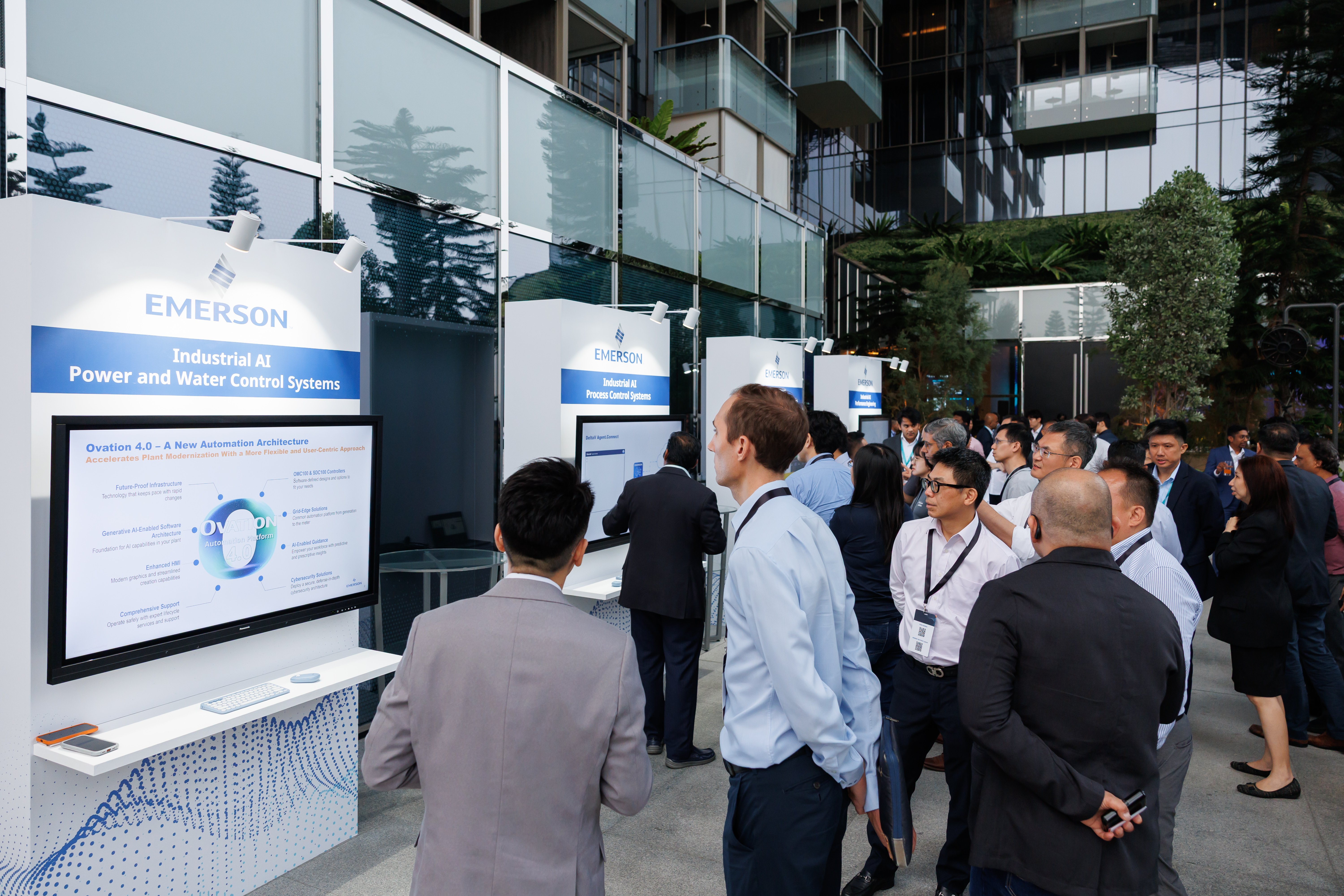
Returning to Peter Zornio’s point about being born digital, if foundational technology elements such as expanded sensing capabilities, lifecycle digital twins, and a comprehensive data fabric are in place, organizations can more easily leverage new AI-driven applications throughout the facility lifecycle.
Given this sentiment, it would not have escaped attention that Emerson has been investing significantly over the last few years to broaden and strengthen its technology offerings, notably with the acquisition of AspenTech. This adds a comprehensive software portfolio to the company’s solid measurement and control base, enabling customers to, for example, simulate processes, establish optimal operating points, and predict when a critical asset is likely to fail.
AspenTech also brought with it a data fabric, which is important because, as we hear at almost every automation industry event, AI is only as effective as the data it can access. Traditionally, industrial organizations maintain separate systems for control, maintenance, reliability, environmental performance, and operations, and integrating these silos is complex and costly. AspenTech Inmation addresses this challenge as a unified data fabric that provides common access, context, and governance across data sources. This enables the rapid development and deployment of new AI applications without repeatedly rebuilding data connections.
Internally, Emerson’s flagship DCS, DeltaV, is evolving from a process control system into a much broader and increasingly software-defined operating environment through which engineering models, operational and asset data, analytics, and AI capabilities converge. This creates a foundation for applications that can guide operators, optimize processes, and eventually support autonomous decision-making.
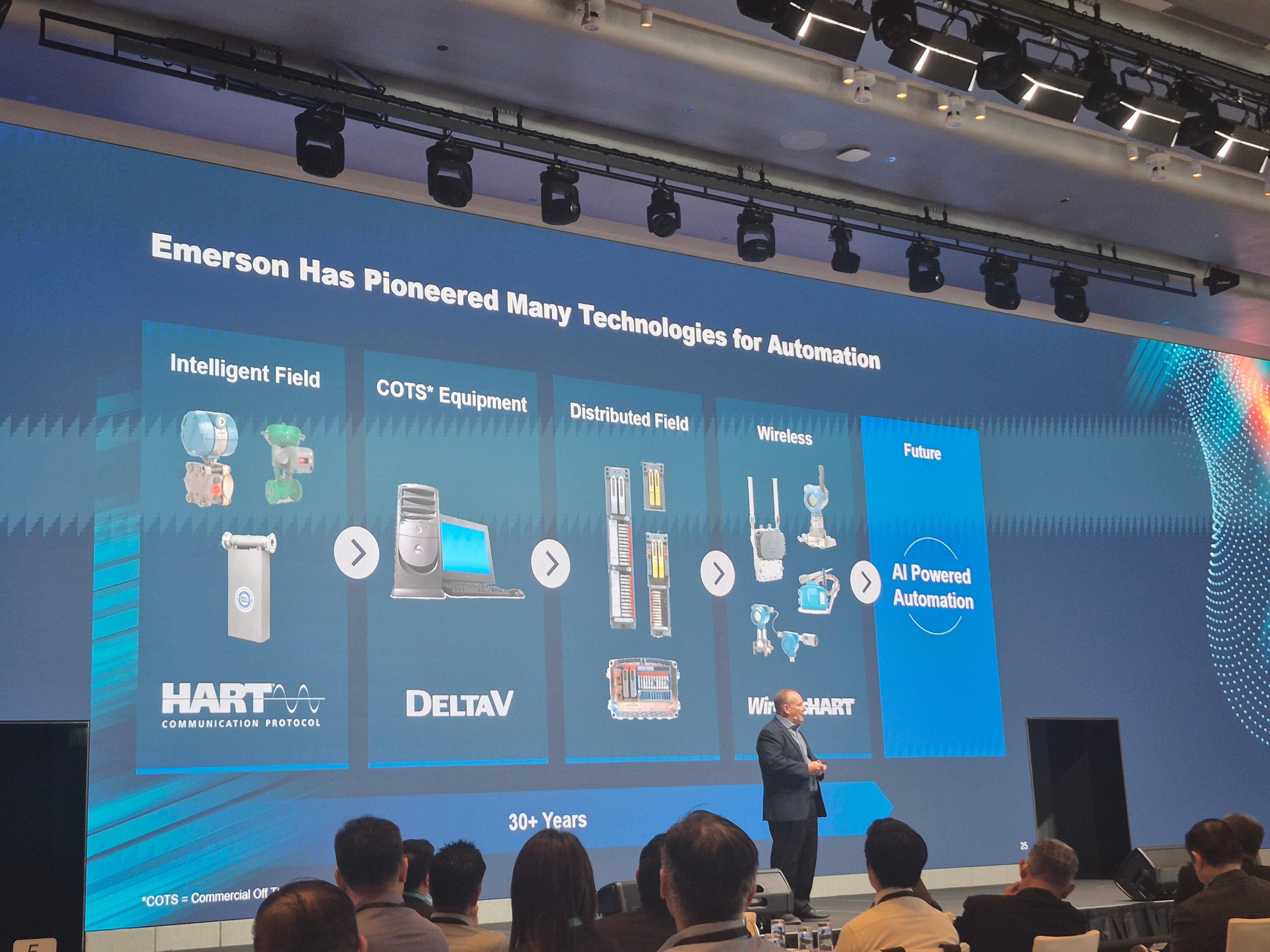
Artificial intelligence is not merely another technology trend, said Peter Zornio. Rather, when combined with a strong digital foundation, it has the potential to radically improve how facilities are designed, operated, modernized, and optimized.
For example, many facilities around the world continue to operate legacy control systems that can be several decades old. Historically, modernizing aging automation infrastructure and migrating from one control platform to another required skilled engineers to manually translate configurations, consuming thousands of engineering hours.
But as Zornio outlined, today’s AI-powered tools can automatically convert legacy configurations from older control systems into modern DeltaV configurations, accomplishing most of the work automatically. This significantly reduces both project effort and migration risk. Combined with technologies that preserve existing I/O infrastructure, modernization projects can now be executed far more efficiently than ever before and cause far less disruption to the process.
When it comes to operations and optimization, AspenTech brings important capabilities in process modeling and digital twin technologies. Emerson’s vision is for digital twins to evolve into lifecycle assets that remain active throughout plant operation, rather than be used only during plant design and then largely set aside after startup, as is more common practice.
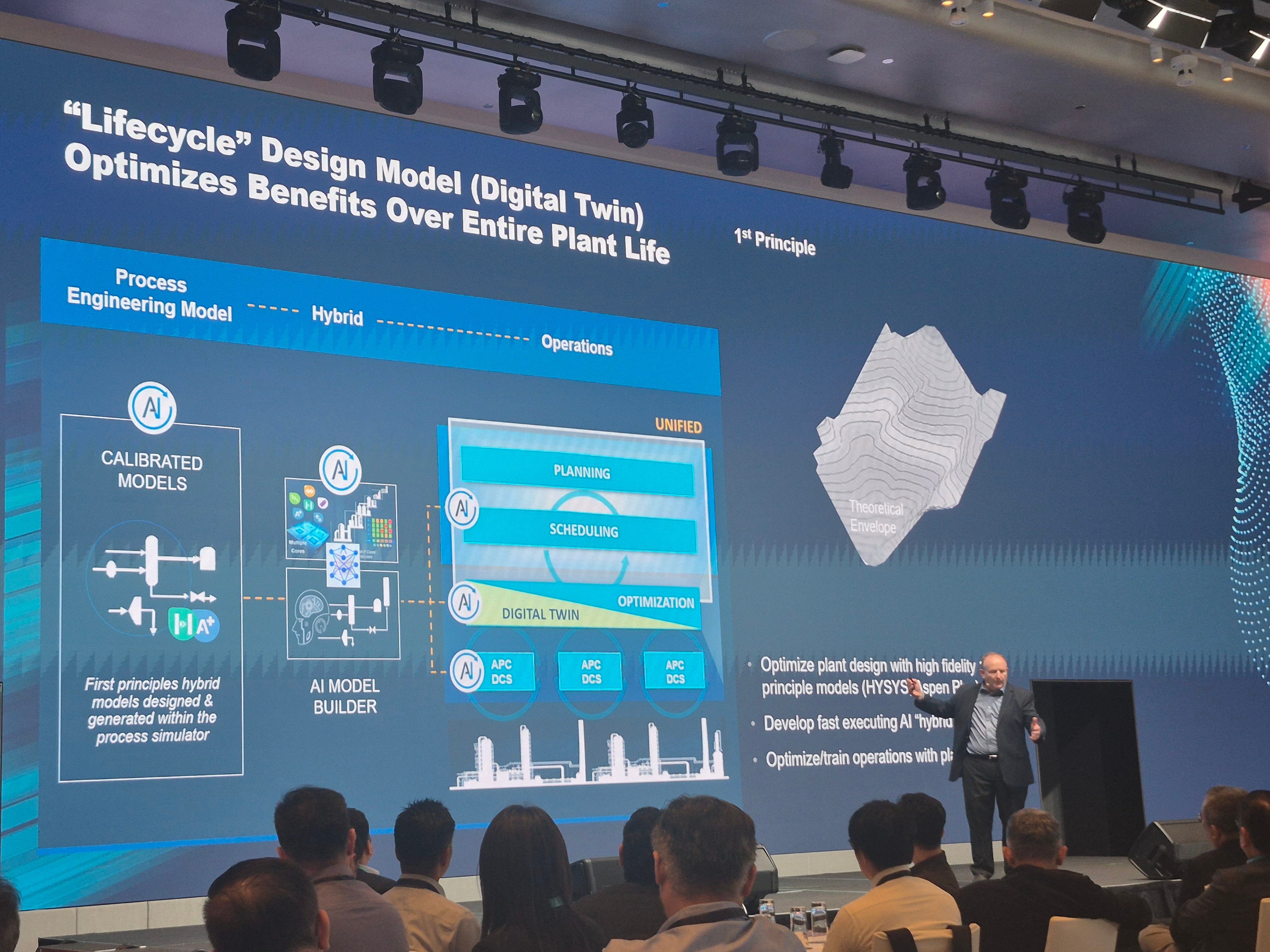
By combining first-principles models based on solid physics and engineering with AI and data-driven methods, digital twins can remain trustworthy while also producing more accurate predictions and faster simulations suitable for real-time use. They can thus support activities such as online optimization, real-time decision support, operator guidance, predictive analysis, and what-if scenario modeling.
Zornio emphasized that physics-based models, such as Aspen HYSYS, provide critical operating guardrails, helping ensure that AI-derived recommendations from resulting hybrid models avoid hallucinations and remain grounded in the realities of process behavior.
Another compelling use of artificial intelligence presented by Peter Zornio is that of an AI-powered operations advisor. By combining plant historians, operating procedures, maintenance records, engineering documentation, alarm data, and digital twins, these systems can serve as a continually expanding repository of operational knowledge and help companies meet the challenge of losing valuable expertise when experienced staff leave or retire.
For example, an operator facing a process excursion can interact with an AI advisor that understands not only general engineering principles but also the specific history and operating practices of that facility. The system could recommend corrective actions, identify likely root causes, guide troubleshooting, or assist during startup and shutdown events.
For Emerson Ovation DCS users in the power and water industries, the Ovation Virtual Advisor (OVA) was introduced in 2025 with the release of the Ovation 4.0 Automation Platform. Advisor agents for alarms, root cause, and control performance are among those already available, while agents for load balance, thermal efficiency, graphics, and other applications continue to be developed.
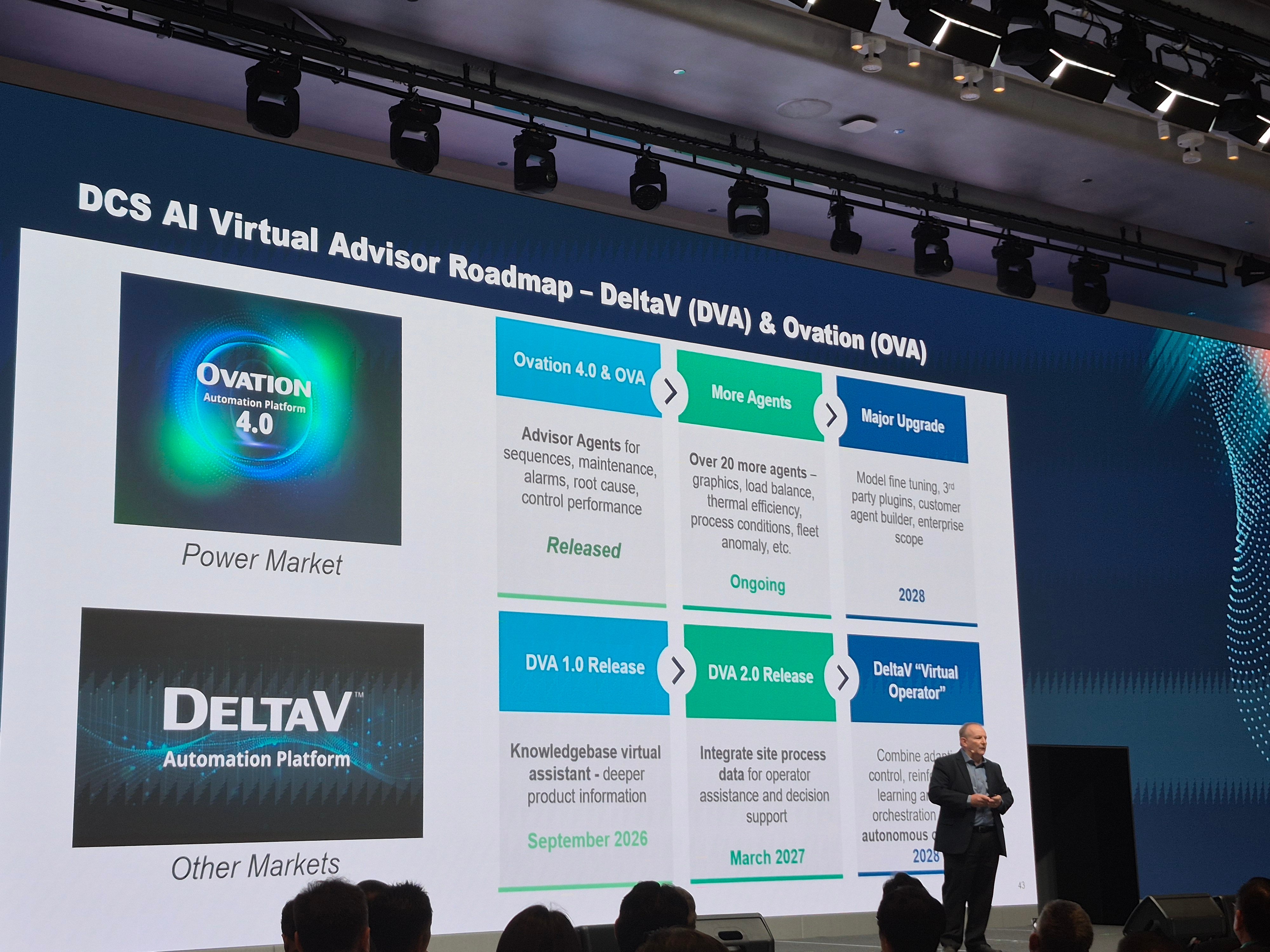
Meanwhile, for DeltaV users, the DeltaV Advisor (DVA) is set to launch in the fourth quarter of this year, with further enhancements planned for 2027. Embedding AI directly into the control systems layer, rather than as a standalone analytics tool, is a good example of how Emerson is evolving its automation solutions in the age of AI.
The concept of autonomous operations has become a major topic across the process industries. However, Zornio argued that the industry's greatest challenge is not automating steady-state operations, which are already highly efficient, but automating abnormal situations.
Equipment failures, changing feedstocks, weather events, and process upsets continue to require experienced human judgment. Future AI systems will increasingly assist operators by identifying, diagnosing, and responding to these events faster and more consistently than traditional approaches. “The challenge is automating the abnormal,” Zornio noted, describing it as the next frontier for industrial automation.
Looking ahead, Zornio described the journey toward autonomy as evolutionary rather than revolutionary. Manufacturers will progress through a series of maturity stages encompassing advanced process control, cybersecurity, alarm management, predictive maintenance, digital twins, enterprise optimization, AI advisors, and, ultimately, AI agents capable of coordinating plant-wide decisions.
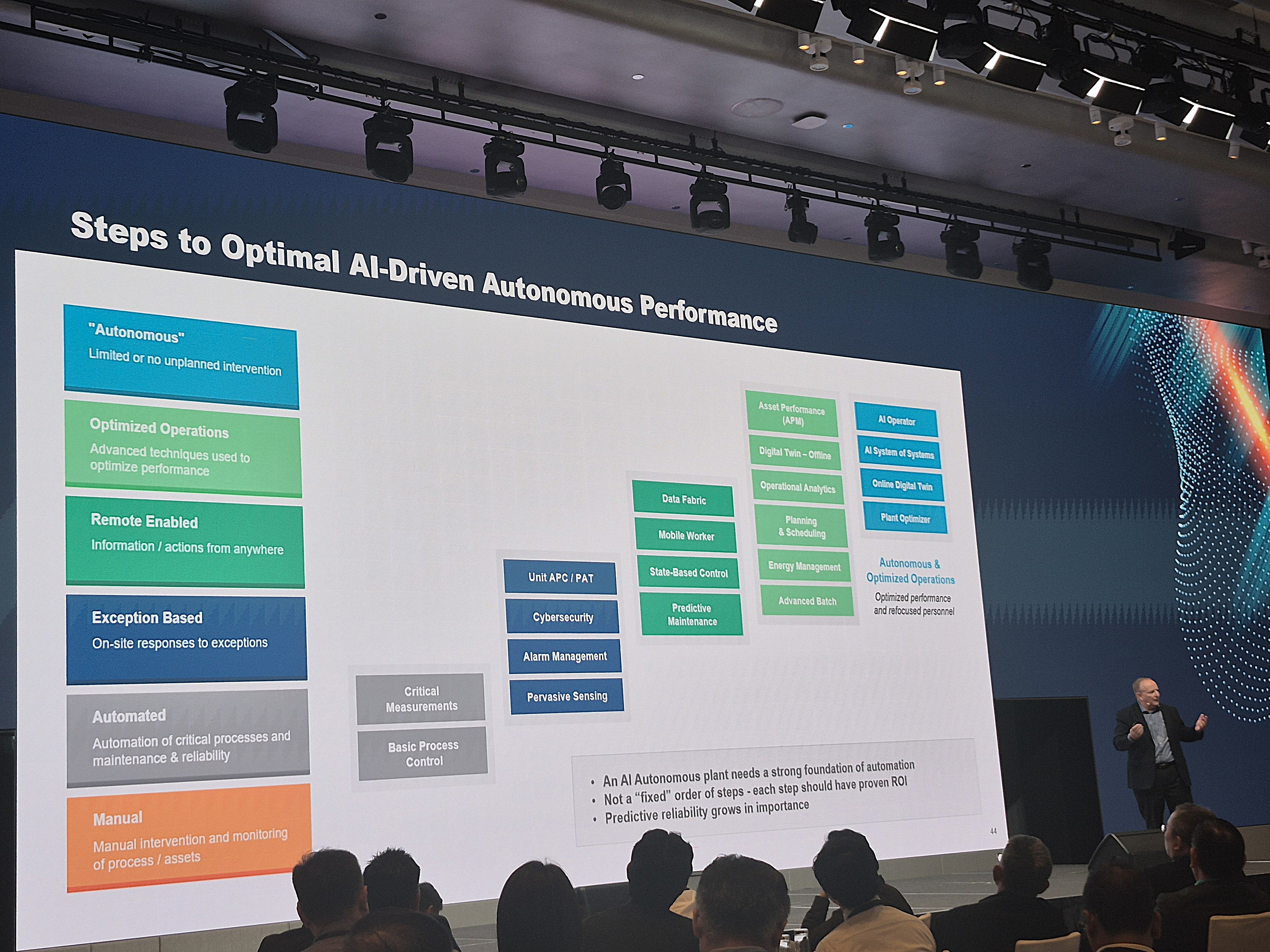
The objective is not necessarily operator-free facilities, but smarter operations where AI and human expertise work together to improve performance, reliability, sustainability, and workforce effectiveness. As the industry embraces AI, Peter Zornio emphasizes that human expertise will not disappear, but rather that organizations must deploy technology that allows AI and human operators to work together more effectively than ever before.
For Emerson customers, the future industrial enterprise will increasingly rely on software-defined automation, a contextualized data fabric, and AI-driven decision support, which will enable higher levels of operational autonomy and the next generation of industrial operations.