Representative End User Clients







Representative Automation Clients







Representative Software Clients









Refineries are applying AI and machine learning (ML) to move beyond traditional maintenance approaches and adopt more predictive, data-driven strategies. Advanced analytics, intelligent monitoring, digital twins, robotics, and engineering expertise can help improve asset performance while making maintenance activities safer, faster, and more efficient.
At the Manufacturing Innovation Conclave during ARC Advisory Group’s 24th India Forum in Bengaluru, held July 9–10, 2026, Arun Kumar, General Manager of Operational Excellence at HPCL-Mittal Energy Limited (HMEL), presented “Operational Excellence through AI/ML Solutions for Maintenance and Reliability.” He discussed how AI and ML can support predictive analytics, intelligent monitoring, and data-driven decision-making across complex refining operations.
Kumar’s presentation, “Operational Excellence through AI/ML Solutions for Maintenance and Reliability,” can be viewed on YouTube or here:
Turnarounds are among the most complex, resource-intensive, and time-sensitive activities in refinery operations. A typical refinery turnaround can require approximately 30–35 days, while petrochemical facilities may require 40–45 days.
The challenge extends beyond completing maintenance activities on schedule. Organizations must restore equipment reliably and prepare assets for several years of safe and efficient operation before the next turnaround cycle.
Business priorities therefore include reducing turnaround duration, improving equipment reliability, enhancing worker safety, increasing inspection accuracy, and controlling maintenance costs. Digital technologies can support these objectives by improving planning, increasing asset visibility, and enabling more informed decisions before and during shutdowns.
One of the most significant benefits of digital transformation is its potential to reduce equipment-overhaul and maintenance timelines. Traditionally, steam-turbine overhauls could require approximately 15–20 days. Through advanced measurement technologies, AI-enabled diagnostics, improved planning, and data-driven maintenance strategies, overhaul durations could potentially be reduced to approximately 10 days.
The improvement comes from earlier identification of equipment conditions, greater planning accuracy, better access to technical information, and reduced uncertainty during execution. The resulting benefits can include faster maintenance execution, improved scheduling, reduced equipment downtime, lower turnaround costs, and increased asset availability.
Industrial inspections have traditionally relied on scaffolding, manual measurements, and confined-space entry. These approaches can be time-consuming, resource-intensive, and potentially hazardous.
Drones and robotic inspection systems are changing this model. Advanced crawling robots and drones can inspect difficult-to-access areas, collect detailed equipment data, and reduce the need for personnel to work in hazardous environments.
Robotic inspection can enable comprehensive equipment scanning rather than limited spot inspections, reduce scaffolding requirements, minimize confined-space exposure, accelerate inspection cycles, and improve data consistency.
The result is a safer, faster, and more reliable inspection process that can contribute to asset integrity and shorter turnaround schedules.
Virtual assembly and digital equipment overhauls represent another important development in industrial maintenance. Using laser scanning and advanced 3D modeling, maintenance teams can digitally capture equipment dimensions within hours. These measurements can then be compared with replacement components and engineering models using digital twin technology.
This enables teams to verify component compatibility, identify machining requirements before installation, assess equipment condition more accurately, and reduce uncertainty during maintenance. As baseline measurements and digital models become available, subsequent maintenance cycles can become faster, more predictable, and better planned.
Digital twins provide virtual representations of physical assets, enabling organizations to monitor performance, simulate operating conditions, identify potential problems, and optimize maintenance strategies.
For reliability teams, digital twins can help answer critical questions: Which components require replacement? What equipment conditions need attention? How could a maintenance decision affect performance? Can proposed modifications be evaluated before implementation?
This capability supports the transition from reactive maintenance toward proactive and predictive asset management.
Although AI is often presented as the centerpiece of digital transformation, its effectiveness depends on strong foundational capabilities. Successful implementation requires clean and structured data, reliable instrumentation, connected assets, sensor infrastructure, asset management platforms, skilled personnel, and clearly defined maintenance processes.
Organizations should therefore avoid treating AI as the starting point. The transformation journey should begin with data quality, connectivity, asset visibility, and process discipline. Once these foundations are established, AI and ML can generate more reliable and actionable insights.
Asset Performance Management (APM) platforms provide an important foundation for modern reliability programs. They integrate maintenance information, reliability data, operational performance indicators, and equipment-health information into a centralized environment.
A mature APM framework enables organizations to develop consistent maintenance strategies, identify emerging equipment risks, and support predictive maintenance initiatives. When AI and ML solutions are deployed on reliable asset data, they become more effective at generating actionable recommendations and supporting maintenance decision-making.
Digital transformation typically progresses through multiple stages. The first is remote monitoring through wireless sensors and Industrial IoT technologies. Acoustic monitoring, for example, can identify leaking safety valves and provide real-time information about leakage behavior. Similarly, IoT-enabled steam-trap monitoring can identify passing, blocked, oversized, or undersized traps. Such systems help maintenance teams prioritize interventions while reducing energy losses and operational inefficiencies.
The next stage is predictive analytics. Once sufficient operational and historical data is available, AI and ML models can identify abnormal patterns, predict potential equipment failures, and highlight emerging risks before they result in unplanned shutdowns.
Predictive maintenance solutions are increasingly capable of identifying what may fail, when failure could occur, and how equipment behavior is changing. However, AI does not replace engineering expertise.
Machine-learning models depend on historical operating data, failure records, equipment context, and high-quality training datasets. Experienced reliability engineers and subject matter experts remain essential for validating predictions, interpreting operating conditions, assessing business risks, and determining appropriate corrective actions. The most successful organizations therefore combine digital intelligence with engineering judgment rather than relying exclusively on automated recommendations.
Digital technologies are creating a new model for turnaround execution through connected workflows and intelligent tools. AI-enabled safety monitoring, smart helmets, digital work packages, electronic procedures, drones, robotic inspections, digital scheduling platforms, and remote OEM collaboration can improve communication, visibility, and decision-making throughout the turnaround lifecycle.
Together, these technologies can contribute to shorter turnaround durations, improved reliability, enhanced process safety, greater inspection efficiency, stronger asset integrity management, and faster troubleshooting.
The refining and petrochemical industries are entering an era in which digital technologies are becoming central to operational excellence. AI, ML, digital twins, Industrial IoT, drones, robotics, and predictive analytics are enabling organizations to move from reactive maintenance toward proactive and increasingly predictive asset management.
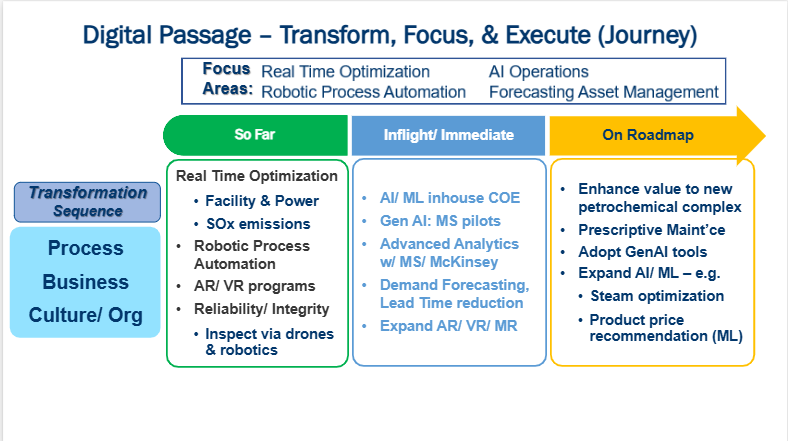
The organizations that gain the greatest advantage will be those that treat digital transformation not simply as a technology initiative, but as a long-term business and reliability strategy. By building strong data foundations, investing in workforce capabilities, integrating engineering expertise with digital intelligence, and focusing on measurable outcomes, refineries can improve asset reliability, reduce turnaround durations, enhance safety performance, and strengthen operational performance.