Representative End User Clients







Representative Automation Clients







Representative Software Clients








If my last post made it sound like CESMII’s i3X was the magical silver bullet that would instantly solve all our Agentic AI problems... I offer a tongue-in-cheek apology. There are no silver bullets in industrial automation.
While standardized APIs are critical, the truth is that navigating the physical complexities of a factory floor requires deep, hard-earned industrial domain expertise. My sincere hope is that the massive, board-level demand to scale Industrial AI will finally trigger the investment that the industrial software stack has been missing for the last two decades.
The industrial software stack is currently undergoing a profound architectural realignment. Following the widespread industry adoption of "Data Decoupling" strategies, the manufacturing sector has collided with a severe "Context Crisis." The industry has learned a difficult lesson: moving data across an enterprise network is fundamentally different from understanding its operational reality.
Almost immediately after publishing my piece on i3X, my inbox lit up with pushback from a very specific, highly advanced cohort of enterprise data architects. Their message was consistent and forceful:
"Colin, a bottom-up API that standardizes payload schemas is great for a single factory. But for a Fortune 500 enterprise, an API isn't enough. You need a Top-Down Context Layer."
This friction represents the next massive fault line in the Industrial Data Fabric (IDF) market. To navigate this clash between bottom-up APIs and top-down ontologies, we need to evaluate the architectural progression in terms of the "Good," the "Better," and the "Future Best."
When an autonomous AI agent attempts to ingest raw telemetry from a shop floor, it frequently encounters esoteric tag structures, inconsistent naming conventions, and a complete absence of relational logic.
Initiatives like CESMII’s i3X provide the "Good" baseline. They offer the necessary vocabulary, allowing developers to quickly standardize the data coming off a PLC and establish clear data contracts at the edge.
However, as Jonathan Wise (Chief Technology Architect at CESMII) candidly shared with me:
"i3X is a common API for brownfield-wrapping platforms. i3X is not itself a platform; it sits on top of a platform that does that heavy lifting..."
An API is just the window; Agentic AI still needs the house behind it. Foundational work by Unified Namespace (UNS) champions like Inductive Automation—powered heavily by their closeness with Cirrus Link's MQTT solutions—and Edge DataOps vendors like HighByte has successfully built the reliable data pipes, but now we must contextualize what flows through them.
This is where the platform heavy lifting comes in. In ARC Advisory Group's Q4 2025 Industrial AI Survey, a staggering 63 percent of respondents stated that decoupling data from monolithic software applications is critically important. In our research, we clearly gathered data showing that pacesetters are actively marginalizing their legacy, monolithic Manufacturing Execution Systems (MES), relegating them to a "System of Record" that simply feeds context into a broader assembled Industrial Data Fabric.
This decoupling has accelerated the rise of what many are calling the "Composable MES" or Manufacturing Data Hub. However, as my colleague Greg Gorbach correctly points out, clinging to the term "MES"—even a composable one—dangerously implies that a traditional execution system will still be the ultimate answer. It won't be.
Instead, we must view this tier as the Composable Context Hub. The true defining attributes of these modern, lightweight innovators (such as Rhize or frontline operations platforms like Tulip) are that they are inherently API-first, highly composable, and Agentic AI-ready. They don't force a manufacturer to rip out existing systems; they allow architects to assemble best-of-breed components and connect them to a unified, relational context engine. (It is worth noting that the market is aggressively validating this approach; Tulip recently achieved a $1.3B unicorn valuation following a massive $120M Series D investment led solely by Mitsubishi Electric.)
Acknowledging the enduring foundational value of the ISA-95 vocabulary, platforms like Rhize go far beyond basic MQTT folder structures. They take the entirety of the ISA-95 standard (Parts 1 through 4)—encompassing the complex, multi-directional relationships between Materials, Personnel, Equipment, and Process Segments—and enforce it as a strict schema within a highly scalable Knowledge Graph database.
For many traditional brownfield plants or continuous/bulk commodity manufacturers, this "Better" approach is actually the absolute best solution available today. It gives an AI more than just a JSON schema of a pump's temperature; it provides the full contextual ontology to know exactly which operator is running that pump, what specific batch of material is flowing through it, and what step of the work order is currently active. By enforcing this structure, these composable platforms feed a pristine semantic layer into the broader Data Fabric, allowing advanced industrial analytics leaders like Seeq and Twin Thread to finally apply advanced machine learning algorithms without spending months manually cleaning tag data.
While a robust Knowledge Graph based on ISA-95 is a brilliant realization of the Data Decoupling trend for today's factories, enterprise architects must also prepare for the "Future Best." The next horizon is defined by Software-Defined Automation (SDA), highly flexible manufacturing, and autonomous robotics.
As we move toward this future, we must recognize where our current legacy frameworks will eventually hit their limits:
The Rigidity of the Purdue Model: ISA-95 was conceived to cleanly separate Level 4 (Enterprise) from Level 3 (MES) down to Level 1 (Control). However, the introduction of Automated Mobile Robots (AMRs), collaborative robots (cobots), and 5G-connected tooling requires data to flow horizontally and diagonally across mesh networks.
Dynamic Routing Clashes: When an AMR dynamically recalculates a route across multiple factory zones to bypass a sudden obstruction, it operates entirely outside the predefined, sequential logic of a traditional MES.
The Collision with Software-Defined Automation (SDA): SDA represents the ultimate abstraction of control logic from proprietary PLC hardware into flexible, containerized IT software. It merges Level 1 (sensing), Level 2 (control), and Level 3 (contextualization) into a single, unified execution environment. If your entire enterprise ontology relies on strict, hard-coded definitions of "Level 2 telemetry" versus "Level 3 transactional data," that ontology will invariably fracture under the weight of an SDA deployment. We are seeing major control titans lead this charge: Schneider Electric (working seamlessly with AVEVA) is aggressively pushing open, decoupled hardware and software, while Siemens is rapidly accelerating the virtualization of control with its vPLC initiatives.
The Death of Physical Air Gaps: As Industrial IoT devices and edge nodes reach directly into cloud environments to access foundational AI models, physical "air gaps" vanish, requiring a pivot to modern logical cybersecurity standards like ISA/IEC 62443.
The industry is currently obsessed with Knowledge Graphs—and rightly so for standardizing spatial and semantic relationships (as seen in the Open Asset Digital Twin (OADT) initiatives driven by heavy process operators). But a topological graph is fundamentally blind to behavioral physics. If an AI agent identifies a sudden pressure drop in a pipeline via a graph, the graph alone cannot explain the physical causation. Research indicates that without physical grounding, AI agents can easily get stuck in infinite loops, recursively calling APIs without making meaningful progress.
To safely orchestrate autonomous Agentic AI, topological graphs must be augmented by rigorous mathematical and physical frameworks that look significantly beyond standard Physics-Informed Neural Networks (PINNs):
Chemistry and SciML: PINNs struggle significantly with the "stiffness" of industrial chemical reaction systems in which equations operate on vastly different time scales. The industry is embracing Scientific Machine Learning (SciML) and Universal Differential Equations (UDEs), where known physics strictly guides the mathematical architecture, and neural networks only learn the missing physical terms.
Causal AI for Root Cause: Traditional machine learning relies on statistical correlation. Causal AI utilizes Structural Causal Models (SCMs) and Directed Acyclic Graphs (DAGs) to map the true generative processes underlying a manufacturing operation.
NeuroSymbolic AI for Safety: For highly regulated industries, the "black box" of deep learning is fundamentally unacceptable. NeuroSymbolic AI fuses statistical pattern-matching with deterministic symbolic logic, forcing the output of a neural network through hard-coded logic constraints before any action is executed.
Finally, the industrial stack is moving beyond stationary sensing. To effectively orchestrate AMRs and dynamic workflows, standard logical Knowledge Graphs are insufficient. We must embrace Spatial Knowledge Graphs and pre-trained Geospatial AI (GeoAI) foundation models (such as those provided by Esri) to perform complex spatial reasoning and real-time route optimization.
But the true frontier is Embodied AI. To bridge the "Sim2Real" gap (Simulation-to-Reality), physical AI architectures must incorporate World Models, Large Behavior Models (LBMs) trained on physical movement to predict the next action, and Vision-Language-Action (VLA) models.
Look no further than Rockwell Automation's strategic obsession with autonomous routing and material handling. Fueled by its strategic acquisition of Clearpath Robotics / OTTO Motors, Rockwell is building a massive new factory of the future in New Berlin, Wisconsin, that will be heavily populated by AMR, AGV, and humanoid robotics seamlessly interacting with the human workforce.
The "Bottom-Up vs. Top-Down" debate is ultimately a false dichotomy. The true Pacesetters in 2026 are abandoning monolithic mentalities and adopting a synthesized, multi-layered approach to modern Industrial Architecture.
We are moving far beyond the practice of "Context Engineering." A completely new industrial architecture is emerging to support the next era of operations. Let's call it the Cyber-Physical Industrial Architecture (CPIA).
At ARC Advisory Group, our heritage and ongoing mission is analyze the entire industrial ecosystem—encompassing people, processes, and all technology. The CPIA is not just a software architecture; it is a holistic, composable, API-first framework designed to safely orchestrate autonomous, human-in-the-loop, and embodied AI operations across both decoupled software and physical hardware.
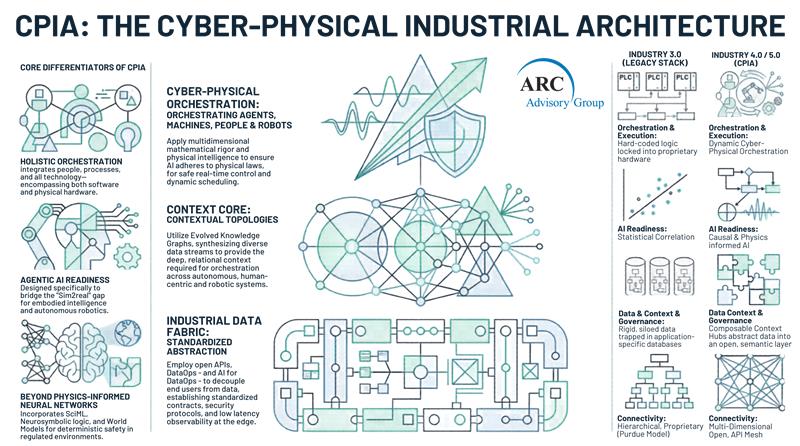
Moving beyond the rigid constraints of the Purdue Model, the CPIA is built on three synthesized pillars:
Industrial Data Fabric Foundation (Standardized Abstraction): Bottom-Up Agility via Standardized APIs and Edge DataOps. Initiatives like CESMII’s i3X and highly capable Edge DataOps platforms (such as HighByte and Litmus) are critical for establishing standardized data contracts directly at the edge, effectively decoupling hardware from the data layer.
Context Engineering Core (Contextual Topologies): Top-Down Relational Power via Evolved Knowledge Graphs. To feed autonomous systems the deep, cross-domain context they require, organizations must deploy graph databases. Modern implementations—whether through graph-native Composable Context Hubs like Rhize, or expansive enterprise digital twin fabrics like Cognite and SymphonyAI—must support dynamic routing, spatial reasoning, and the fluid integration of IT, OT, and engineering data.
Cyber-Physical Orchestration (and Cyber-Physical Execution): Behavioral Constraints via Multidimensional Mathematical Rigor. Ultimately, the safety, efficacy, and economic viability of autonomous industrial systems depend entirely on their strict adherence to physical and logical laws. AI architectures must transcend standard deep learning and integrate SciML, UDEs, Causal AI, NeuroSymbolic logic, and Large Behavior Models to orchestrate physical reality safely.
The (industrial software) future does not belong to the vendor with the purest adherence to a thirty-year-old integration standard, nor does it belong to the platform with the most sophisticated generalized chatbot. It belongs to those assembling a hybrid Cyber-Physical Industrial Architecture (CPIA) that can seamlessly weave together standardized edge data, fluid semantic relationships, and immutable physical laws at the speed of modern automation, robotics, and AI.
Navigating this architectural realignment is incredibly complex, and the immediate challenges you face depend entirely on where you sit within the organization:
For OT Leaders: Are you struggling to choose between a "Bottom-Up" Edge DataOps approach and a "Top-Down" Composable Context Hub to manage your factory floor context?
For IT Architects: How are you ensuring seamless interoperability between your enterprise backbone (like SAP) and these new, highly contextualized manufacturing data hubs?
For Data Science Teams: Are you able to seamlessly pipe this multidimensional, physics-based OT data into your Databricks, Snowflake, or Hyperscaler (AWS, Microsoft) environments to train your Agentic AI models without losing the critical operational context?
Whatever your specific challenge, you aren't alone. Reach out to me or the team at ARC Advisory Group to discuss how to assemble the right Industrial Data Fabric and Cyber-Physical Industrial Architecture to support your next generation of Industrial AI.
For ARC Advisory Group recommendations for Navigating the AI Wars—including the Industrial Robot Wars—Closing the Digital Divide by Embracing Industrial AI, assembling your Industrial-Grade Data Fabric, and governing and guiding major people, processes, and technology decisions about enterprise, cloud, industrial edge, and AI, please contact Colin Masson at [email protected].
Or set up a meeting with my fellow Analysts and I, at ARC Advisory Group to find out more about our Executive Insights Service for Industrial organizations, and Industrial AI Insights Service for Vendors.