Representative End User Clients







Representative Automation Clients







Representative Software Clients








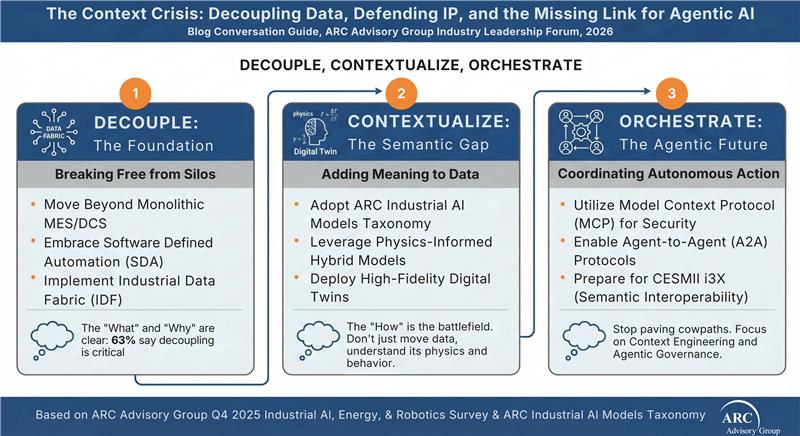
If you were with us on Thursday morning at the ARC Industry Leadership Forum in Orlando, you know the coffee was strong, but the debates were even stronger. As my colleagues and I sat down with our morning audience to unpack the final cuts of our Q4 2025 Industrial AI, Energy, and Robotics Survey, we kept circling back to one unavoidable, highly charged topic: Data Decoupling. Across our aggregate data, a massive 63 percent of respondents consider decoupling data from software to be critically important.
As my colleagues Craig Resnick and Mike Guilfoyle rightly pointed out during our discussions, our entire analyst team is in furious agreement on the big picture. We all know the old Purdue Model-style data silos have to go. We universally agree that we must decouple data from proprietary software (the what) in order to achieve true interoperability and scale Agentic AI (the why).
The debate was not about the destination. It was entirely about the how.
And that is exactly where I found myself playing the devil’s advocate. While many of my ARC Advisory Group colleagues are deep in the trenches championing vital, consensus-driven open architecture initiatives to break the grip of vendor lock-in, I posed a different, perhaps more provocative question to the audience:
In our drive to integrate IT and OT, are we mistakenly assuming that rigid, top-down open architectural standards are the only path forward? By aggressively forcing hardware and software commoditization to achieve this "openness," do we risk starving the very vendor R&D engines required to build the autonomous future? Or is there a smarter way to achieve true interoperability through Software Defined Automation (SDA) and higher-level abstraction, rather than ripping and replacing our physical infrastructure?
Over my 40-year career in the industrial technology sector, I have sat on both sides of this table, and I understand this friction intimately. In my past lives as a CIO and a Business Decision Maker (BDM) at industrial organizations, I fought tooth and nail for open systems. I wanted the agility to swap out a failing component without ripping out the entire nervous system of my plant.
But in my other past lives, playing various leadership roles up to CTO at industrial software vendors, I viewed the world through a different lens. Building reliable, mission-critical industrial technology requires staggering investments in R&D. By driving the market toward hardware commoditization and homogenized software stacks, rigid consensus standards threaten to erode vendor profit margins. If vendors fall into a "commodity trap" that penalizes groundbreaking engineering, we stifle the exact technological leaps the industry desperately needs to fuel the Industrial AI (R)Evolution.
Instead, the true Pacesetters are bypassing the hardware debate entirely. By embracing Software Defined Automation (SDA)—a shift my colleague Craig Resnick recently detailed in his exploration of open, software-centric control systems—they are abstracting control logic away from rigid, proprietary PLCs and moving it into flexible, IT-friendly software containers. They get the open, interoperable agility they crave without destroying the vendor ecosystem.
There is another, perhaps more controversial, argument against blindly dumping all your data into a massive, open data lake. Let’s address the elephant in the room regarding certain heavily funded, monolithic analytics platforms currently dominating headlines. There is a deeply polarizing, "love them or hate them" mentality surrounding these black-box aggregators.
Without getting too Orwellian, skeptics rightly point out a massive risk: when you hand over your raw operational data to a third party, you surrender data sovereignty. Are they truly respecting your IP? Is your proprietary process data secretly training a generic model for your competitors? Is it being aggregated for unknown, secondary purposes? Open systems are great for interoperability, but providing direct, unrestrained access to the core chemistry and physics of your enterprise is a profound business risk.
We need the benefits of decoupled data, but we need it in a way that allows us to maintain absolute control over access—the ability to toggle visibility on and off instantly, without ever handing over the keys to the underlying database.
This is why the emerging abstraction layers are so fascinating. In a recent series of articles, I explored the massive implications of the Model Context Protocol (MCP) and Agent-to-Agent (A2A) communications. Conceptually, MCP acts as a "Universal Translator" between AI models and industrial systems. But more importantly, it acts as a secure valve.
By utilizing an MCP Server, an industrial organization (or a proprietary vendor) can expose specific tools and telemetry to an AI agent without exposing their underlying source code or handing over the raw database. You grant the AI agent the specific context it needs to answer a prompt or execute a task, and nothing more. The data owner retains ultimate custody and can revoke access at any time.
Why are the hyperscalers throwing their massive weight behind this open standard? Look at their financials. The hyperscalers have poured hundreds of billions of dollars into AI infrastructure pre-investments. To recoup that CAPEX, they desperately need to scale inference workloads. However, industrial companies have been rightly terrified to upload their "crown jewels" (OT data) to the cloud due to the exact IP and sovereignty concerns mentioned above. By aggressively backing MCP, the hyperscalers are solving the trust deficit, providing a standardized, secure valve that protects customer data and IP from abuse.
But let’s be clear: while MCP is a brilliant, secure valve, it does not automatically organize the water flowing through it.
The industry has made massive strides in democratizing OT data. Architectures like the Unified Namespace (UNS) have been phenomenal tools for breaking down point-to-point spaghetti integrations, acting as a highly efficient, centralized event broker. But moving data is not the same as understanding it.
As we attempt to modernize the Industrial AI stack for Agentic AI at scale, we are realizing that a highly efficient data broker is not quite enough. A temperature tag streaming across your infrastructure still lacks deep, universally understood semantic meaning. To an autonomous AI agent, without standardized context, it is just a random number.
This brings us to the "C" in MCP: Context. In the enterprise IT world, context is increasingly provided by Retrieval-Augmented Generation (RAG) architectures utilizing Vector Databases and Knowledge Graphs. These are fantastic tools for preserving IP—you can vectorize your standard operating procedures, completely shielding your broader intellectual property from the foundation model.
But in the industrial world, a static Knowledge Graph is simply not enough. Our latest ARC research shows that digital twins will be more important than ever in the AI era because they represent the ultimate construct for providing industrial context. While a knowledge graph connects concepts, a digital twin adds critical layers of operational, temporal, and behavioral context that go far beyond what a database typically represents. A temperature reading of "450 degrees" is meaningless without the temporal context of the heat-up cycle and the behavioral physics of the specific furnace it came from.
This brings us to a looming question about scale. Can we really expect these nascent agentic protocols to handle the massive, physics-based complexity of these highly contextual digital twins?
To find out, we need to look at the heart of the factory floor. When we designed the Q4 2025 survey, we deliberately included specific questions about the future of the manufacturing execution system (MES). My goal was not to reignite the tired "MES is dead versus Long Live MES" debate. Rather, I view MES as the ultimate litmus test. It is the perfect indicator of whether data decoupling and Agentic AI modernization are actually penetrating the rigorous, risk-averse Operational Technology (OT) domain, or if they are just IT science projects.
When we look at the vertical cuts from the survey, the approach to MES—whether to keep it as a monolithic system of record or decouple its data into an Industrial Data Fabric to feed composable Agentic AI workflows and digital twins—reveals the unique "personality" and risk tolerance of each industry. Let's look at what the verticals are doing:
Pharmaceuticals (Pharma): Leading the charge, 42 percent are presently implementing digital twins. They are intensely focused on decoupling (56 percent consider it critical) and actively prioritize the IDF Foundation layer to build "Sim-to-Real" twins spanning localized cleanrooms and regulated global supply chains.
Industrial Equipment/Machinery (IEM): Close behind, with 38 percent presently implementing digital twins. They demand decoupled data at the highest rate (80 percent). They are shifting to a "Machine-as-a-Service" model, using digital replicas of the equipment they sell to offer remote optimization directly to their customers.
Automotive: The "Conservative Standardizer" is actively resisting the decoupling of MES (31 percent want to keep it central). Ripping out a legacy MES creates unacceptable downtime risk. Their 20 percent interest in the Metaverse is strictly for pragmatic, mature use cases like plant layout simulation.
Chemicals: Trailing the group, with only 22 percent having implemented digital twins. Dealing with complex continuous processes and massive legacy DCS technical debt, 58 percent are actively implementing an IDF first, laying the decoupled groundwork today for heavy, physics-based optimization twins tomorrow.
Energy: Currently, 26 percent are implementing digital twins, but a massive 67 percent consider data decoupling critical. They are targeting continuous asset twins to drive autonomous yield operations where AI agents directly adjust setpoints to manage grid volatility.
To synthesize these complex behavioral twins with AI, we need the expertise of a "Context Engineer"—a critical role entirely distinct from the generic "Prompt Engineer" you see in the IT world. As I shared in a sneak peek during our Thursday morning session, this is exactly why we developed the ARC Advisory Group Industrial AI Models Taxonomy. It provides a 3-dimensional framework for assessing the maturity and applicability of AI solutions:
Axis 1: Application Domain (The "What"): Are we optimizing Supply Chain & Logistics, or managing Operations & Process Control?
Axis 2: AI Model Class (The "How"): We are tracking a crucial shift away from basic machine learning and generative text. The future belongs to Physics-Informed and Hybrid Models.
Axis 3: Domain Specificity & Governance (The "Context"): The true Pacesetters are graduating to "Level 3" (Domain-Specific) models and "Level 4" (Regulated/Certified) models built for safety-critical frameworks like SIL or 21 CFR Part 11.
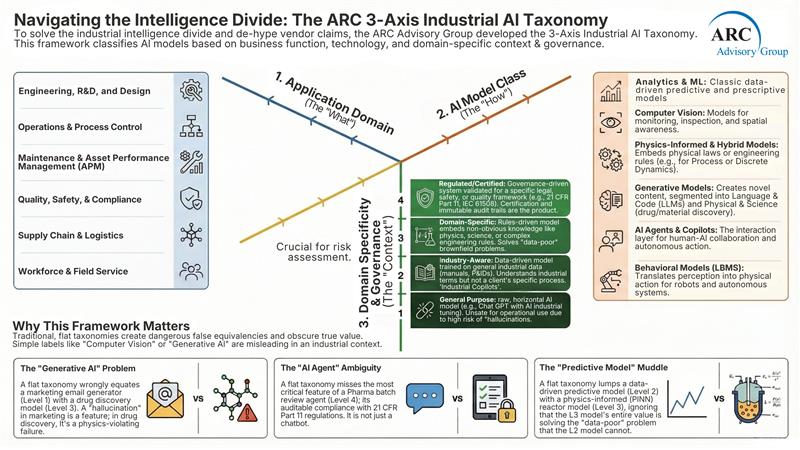
Notice how Axis 2 and Axis 3 perfectly address the digital twin dilemma. You cannot have a highly contextual, behavioral digital twin powered by an AI that does not understand physics. By embedding massive amounts of engineering context—the actual physical, chemical, and thermodynamic equations—directly into the mathematical architecture of the AI, these Hybrid models are physically constrained. They cannot hallucinate a recommendation that violates the laws of thermodynamics because the math simply will not allow it.
This is the ultimate evolution of context. Instead of just competing on unstructured data to build a generic "Data Moat," industrial vendors are leveraging these Physics-Informed Hybrid models to build highly defensible "Domain Moats."
So, to return to the question I posed to our Thursday morning audience at the ARC Advisory Group Forum:
"In our drive to integrate IT and OT, are we mistakenly assuming that rigid, top-down open architectural standards are the only path forward? By aggressively forcing hardware and software commoditization to achieve this 'openness,' do we risk starving the very vendor R&D engines required to build the autonomous future? Or is there a smarter way to achieve true interoperability through Software Defined Automation (SDA) and higher-level abstraction, rather than ripping and replacing our physical infrastructure?"
I realize I might be in the minority here. But to borrow a lesson from the past: if you're old enough to remember the previous wave of Business Process Reengineering, you might remember Michael Hammer's book Reengineering the Corporation. His warning is still incredibly relevant today:
"We need to stop paving the cowpaths and focus on the work that truly creates value."
Forcing a universal, monolithic data model on every vendor feels exactly like paving the cowpaths of Industry 3.0.
The real challenge of the 2026 horizon is Context Engineering and Agentic Governance.
We can achieve the interoperability and data fluidity that open architectures promised. But we can do it smarter, faster, and more securely by leaning into abstraction—decoupling the control layer via Software Defined Automation (SDA), leveraging MCP and A2A protocols for intelligence, and assembling an Industrial Data Fabric from best-of-breed components.
But how do we bridge the semantic gap? How do we standardize the exchange of this deep, physics-based context across disparate IT, OT, and Data Science systems without suffocating vendor innovation?
That is the exact challenge being tackled by CESMII's Industrial Information Interoperability Exchange (i3X). In a subsequent post, I will be providing a critical analysis of i3X and why it may be the missing semantic standard required to truly modernize the Industrial AI stack for Agentic scale.
For ARC Advisory Group recommendations for Navigating the AI Wars—including the Industrial Robot Wars—Closing the Digital Divide by Embracing Industrial AI, assembling your Industrial-Grade Data Fabric, and governing and guiding major people, processes, and technology decisions about enterprise, cloud, industrial edge, and AI, please contact Colin Masson at [email protected].
Or set up a meeting with my fellow Analysts and I, at ARC Advisory Group to find out more about our Executive Insights Service for Industrial organizations, and Industrial AI Insights Service for Vendors.