Representative End User Clients







Representative Automation Clients







Representative Software Clients








Across the first three installments of this five-part series, our investigation focused primarily on technology, code, and systems architecture. In Blog 1, we challenged the vendor marketing myth of "AI Native" perfection and established the pragmatic imperative of wrapping proven legacy IP into deterministic Skills. In Blog 2, we deconstructed the four-tier hybrid enterprise topology and revealed why external software scaffolding dominates foundation model weights. And in Blog 3, we examined the buyer's tri-domain dilemma across Supply Chain, Factory Floor OT, and Enterprise Core ledgers, exposed the danger of cross-domain algorithmic collisions, and illustrated why the industrial sector has moved beyond closed data platforms toward open, decoupled Industrial Data Fabrics and the Cyber-Physical Industrial Architecture (CPIA).
Yet behind every architectural diagram, solver script, and PLC control loop sits the ultimate enterprise variable: human expertise.
For the last three years, corporate PR departments and software vendor keynotes have operated under a carefully sanitized public narrative:
"Artificial Intelligence is strictly about human augmentation. We are not replacing our valued workforce; we are giving them digital superpowers!"
While augmentation remains a noble and highly productive path for skilled engineers—and one I advocate for passionately in my research—it is time to step out of the PR lounge and enter the executive boardroom.
Industrial CFOs and COOs are actively running the numbers on labor substitution.
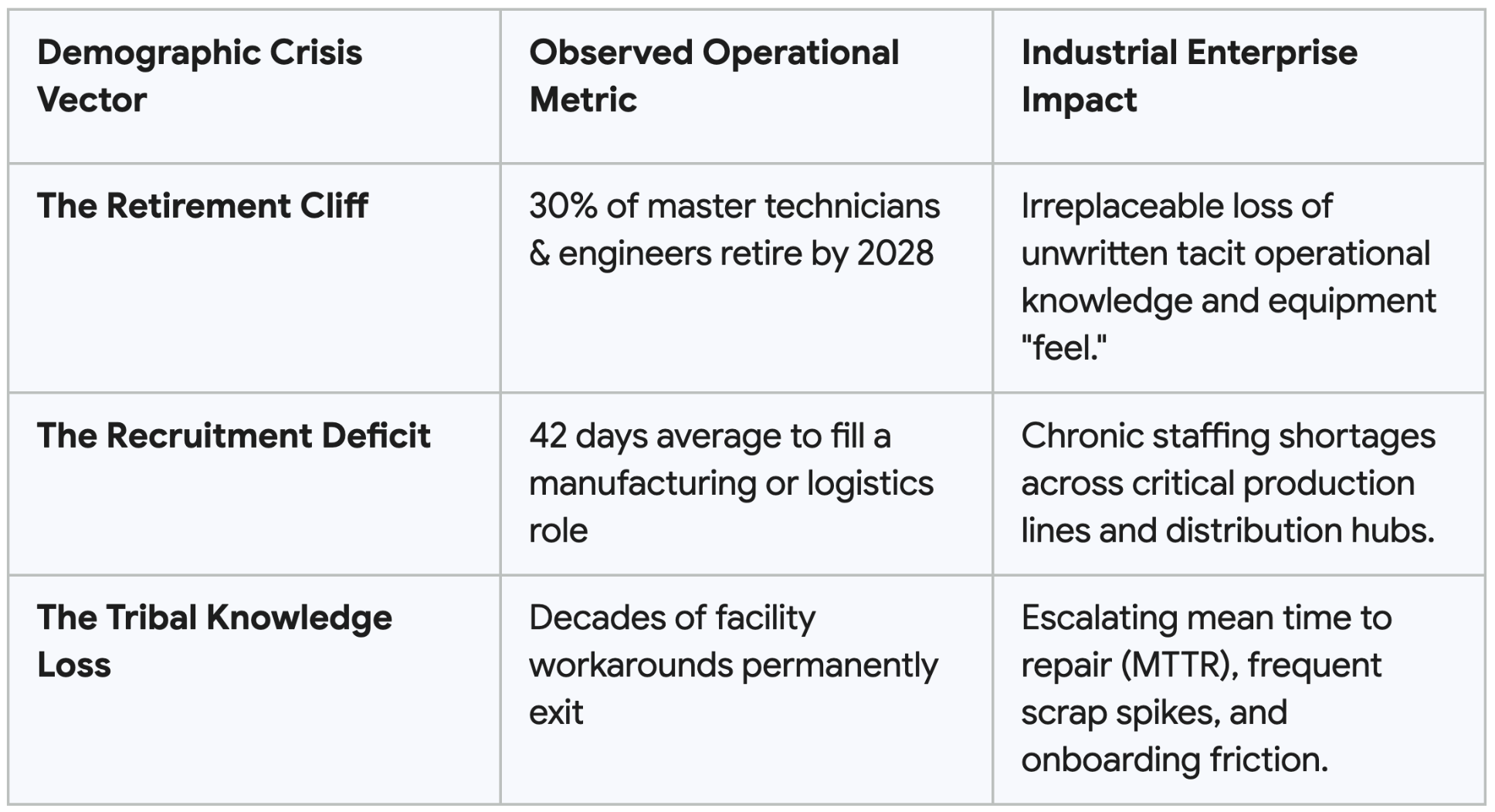
When an industrial executive audits their operations, they are not adopting AI as an experimental luxury. They are adopting AI because they physically cannot recruit enough human labor to maintain operational continuity.
However, corporate leadership must confront a profound macroeconomic paradox illuminated by recent labor economics and corporate earnings data:
Zero Aggregate Displacement: Across the broader industrial macroeconomy, AI adoption has produced virtually zero aggregate unemployment or net payroll drag.
The Junior Hiring Freeze: The actual divergence is microeconomic and generational: hiring has slowed dramatically for early-career workers under 30, with entry-level engineering wage growth stalling, while corporate demand for senior, veteran craftsmen remains at record highs.
This reveals a severe operational trap for industrial manufacturers. If enterprises deploy agentic AI to eliminate entry-level engineering and technician positions, they sever the apprenticeship pipeline that creates future master engineers and plant managers. Automating entry-level roles without structured human mentorship does not solve the skills shortage; it hollows out your future technical bench while exposing current operations to unvetted digital actors whose failure modes remain poorly understood.
If the sudden explosion of autonomous micro-agents feels familiar to those of us who have lived through a few software architectural revolutions, it should. We have fought this coordination battle before.
Three decades ago, during the Object-Oriented Programming (OOP) revolution, the enterprise software industry was gripped by the same fever:
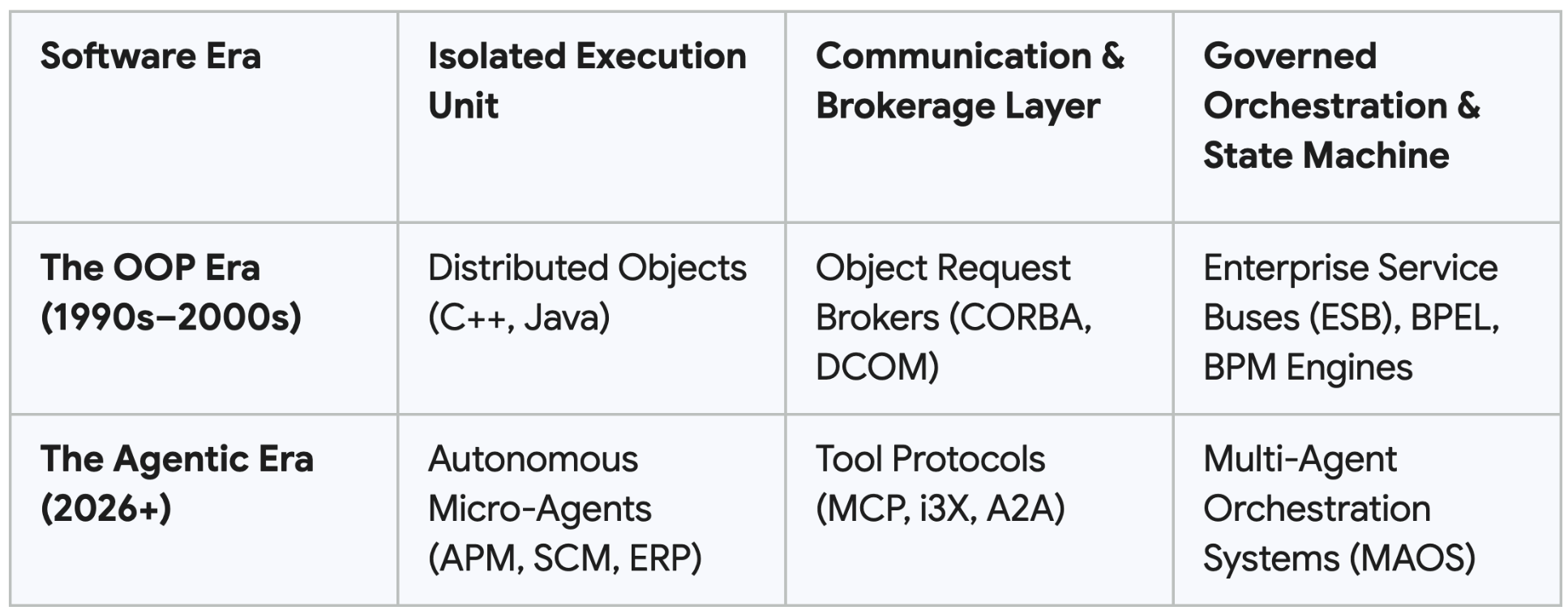
The Object Broker Phase (ORBs): In the 1990s, developers created thousands of isolated software objects, only to realize they could not locate each other or negotiate transactions. The industry responded by building Object Request Brokers—CORBA and Microsoft's DCOM—to allow distributed objects to exchange typed messages.
The Business Process Management (BPM) Phase: Once objects could communicate, enterprises realized that point-to-point chatting created unmanageable spaghetti architecture. We built Enterprise Service Buses (ESBs), BPEL state engines, and BPM orchestrators to enforce deterministic transaction rollbacks, sequence steps, and govern business rules.
Today, the agentic AI landscape is reliving that exact adolescent growth spurt.
Vendors are currently shipping thousands of isolated micro-agents across ERP, MES, and WMS. Emerging protocols represent our modern "Object Broker Phase"—the necessary telephone wires. But protocols alone do not govern business logic. To prevent multi-agent deadlocks and unstable control loop oscillations, the industrial sector urgently requires Multi-Agent Orchestration Systems (MAOS) that act as deterministic process governors.
Following Dreamforce and the race across SAP Joule, Salesforce Agentforce, and automation suites to deploy autonomous digital agents, enterprise operations face an immediate dilemma: The Arbitration Vacuum. When multiple vendor agents issue conflicting setpoints to the exact same piece of physical equipment, who decides whose priority wins?
Naive architectures attempt to solve this by placing another probabilistic "Supervisor LLM" on top to referee the debate conversationally. In mission-critical OT, using a probabilistic LLM to arbitrate other probabilistic LLMs guarantees compounded hallucinations, non-deterministic drift, and runaway token spend.
As proven by architectures pairing AWS Step Functions with Bedrock AgentCore, the meta-orchestration plane must be a hard-coded deterministic state machine executing hardcoded priority matrices, physical safety envelopes, and timeout clocks: Agents propose, and deterministic code validates.
In classical organizational theory, Henry Mintzberg defined legacy manufacturing as the Programmed Machine (Bureaucracy). This organizational structure relies on the standardization of work routines as its primary coordinating mechanism. It requires a massive human operating core to perform manual tasks, a middle-management layer to administer execution, and an analytical "technostructure" to design workflows.
Agentic AI and Physical Intelligence fundamentally disassemble the Programmed Machine.
INSEAD Professor Phanish Puranam conceptualizes the organizational model emerging from this disruption as the Headless Firm. In a Headless Enterprise, routine administrative, scheduling, procurement, and data-translation tasks are abstracted away by autonomous software agents. The organization transforms into an hourglass topology:
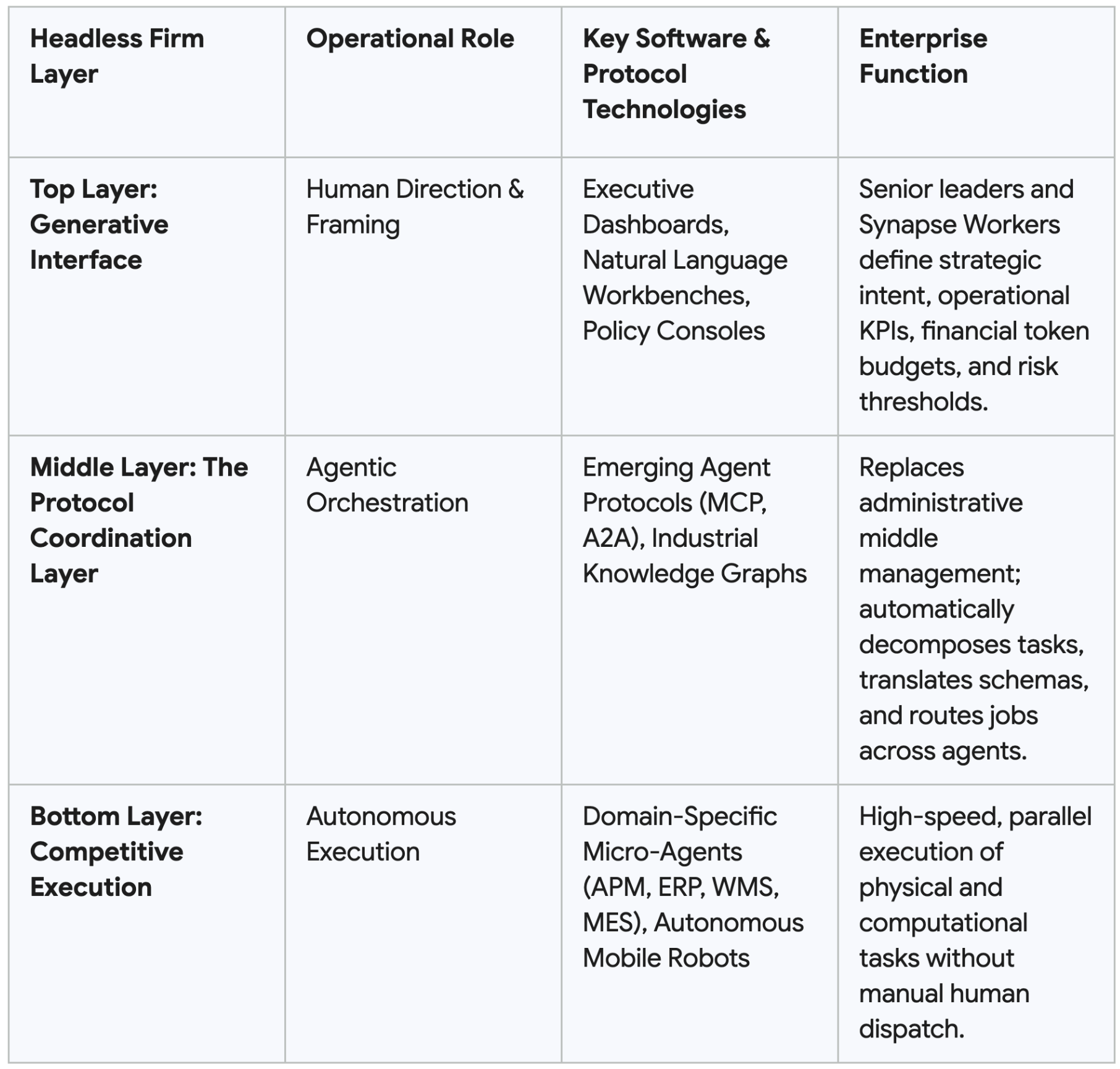
In this architecture, middle management's traditional administrative role—routing emails, manually consolidating spreadsheets, and scheduling shift handovers—collapses into the Protocol Coordination Layer.
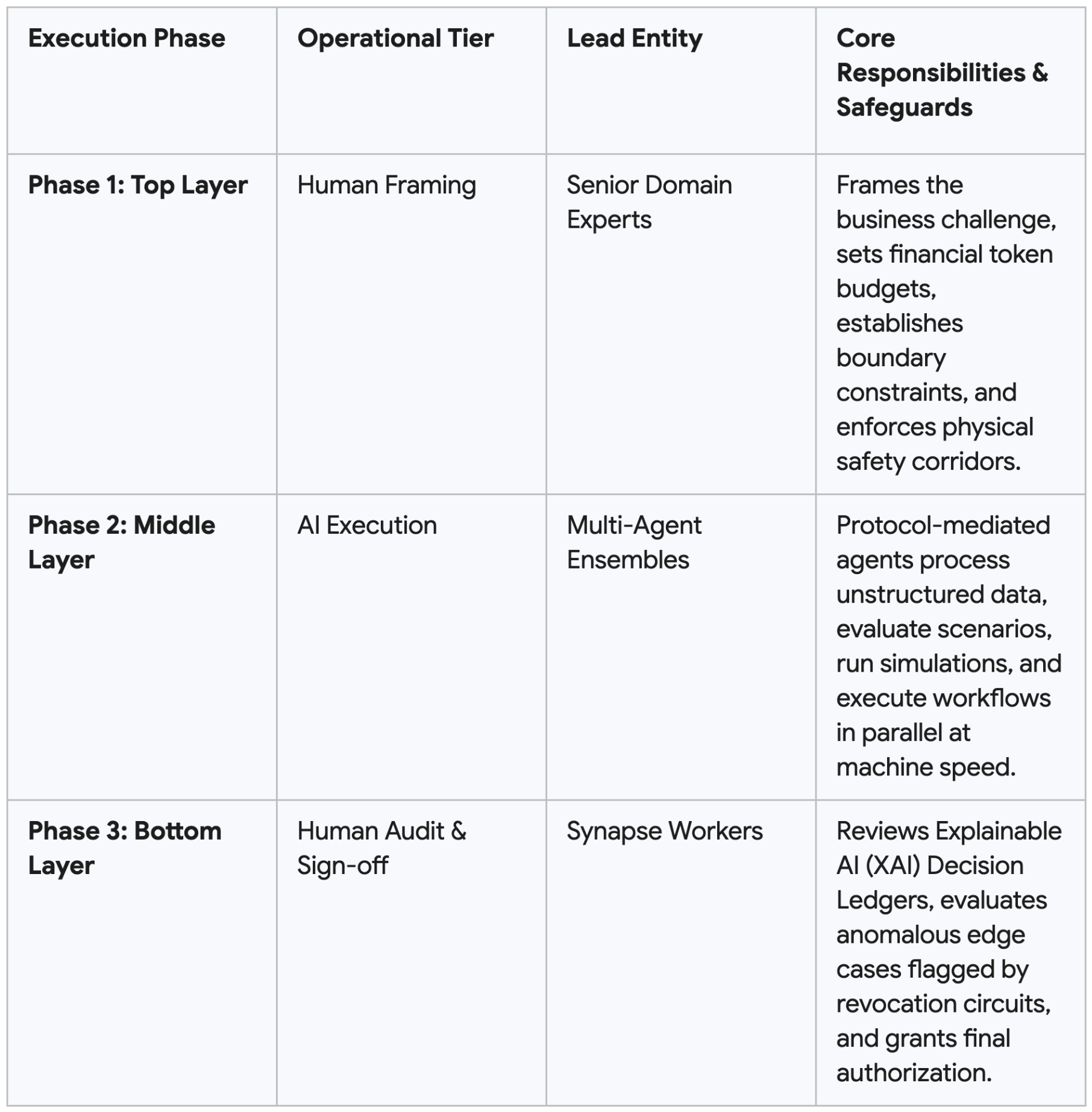
To prevent the Headless Enterprise from devolving into operational chaos, hallucinations, and what Deloitte terms "workslop" (layering AI onto broken, ungoverned human processes), pacesetting organizations enforce the Human-AI Sandwich Pattern:
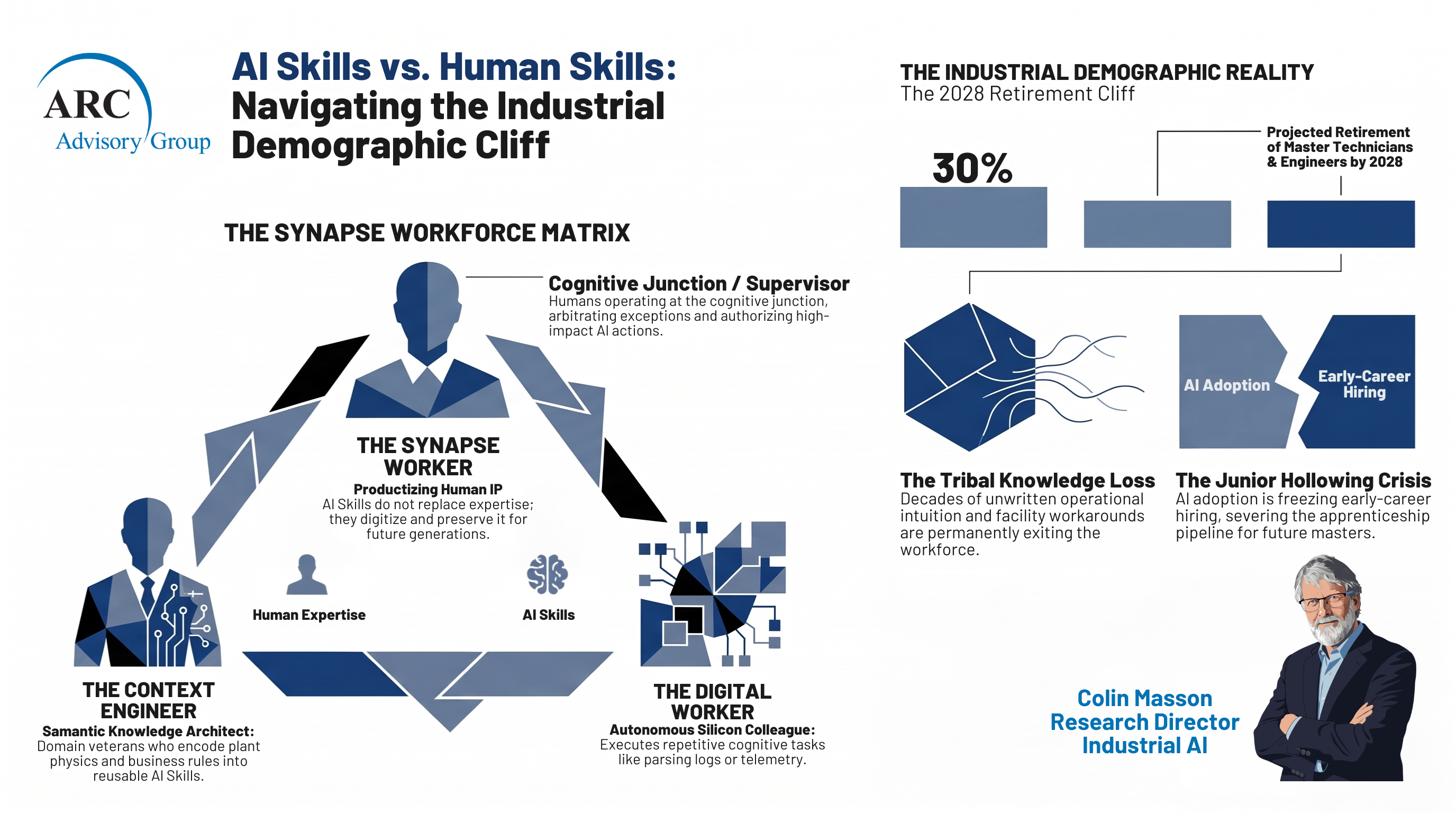
This structural evolution redefines human capital across the entire industrial enterprise, transitioning workers across four distinct archetypes:
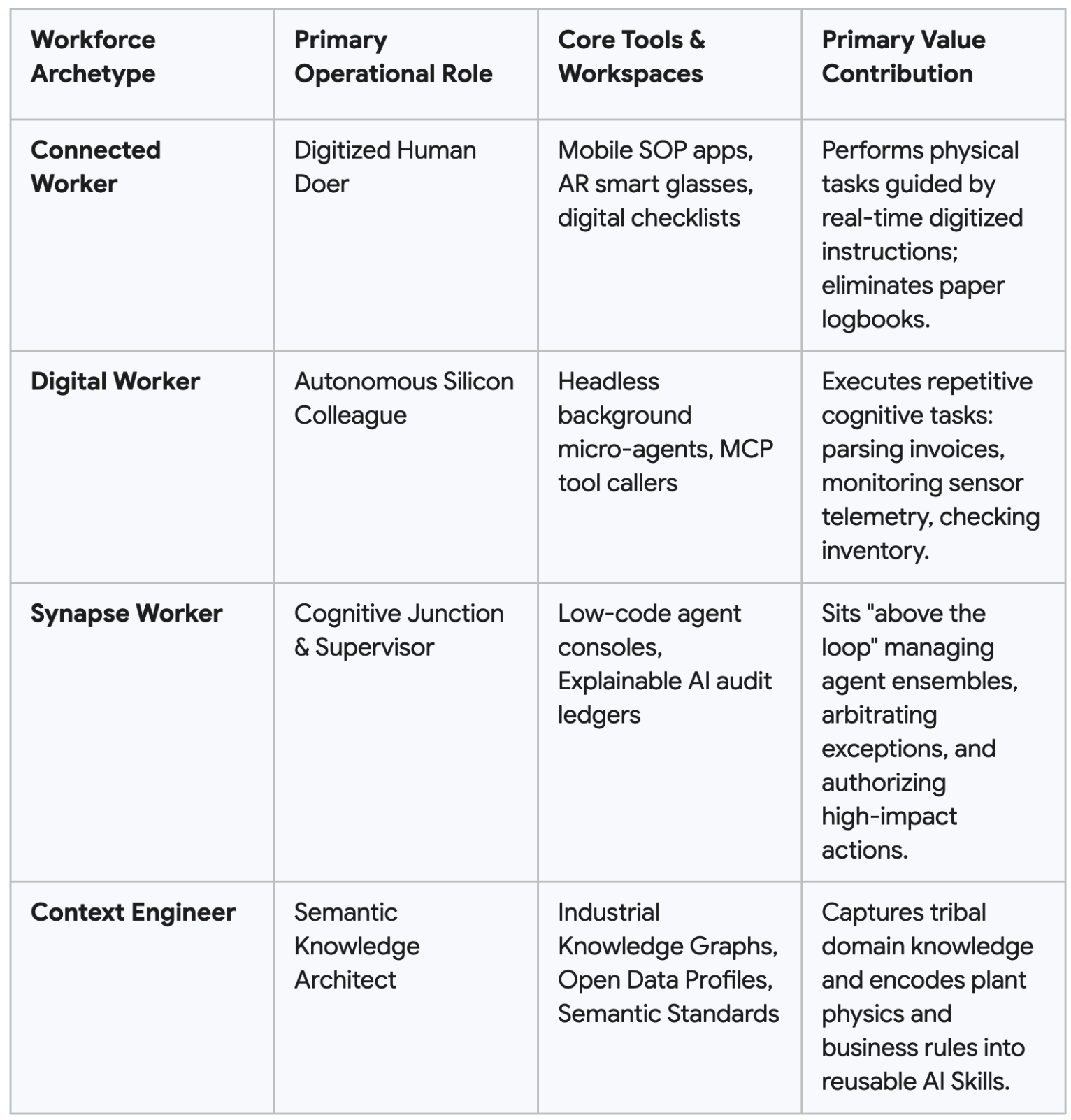
1. The Connected Worker (The Digitized Doer)
Equips the frontline operator with mobile devices, wearable AR glasses, and digitized Standard Operating Procedures (SOPs). The human remains the primary manual actor, but paper clipboards are eliminated.
2. The Digital Worker (The Silicon Colleague)
Autonomous software bots and virtual assistants that handle high-volume, routine cognitive tasks—such as reconciling invoices, parsing maintenance logs, or detecting acoustic telemetry anomalies—operating independently in the background.
3. The Synapse Worker (The Human-at-the-Helm)
The human professional operating at the cognitive junction—the synapse—between high-level corporate strategy, physical plant reality, and autonomous digital execution. Relieved of repetitive manual data entry, the Synapse Worker sits "above the loop" (Level 3 Autonomy) to frame operating parameters, direct ensembles of Digital Workers, and arbitrate complex process exceptions.
4. The Context Engineer (The Knowledge Curator)
The evolution of the prompt engineer. Context Engineers are domain veterans who structure the enterprise semantic fabric. They build dynamic Industrial Knowledge Graphs, map type-safe data profiles, and translate thirty years of physical operating wisdom into structured, machine-executable AI Skills.
This brings us to the core synthesis of our human capital analysis: AI Skills do not replace Human Expertise; they productize it.
An "AI Skill" inside a multi-agent system is simply the mathematical digitization of hard-won human knowledge. It is the code representation of a master reliability engineer’s diagnostic intuition, an MES shift dispatch rule, or a veteran supply planner’s constraint management.
The strategic imperative for industrial enterprises is not to engage in a reckless race toward "lights-out" automation. The imperative is to systematically capture, digitize, and encapsulate the tacit domain knowledge of retiring master operators into reusable software Skills before they leave the building.
By embedding human expertise into structured AI Skills, organizations empower incoming, less experienced Synapse Workers to operate with master-level competence from day one—protecting the talent pipeline from the junior hollowing crisis.
Having explored the organizational collapse into the Headless Firm, the historical lessons of software coordination, and the elevation of workers into Synapse Supervisors, one urgent question remains: how do we actually govern these autonomous agents when they touch live physical iron or binding financial ledgers?
Up Next in Blog 5 (The Grand Finale): "Bounding the Brain—The 4 Levels of Industrial Autonomy and Why Domain Expertise Reigns Supreme." We will bring all the threads of this series together. We will detail the Industrial Runtime Containment Plane, enforce ARC's 4-Level Graduated Autonomy Framework within CPIA, define automated Autonomy Revocation Protocols, provide the 10-Point Executive Diagnostic Framework, answer the critical Architectural FAQs, and deliver the complete series blueprint for the autonomous era. Stay tuned.
The Industrial AI (R)Evolution is moving faster than ever. To dive deeper into the frameworks and data shaping the future of the industrial sector, explore my latest research:
Navigating the AI Wars and the escalating Industrial Robot Wars
Closing the Digital Divide by Embracing Industrial AI
Assembling your Industrial-Grade Data Fabric
Charting the new frontier of Physical Intelligence and transitioning to a Cyber-Physical Industrial Architecture (CPIA)
Mapping your maturity and strategy with ARC's 3-Axis Industrial AI Models Taxonomy
Surviving the SaaSpocalypse and Taming the Tokenpocalypse by Mastering Multi-Agent Industrial Governance
Organizational Design and the Future of Industrial Work in the era of Agentic AI
Take our Industrial AI Assessment to benchmark your organization's maturity, identify critical gaps in your IT/OT/ET convergence, and get actionable recommendations to accelerate your path to becoming an Industrial AI Pacesetter (and download the 2026 Report). If you think you’re already a Pacesetter, nominate your team for the ARC Industrial Pacesetters Awards!
Don't guess what your global operations or prospective customers need. Use empirical data to align your stakeholders and de-hype the market with ARC Advisory Group's Voice of Market Service.
For tailored recommendations on governing and guiding major people, process, and technology decisions across the enterprise, cloud, industrial edge, and AI, please contact Colin Masson at [email protected].
Or, set up a meeting with my fellow Analysts and I at ARC Advisory Group to find out more about our Executive Insights Service for Industrial organizations and our Industrial AI Insights Service for Vendors.