Representative End User Clients







Representative Automation Clients







Representative Software Clients








Artificial intelligence (AI) is moving into a new phase in enterprise IT. The first wave of generative AI focused largely on AI assistants that helped employees write, search, analyze information, and complete routine tasks.
In 2026, the focus is shifting toward AI agents that can understand operational context, make recommendations, coordinate tasks, and increasingly take action.
This transition is particularly visible in infrastructure and IT operations, where agentic AI is becoming an important trend shaping how enterprises manage complex environments. AI agents are increasingly being embedded in IT operations and enterprise applications.
The evolution can be summarized as:
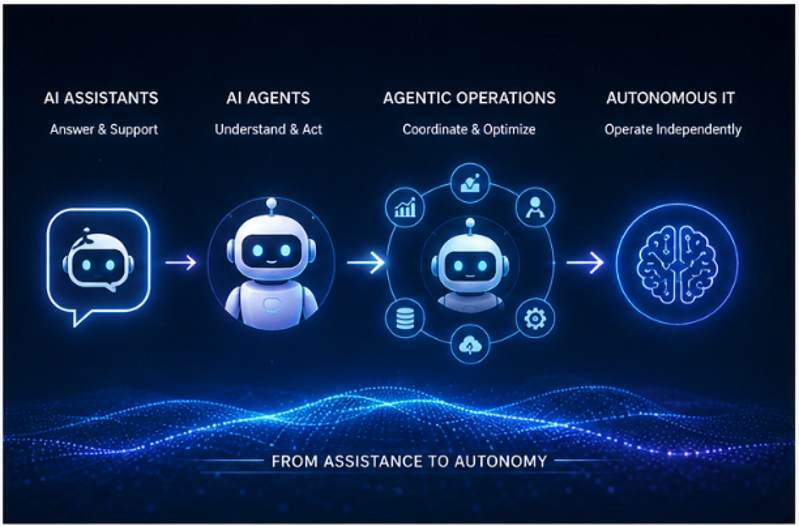
AI assistants still depend heavily on human direction. An employee asks a question, requests an analysis, or instructs the system to perform a task. AI agents take a different approach by working toward a defined objective and performing multiple steps across connected systems.
Enterprise applications are expected to increasingly include task-specific AI agents that move beyond productivity support to completing complex, end-to-end tasks.
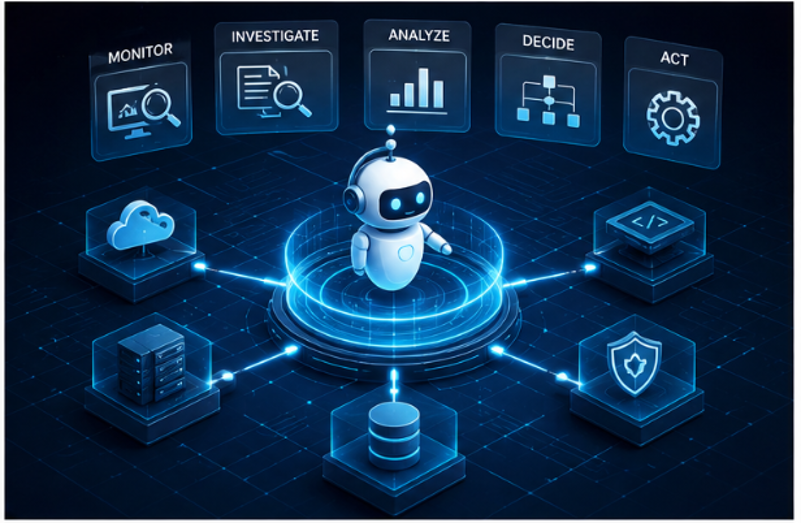
For IT operations, this could include:
Investigating infrastructure alerts.
Identifying potential root causes.
Optimizing cloud resources.
Managing repetitive configuration tasks.
Recommending or executing remediation.
Supporting capacity and performance management.
The important change is that AI is moving from providing information to participating in operational workflows.
Modern IT environments are increasingly distributed across cloud platforms, data centers, applications, networks, APIs, and AI services. Monitoring these environments creates large volumes of operational data that can be difficult for human teams to correlate manually.
Agentic AI can help connect these signals and provide operational context.
Microsoft's 2026 work on agentic observability, for example, connects logs, metrics, traces, topology, and operational context to help identify issues and accelerate investigations. Microsoft has also introduced autonomous operations in preview, where AI can continuously perform preparation and triage while humans retain control over decisions that change the environment.
This points toward a new operational cycle:
The objective is not necessarily to eliminate human involvement, but to reduce the amount of manual work required to move from an operational signal to an appropriate response.
As AI agents become more active, traditional observability alone may not be sufficient.
Organizations need visibility not only into applications and infrastructure, but also into the behavior of AI systems. This includes understanding model outputs, agent actions, tool usage, performance, and interactions with enterprise systems.
In 2026, IBM introduced AI Agent and LLM Observability to improve visibility into production AI systems as agents interact with APIs, data pipelines, and enterprise services.
AI observability therefore needs to answer questions such as:
What did the AI agent do?
Why did it make that decision?
Which systems did it interact with?
Did the action produce the expected result?
Can the action be traced and audited?
This makes observability a foundation for trustworthy autonomous operations.
Greater autonomy also introduces greater risk. An AI agent with access to infrastructure can potentially make changes faster than a human operator, but an incorrect decision can also create security, availability, or cost problems.
Organizations therefore need to establish clear boundaries around what AI agents can do independently.
Key controls include:
Role-based access and permissions.
Human approval for high-impact actions.
Continuous monitoring.
Audit trails.
Policy-based controls.
Testing before production deployment.
The direction is therefore toward controlled autonomy rather than unrestricted automation.
The longer-term opportunity is a shift from reactive IT toward continuously optimized operations.
Traditional operations often follow a pattern of alert → investigation → decision → remediation. AI-driven operations can shorten this cycle by allowing agents to correlate events, investigate issues, recommend actions, and perform approved remediation.
However, fully autonomous IT will not happen uniformly. Only a minority of AI agents are expected to become fully autonomous in the near term, reinforcing the importance of phased adoption and guardrails.
For enterprises, 2026 is less about simply adding AI assistants to existing software and more about redesigning how technology is operated.
The next stage will likely combine:
AI agents + observability + automation + governance + enterprise data
This evolution also has implications beyond IT infrastructure. Engineering software, simulation, PLM, digital twins, and other enterprise platforms can increasingly use AI to interpret operational information, automate workflows, and support lifecycle decisions.
The result could be a broader shift from software that helps people operate systems toward software that can participate in operating those systems.
AI-driven operations are therefore still at an early stage, but the direction is becoming clearer in 2026. AI assistants are becoming AI agents, observability is becoming more intelligent, and automation is moving toward controlled autonomy. The organizations that benefit most will not necessarily be those that deploy the most AI, but those that combine AI capabilities with reliable data, strong governance, and clearly defined operational boundaries.
For additional ARC perspectives on agentic AI, autonomous operations, observability, and governance, see:
Cisco Introduces AgenticOps, Multi-Site Security, and Cloud Management for OT Networks.
For Powerful Autonomous Execution Agent Deployments, Start with a Capability-Based View.
Together, these ARC resources provide additional context on how organizations are moving from AI-assisted workflows toward more autonomous execution while maintaining the observability, governance, human oversight, and operational controls required for responsible deployment.