Representative End User Clients







Representative Automation Clients







Representative Software Clients








Autonomous Execution Agents (AEAs) are powerful, cross-functional agents that act upon an integrated operational capability model. They bring together data ingestion, contextual understanding, decision logic, and execution within a continuous loop that links real-time operations to business objectives.
This framing is important. Many industrial AI initiatives underperform not because analytics are inadequate, but because the surrounding capabilities required to translate analytics into sustained operational action are missing. A capability-based perspective provides a more reliable foundation for evaluating and deploying AEA-type solutions than a focus on individual AI techniques.
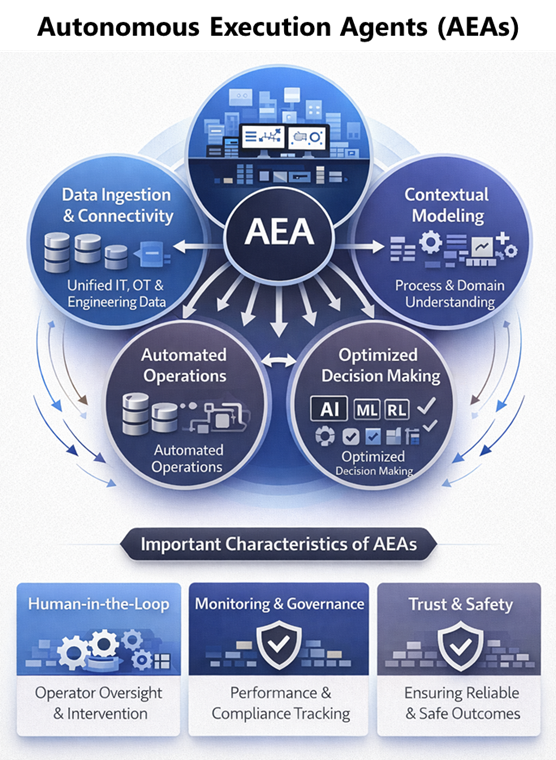
Traditional industrial analytics systems are largely designed to inform human decision-making. They surface patterns, generate predictions, or recommend actions, but execution typically remains outside their scope. AEAs represent a structural shift away from this separation.
AEA vendors position their solutions as execution-centric systems, not standalone analytics components. They are designed to operate continuously within industrial environments, responding to changing conditions and translating analytical insight into operational change. This shift requires that analytics, execution, and governance be treated as inseparable parts of a single system rather than independent layers.
At the base of the AEA capability model is the ability to ingest and synchronize operational data across IT, OT, and engineering domains. High-frequency sensor data, control system signals, production context, and business information must all be available within a unified operational view.
However, data availability alone is insufficient. AEAs depend on context modeling to make data operationally meaningful. Solutions incorporate structured representations of assets, process relationships, constraints, and objectives. This contextual layer allows the system to understand where an issue is occurring, how it propagates through the process, and which outcomes are economically or operationally relevant. Without this context, execution-oriented AI systems risk producing recommendations that are technically valid but operationally impractical.
Within this contextual framework, AEAs apply decision logic to determine how operations should change in response to current conditions. A wide range of analytical approaches, including machine learning, reinforcement learning, causal inference, physics-based models, and hybrid combinations, may be used in this process. No single technique defines the category.
What unifies these approaches is their purpose. In all cases, the decision logic is designed to determine specific operational actions that advance defined objectives while respecting constraints. This directly enables the next—and defining—capability of AEAs: execution.
Execution distinguishes AEAs from analytics platforms, optimization tools, and AI assistants. Vendor materials describe execution modes that range from prescriptive recommendations presented to operators, through supervised execution requiring human approval, to closed-loop operation in which changes are applied automatically within predefined guardrails. Importantly, execution is not binary. Most AEA-type solutions support graduated autonomy, allowing organizations to move incrementally from advisory use cases toward higher levels of automation as trust and readiness increase.
Despite their name, Autonomous Execution Agents are not designed to remove humans from industrial decision-making. On the contrary, human oversight is a central design principle. Vendor materials consistently emphasize explainability, transparency, and operator involvement as prerequisites for deployment.
Human-in-the-loop mechanisms include clear explanations of recommended or executed actions, visibility into expected outcomes, configurable constraints, and override capabilities. These features are essential in industrial environments, where decisions have physical consequences and safety, quality, and regulatory considerations cannot be abstracted away.
Once execution is introduced, monitoring and governance become continuous requirements rather than afterthoughts. AEAs must ensure not only process performance, but also model behavior, outcome consistency, and adherence to constraints. While governance capabilities vary widely from vendor to vendor, the need for ongoing observability and control is implicit across AEA-oriented architectures. These systems are intended to operate indefinitely, not as one-time optimization exercises.
Some AEA solutions emphasize closed-loop process optimization in continuous industries, others focus on operator-centric execution in discrete manufacturing, and others prioritize explainability through causal reasoning. These differences should not be interpreted as indicators of superiority or maturity, but rather as evidence of an emerging category with multiple viable architectural paths.
Use cases illustrate the breadth of applicability. In continuous process industries, AEAs are used to dynamically adjust setpoints in response to changing conditions and objectives. In discrete manufacturing, they support real-time optimization of machine parameters and production outcomes. Energy and sustainability applications focus on modifying operating conditions to reduce consumption while maintaining performance. Supply chain applications support multi-enterprise demand and supply planning. Across these contexts, the common pattern is a continuous loop linking data, decisions, and execution.
Autonomous Execution Agents (AEAs) are powerful, cross-functional agents that act upon an integrated operational capability model. Their defining characteristic is the ability to connect data ingestion, contextual understanding, decision logic, and execution into a continuous loop that aligns real-time operations with business objectives.
Viewing AEAs through this capability-based lens provides greater clarity for industrial organizations evaluating, piloting, and scaling these solutions. As the category continues to evolve, this perspective will be more durable than technology-specific definitions and more actionable than vendor-specific descriptions.
Be on the lookout for our upcoming MarketMap report about Autonomous Execution Agents. See how some of the leading solutions compare.
The Industrial AI (R)Evolution is moving faster than ever. To dive deeper into the frameworks and data shaping the future of the industrial sector, explore some of ARC’s latest research:
What Are Autonomous Execution Agents? A New Category for Industrial AI What Are Autonomous Execution Agents? A New Category for Industrial AI | ARC Advisory Group
Mapping your maturity and strategy with ARC's 3-Axis Industrial AI Models Taxonomy
Where do you stand in the Industrial AI (R)Evolution? Take our Industrial AI Assessment to benchmark your organization's maturity, identify critical gaps in your IT/OT/ET convergence, and get actionable recommendations to accelerate your path to becoming an Industrial AI Pacesetter.
Don't guess what your global operations or prospective customers need. Use empirical data to align your stakeholders and de-hype the market with ARC Advisory Group's Voice of Market Service.
For tailored recommendations on governing and guiding major people, process, and technology decisions across the enterprise, cloud, industrial edge, and AI, please contact Greg Gorbach at [email protected].
Or, set up a meeting with my fellow Analysts and I at ARC Advisory Group to find out more about our Executive Insights Service for Industrial organizations and our Industrial AI Insights Service for Vendors.