Representative End User Clients







Representative Automation Clients







Representative Software Clients








For more than a decade, industrial companies have invested heavily in analytics—dashboards, predictive models, and AI pilots. Yet a persistent gap remains: insight does not automatically translate into action.
This gap is where a new category—Autonomous Execution Agents (AEAs)—is emerging.
While the terminology is still evolving across the industry, the underlying concept addresses a clear need: systems that not only generate insights but also continuously act on those insights to optimize operations in real time.
Autonomous Execution Agents are intelligent software systems that continuously ingest contextualized operational data and dynamically adjust processes to achieve business objectives such as yield, efficiency, and quality.
AEAs represent a class of industrial AI systems designed to bridge enterprise strategy and operational execution. They integrate data from across IT, OT, and engineering domains, interpret that data using advanced analytics and domain knowledge, and then adjust operational parameters—either by recommending actions or executing them automatically. These systems operate along a spectrum from advisory tools to fully autonomous control agents, adapting continuously to real-world conditions.
One of the most important points:
AEAs are not a product category in the traditional sense.
It is best understood as a functional archetype, meaning:
Multiple types of products can exhibit AEA characteristics.
Vendors describe similar concepts using different terms.
The boundaries with adjacent categories are still evolving.
Common related terms include:
Industrial AI optimizers or process optimizers.
Closed-loop AI systems.
Autonomous operations platforms.
Agent-based industrial AI.
AEAs are explicitly designed to optimize outcomes such as yield and throughput, energy efficiency, product quality, or cost and margin. They span the full maturity spectrum from Diagnostic (why did this happen?) to Predictive (what will happen?) to Prescriptive (what should we do?) to Autonomous (execute the action). Herein lies the key differentiator: they don’t necessarily stop at recommendation. This is where AEAs fundamentally differ.
They recommend actions to operators, directly adjust process parameters, and orchestrate workflows across systems. In other words: they act.
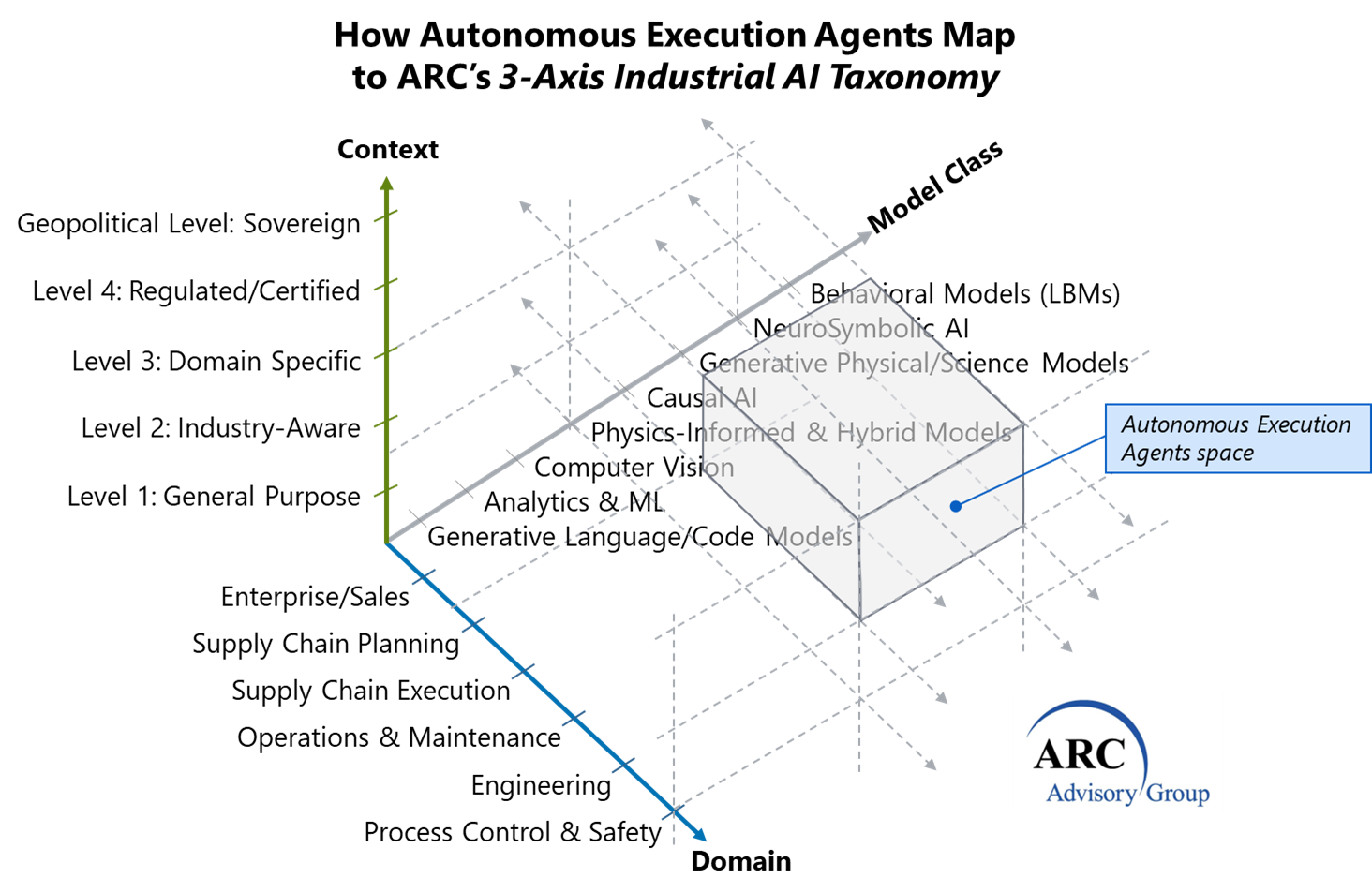
The AEA concept becomes clearer when mapped to ARC’s 3-axis framework:
Context Axis
AEAs are typically domain-specific (Level 3), industry-aware agents.
Model Class Axis
The nature of Autonomous Execution Agents is to act or, at minimum, recommend; this relies on physics-informed, causal AI, or neuro-symbolic models, to ensure the actions are appropriate to the situation.
Domain Axis
AEAs are specialized and usually operate within a single domain such as Operations & Maintenance, Process Control, or Supply Chain, but the greatest value can be obtained when the AEAs are deployed to optimize business processes across multiple domains.
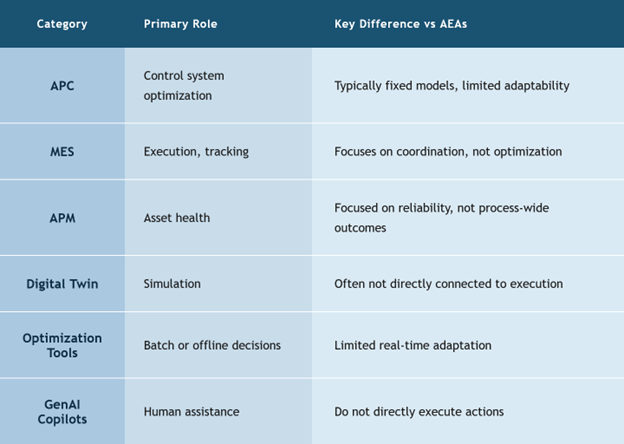
Across vendors (a subset of the broader ecosystem), we see common patterns:
Systems that dynamically optimize process parameters in real time (e.g., Imubit adjusting setpoints using reinforcement learning).
Platforms that unify OT and IT data and provide actionable recommendations to operators (e.g., Oden Technologies).
Solutions that move from analytics to closed-loop automation (e.g., Sorba.ai enabling autonomous control workflows).
These examples illustrate a consistent shift, from “systems that inform decisions” → to “systems that help make and execute decisions.”
Not fully autonomous “lights-out” operations in most deployments.
Not replacements for core control systems (DCS, PLCs).
Not universally applicable without significant data readiness.
Not guaranteed to generalize across plants without tuning.
Many deployments today operate in human-in-the-loop or supervised autonomy modes.
When evaluating AEA-type solutions, consider:
What business objectives are explicitly encoded in the system?
How is data contextualized across IT, OT, and engineering systems?
What level of autonomy is supported today (advisory vs. closed-loop)?
How are safety constraints and guardrails enforced?
What explainability mechanisms are provided to operators?
How easily can models adapt to changing process conditions?
What integration is required with MES, APC, or DCS systems?
How is performance measured and validated operationally?
The emergence of Autonomous Execution Agents signals a broader shift:
From analytics → execution
From isolated optimization → coordinated operational intelligence
From human-only decisions → hybrid human-AI systems
For industrial companies, the key question is not whether this category will emerge—but how quickly it will become central to digital operations.
Identify high-value, high-variability processes where optimization matters.
Assess current gaps between insight and action.
Start with bounded pilots that can demonstrate measurable outcomes.
The Industrial AI (R)Evolution is moving faster than ever. To dive deeper into the frameworks and data shaping the future of the industrial sector, explore some of ARC’s latest research:
Mapping your maturity and strategy with ARC's 3-Axis Industrial AI Models Taxonomy
Navigating the AI Wars and the escalating Industrial Robot Wars
Where do you stand in the Industrial AI (R)Evolution? Take our Industrial AI Assessment to benchmark your organization's maturity, identify critical gaps in your IT/OT/ET convergence, and get actionable recommendations to accelerate your path to becoming an Industrial AI Pacesetter.
Don't guess what your global operations or prospective customers need. Use empirical data to align your stakeholders and de-hype the market with ARC Advisory Group's Voice of Market Service.
For tailored recommendations on governing and guiding major people, process, and technology decisions across the enterprise, cloud, industrial edge, and AI, please contact Greg Gorbach at [email protected].
Or, set up a meeting with my fellow Analysts and I at ARC Advisory Group to find out more about our Executive Insights Service for Industrial organizations and our Industrial AI Insights Service for Vendors.