The
Honeywell Users Group EMEA Conference 2016 was held at the ‘World Forum’ in The Hague, The Netherlands, from Oct 24
th to 27
th.
 Honeywell Process Solutions
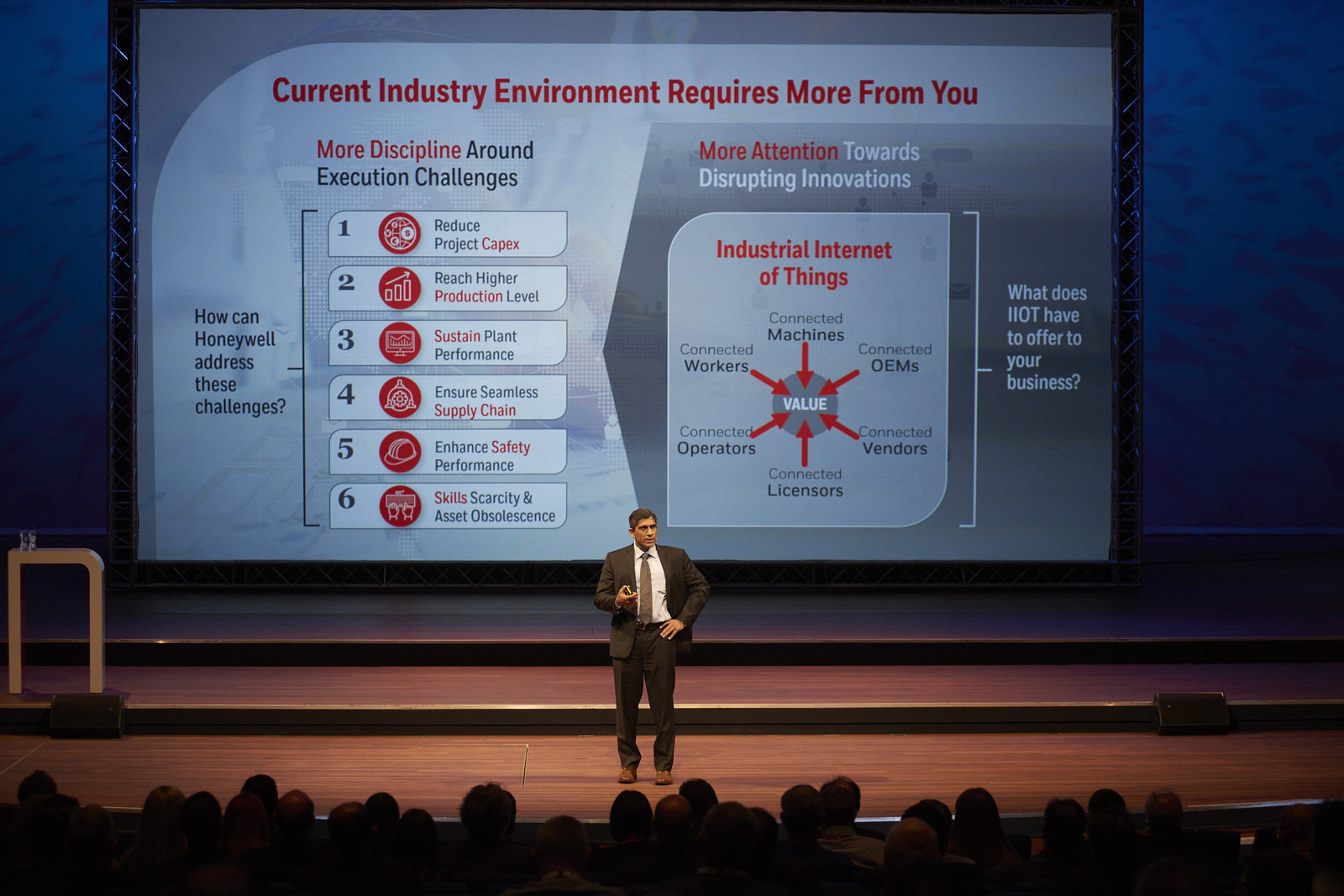
’ (HPS) president, Vimal Kapur, gave the opening keynote. After a brief mention of the
Elster acquisition, which brings connected gas instrumentation and gas heating solutions into the company's portfolio, Mr. Kapur went through the top six challenges of Honeywell’s customers and the the company's responses and solutions to those.
1. Project CAPEX
As capital spending is more and more challenged, Mr. Kapur questions the practice of building highly customized plants, which adds unnecessary risk and cost. With modular engineering, as used for example in template engineering approaches provided by partner
Honeywell UOP, less costly designs leading to less costly construction would be possible. Another lever to reduce capital cost and reduce time to operational readiness is Lean Execution of Automation Projects (LEAP). This includes parallel engineering, the use of configurable I/O (Universal I/O in Honeywell terms), and engineering in a virtualized environment in the cloud. These items reduce the duration of engineering, add flexibility and resilience to last minute changes and reduce the duration of commissioning.
2. Reach higher production levels
Unwanted downtime remains a major factor limiting production. The expectation is that Industrial IoT (IIoT) will reduce upsets and unwanted shutdowns. IIoT provides HPS with additional tools to employ to solve the same problems that manufacturers continue to face including unwanted downtime, maintaining on-spec production, and supply chain integration. Uniformance PHD is the basis. The asset model in Uniformance is constructed from unstructured, time series plant data such as events or alarms, and others sources such as transactional data from an ERP. Once these data are organized, they can be visualized, analyzed with domain knowledge, and compared with similar equipment or process information from within the enterprise, or across operators using equipment or processes from the same provider. Connecting internal and external stakeholders via the cloud makes data more visible to experts outside the plant, and provides more opportunities to improve uptime. Cloud applications also improve application uptime, deployment and maintenance.
3. Sustain plant performance
On process migrations (OPM) and the highly automated digital integration of field devices help minimize migration-related disruptions. The company's Assurance 360 service offering focuses on outcomes of automation, for example measured in automation system uptime.
4. Ensure seamless supply chains
HPS recently grouped and integrated their supply chain solutions (together with production management solutions) in the Symphonite suite, to enable customers to make better supply chain-related decisions based on the way their supply chains are set up.
5. Enhance safety performance
According to Mr. Kapur, ‘more can be done’ when it comes to safety performance. HPS follows the US Homeland Security Guidelines for cyber security. With the company's Industrial Cyber Security Risk Manager that monitors, measures, and manages cyber security risks for industrial environments, the user no longer needs to be an expert. The HPS tools can govern the customers’ policies.
6. Skills scarcity and asset obsolescence
All the items above build on skills. However, with projects and processes becoming more complex, the gradual skill losses related to retirement and the pressure to do more with less people skills become exceptionally important. The recent Orion operator console increases operator effectiveness through faster responses and can be set up remotely. Mr. Kapur closed by showing the HPS parts portal, the equivalent of Amazon.com for parts. In a follow-up briefing with the press, Mr. Kapur said that the six points detailed above correspond to HPS’ clients’ challenges, although not always in the same order of importance. He stressed that industry has stimulated HPS to adopt open systems, such as MS Windows. Similar to in the private and office computing environment, the company does not control the product cycles of some of the solution components, such as MS Windows. He strongly suggests that his customers follow these cycles and stay current or risk getting so far behind that it becomes unmanageable to maintain safe operations or upgrade. Asked about the Exxon-Mobil initiative of open controls systems, he answered that "the company agrees on many aspects of the program with exception of the multi-component interoperability, referring to the interoperability among different types of components such as DCS, IO, etc. Jason Urso’s, HPS CTO’s keynote further detailed many of the above. ARC concludes that HPS has a clear vision for providing gradual and painless control system upgrading and providing added value by applying industrial IoT and big data analytics in a manageable and practical manner.




















