Representative End User Clients







Representative Automation Clients







Representative Software Clients










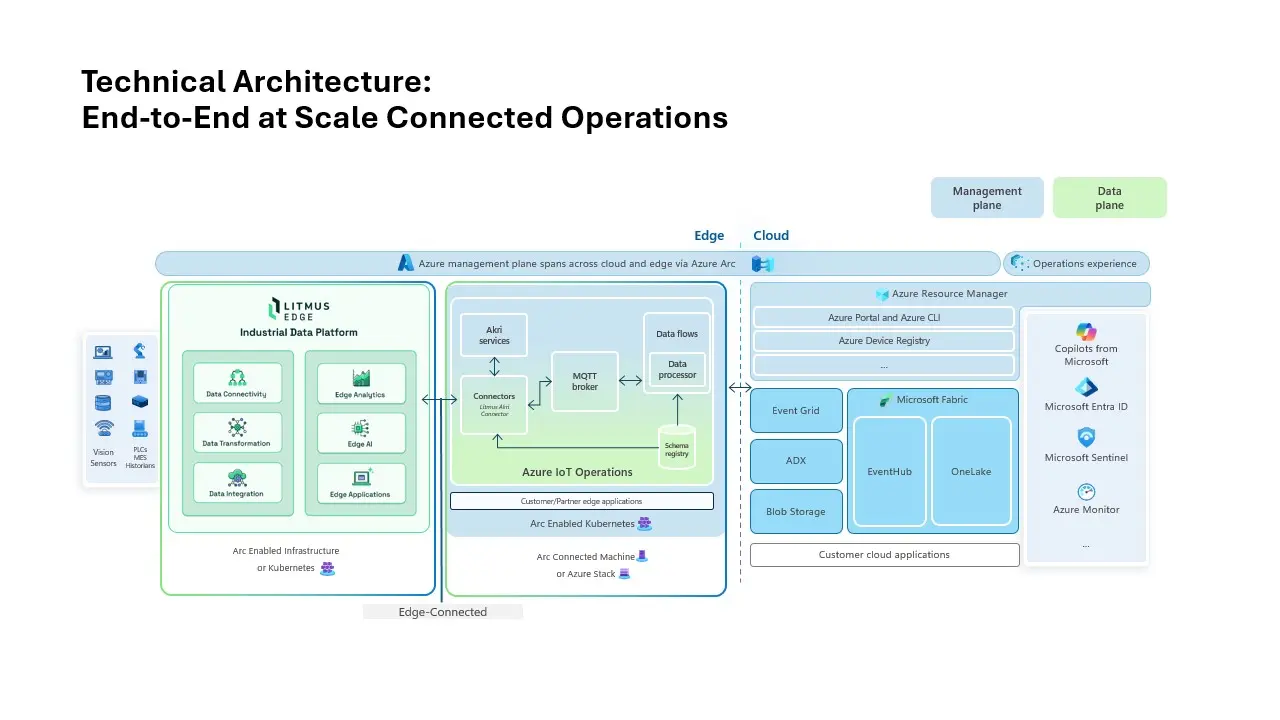
Microsoft and edge platform provider Litmus announced a new integration between Azure IoT Operations and Litmus Edge, bringing speed, automation, and governance to industrial data onboarding and modeling. Through a Litmus connector based on the open-source Akri framework, customers can now achieve real-time device and asset discoverability, seamless onboarding, and Azure-native representation of Litmus Edge data. The new architecture connects the Litmus industrial data platform at the edge with Azure IoT Operations, Azure Arc, and cloud analytics services. Device discovery, schema modeling, and dataflows operate in a unified way.
This collaboration is intended to bridge the long-standing divide between operational technology (OT) systems and cloud IT environments. By natively aligning edge assets, data models, and governance across the stack, enterprises can scale industrial data solutions with confidence and without the traditional integration pain.
Manufacturers often struggle with slow, manual onboarding as they connect PLCs, sensors, and machines from many vendors. Each integration requires custom configuration, tribal knowledge, and repeated effort at every site. Schema mapping is often done by hand, and device details must be recreated in cloud tools. These delays hold back initiatives like predictive maintenance, energy optimization, and OEE analytics. Enterprises need a consistent way to discover assets, build accurate data models, and move clean data into Azure services without friction.
Azure IoT Operations and Litmus Edge now deliver a unified and automated approach to industrial data integration. The Litmus Akri Connector links Litmus Edge with Azure IoT Operations so devices, schemas, and metadata flow smoothly from the edge into Azure. The result is a modern, scalable pattern that supports multi-site operations and keeps both OT and IT aligned on one operational model.
Unlike traditional ingestion pipelines that push raw telemetry into the cloud, Azure IoT Operations automatically generates structured, schema-aware assets from Litmus Edge. Every device, sensor, and tag is represented as a first-class managed object in the Azure Namespace and Azure Resource Manager (ARM).
This enables:
Consistent governance and policy enforcement.
Auditability and lineage tracking across device lifecycles.
Standardized data models that can be reused across analytics, AI, and operational systems.
The result is a unified view of industrial data that accelerates downstream use cases while eliminating brittle custom modeling efforts.
Through the new Akri-based Litmus Connector, Azure IoT Operations provides automated discovery and frictionless onboarding of Litmus-connected devices. When Litmus Edge detects a new PLC, sensor, or controller, it becomes visible to Azure and can be onboarded with a single click; no manual mapping, scripting, or custom pipelines required. This fully automated integration drastically shortens the path from device connection to cloud-ready data.
Customers benefit from:
Massive reductions in deployment and setup time.
Eliminated configuration errors.
Faster OT–IT collaboration and iteration cycles.
Azure IoT Operations introduces powerful in-line data processing capabilities that allow customers to enrich and shape industrial data before it reaches analytics platforms like Microsoft Fabric.
With Azure IoT Operations, you can filter and transform telemetry at the edge, apply rules and trigger alerts, route data to one or many destinations, enrich messages, and harmonize formats.
The Digital Operations Experience (DOE) provides a centralized Azure interface for managing everything originating from Litmus:
Industrial assets modeled from Litmus Edge.
Data flows and routing configurations.
Real-time telemetry visualization and monitoring.
Policy management and lifecycle oversight.
DOE brings together OT context and IT governance in a single cloud experience, reducing operational overhead and giving enterprises a scalable, consistent way to manage industrial data pipelines.
Find out more about the market for industrial edge compute platforms.