Representative End User Clients







Representative Automation Clients







Representative Software Clients








Complexity of Today's Field Device Management
In the process industries intelligent field devices predominantly use three interfaces: HART, FOUNDATION Fieldbus, and PROFIBUS PA. A typical process plant has hundreds or thousands of field devices deployed, often using at least two of these three device interfaces. Plants typically also employ several different device management software applications, sometimes several on a single process unit. Furthermore, these software tools will use different technologies for device management, either EDDL (Electronic Device Description Language) or FDT.
Managing thousands of devices with multiple interfaces, multiple management technologies, and multiple tools makes device management a frequent pain point for process plants. The pain can be acute because process field device performance is critical for overall plant performance.
 Manufacturing end users may not realize that this same jumble of technology is also very difficult for device suppliers to manage. Each technology has its own organization that develops and supports the technology and provides compliance certification. Device suppliers generally have to support every one of them. This is costly, consumes a great deal of scarce human resources, and adds very little incremental value.
Clearly there is a strong value proposition for consolidation, but only if this consolidation provides support for all three popular interface technologies (FOUNDATION Fieldbus, HART, and PROFIBUS PA), since the installed base involves millions of critical devices that cannot be easily replaced.
The FieldComm Group
Meet the FieldComm Group, a new organization formed at the beginning of 2015. FieldComm Group has taken over the intellectual property of the HART Communication Foundation and Fieldbus Foundation, both which then ceased to exist. Their intellectual property (and their human resources as well) were folded into the new group. The mission statement of the FieldComm Group is:
Develop, manage and promote global standards for integrating digital devices into automation system architectures while protecting process automation investments in the HART and FOUNDATION Fieldbus communication technologies.
From the standpoint of process manufacturers, the key point here is that the new group is chartered to protect their large investments i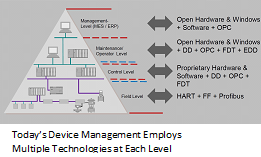 n the existing technologies through ongoing support for both FOUNDATION Fieldbus and HART. The new group will be the home and support center of both technologies. The vision of the new group is to support these technologies, not supersede or replace them. From a supplier standpoint, FieldComm Group offers the benefit of dealing with a single organization.
One measure of assurance for end users should come from the new group's membership; all the major automation suppliers are members. Since this organization was created out of a need for consolidation, it does not represent a faction or segment of the process automation market. FieldComm Group members also include leading end users and some academics.
FDI and the FieldComm Group
HART and FOUNDATION Fieldbus are both decades old and while still being enhanced, the base technologies are very mature. Putting together their respective organizations is helpful, but not revolutionary. However, a new device management technology appearing this year will also become the responsibility of FieldComm Group: FDI. The FieldComm Group will become the home of FDI technology and will manage it going forward. The Group will take over responsibility for the work products of FDI Cooperation, LLC and will support these in the future. This means that the group will be the home of all the critical process field device protocols and device management technologies, both past and future. FieldComm Group will cooperate with PI International to ensure that FDI becomes the single integration solution across the HART, FOUNDATION Fieldbus, PROFIBUS, and  PROFINET protocols.
FDI is a multi-year effort to unify field device management technologies while maintaining backward compatibility with the existing solutions. Part of the maddening complexity of present day device management is that two major techniques are employed at the management level: EDDL and FDT. FDI specifies a single information resource, the FDI Device Package, which can be used with both.
The Fieldbus Foundation, PROFIBUS and PROFINET International, and HART Communication Foundation previously merged their individual variants of device descriptions into the Electronic Device Description Language (EDDL), which is now an IEC standard (IEC 61804). EDDL describes the characteristics of field devices. Device suppliers have used EDDL to create Electronic Device Description (EDD) files, which provide a standardized form and information structure for host systems independent of the device communication protocol.
FDT, the IEC 62453 standard, is a software interface specification for interoperability between field devices and automation systems. Its design basis is such that FDT-enabled applications within the automation system can manage field devices regardless of the device's manufacturer and regardless of the fieldbus protocol employed. This is achieved by equipping each device with a unique executable software element called a Device Type Manager (DTM). FDT-enabled host applications, called FDT Frame Applications, contain a fully defined interface to any DTM, providing interoperability between any Frame Application and any DTM. Frame applications operate in a Microsoft software environment.
Today's market includes device management software products based on both EDDL and FDT. Both have advantages and disadvantages and end users have different preferences. However neither suppliers nor end users want the difficulty of developing two different device packages for the same device. FDI Cooperation LLC is an industry consortium chartered to create this unifying technology (see figure above). FDI device packages can be used with FDI hosts or with FDT Frame applications as the host. FDI hosts can operate on older EDD files and the new FDI Device Packages can operate in existing FDT hosts. This provides backward compatibility while enabling a single FDI Device Package to serve a single device in any environment.
Moving forward, FieldComm Group will manage and support FDI and provide FDI compliance services, development tools, and common host components for rapid host development and certification. When will FDI enabled host and Device Packages be available? It's up to the end users to request FDI host applications which will accelerate development and adoption.
Summary
It appears that the new FieldComm Group will finally provide to the process industries a unified, backward-compatible technology to describe and manage the multitude of intelligent field devices:
All signed-in ARC Advisory Group clients can view this report in pdf format at this Link
If you would like to buy this report or obtain information about how to become a client, please Request ARC Info
Keywords: FieldComm Group, FOUNDATION Fieldbus, HART, FDI, FDT, PROFIBUS, ARC Advisory Group.