Representative End User Clients







Representative Automation Clients







Representative Software Clients








In most process plants, measurement has historically been approached as a device-level decision. Engineers select flowmeters, level sensors, pressure transmitters, and other instruments based on application requirements, performance expectations, and installation constraints. Once installed, these instruments are expected to perform independently within their respective roles.
However, this approach is increasingly proving insufficient.
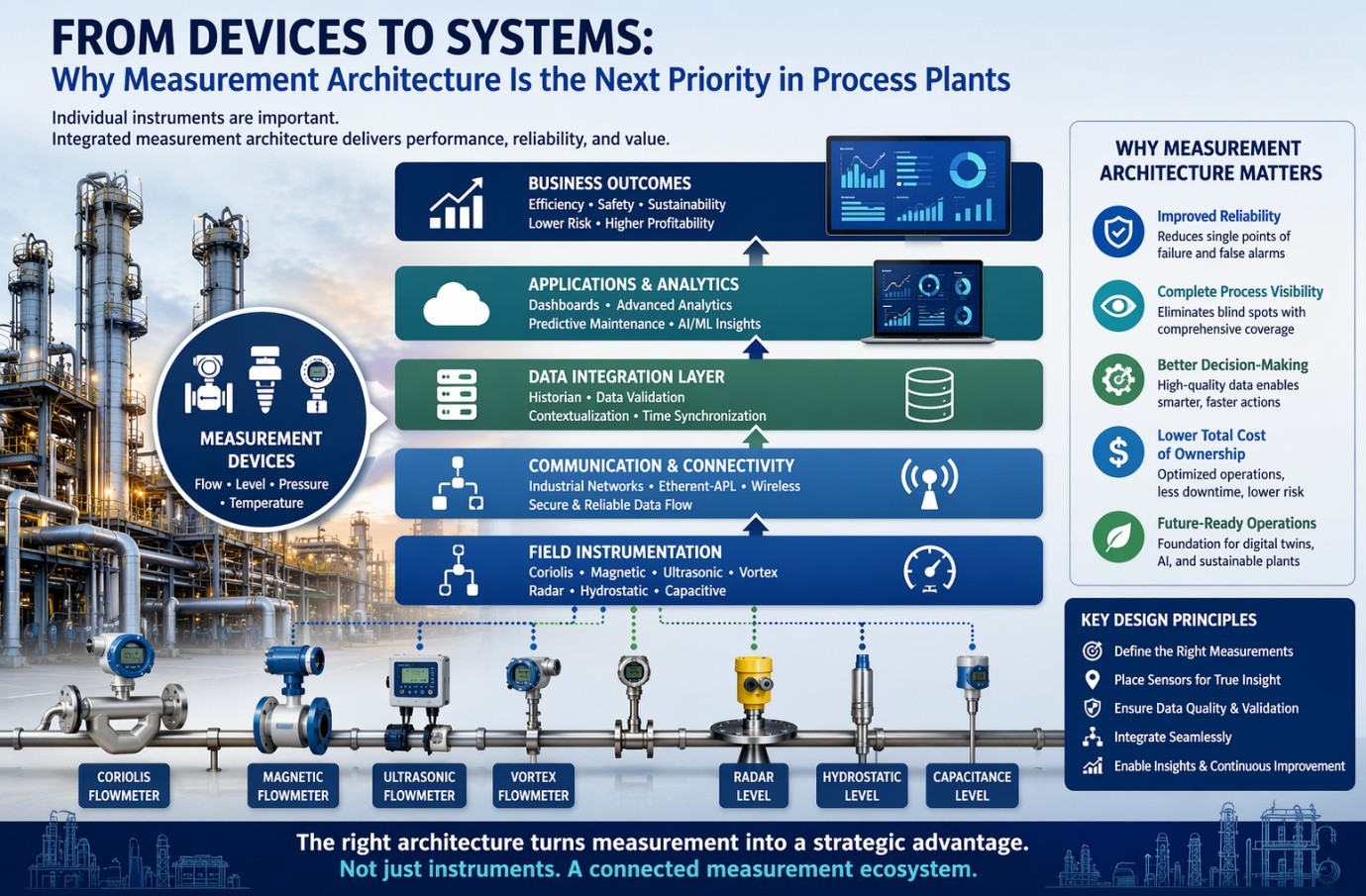
As process environments become more complex and operational expectations continue to rise, the focus is shifting from individual devices to the overall measurement system. Reliability, efficiency, and process visibility are no longer determined by the performance of a single instrument, but by how effectively multiple measurement technologies work together.
This shift marks the emergence of measurement architecture as a critical consideration in modern process plant design.
Traditionally, measurement technologies have been selected in isolation. A flowmeter is chosen based on fluid properties, a level sensor based on tank conditions, and a pressure transmitter based on operating limits. While technically sound, this approach often overlooks the interactions among these measurements within the broader process.
In reality, process systems are interconnected. Flow, level, pressure, and temperature measurements are not independent variables; they are part of a continuous system that governs process behavior.
When these measurements are not aligned or properly integrated, issues can arise, including:
Conflicting readings across measurement points.
Delayed or inaccurate control responses.
Increased dependency on manual intervention.
Reduced confidence in data.
Measurement architecture addresses this gap by focusing on how instrumentation works as a cohesive system rather than as individual components.
Measurement architecture refers to the structured design of measurement systems across a plant. It includes not only the selection of individual technologies, but also their placement, interaction, data flow, and integration into control and monitoring systems.
A well-designed measurement architecture considers:
How different measurements support one another.
Where sensors are placed to capture meaningful data.
How data moves from field devices to control systems.
How redundancy and validation are handled.
How measurement supports both operations and diagnostics.
Instead of optimizing individual instruments, the goal is to optimize the entire measurement ecosystem.
One of the most critical benefits of measurement architecture is the reduction of blind spots.
In process plants, blind spots occur when:
Measurements are missing or incorrectly placed.
Instruments operate outside optimal conditions.
Data from different sources is not synchronized.
For example:
A flowmeter may indicate stable output while level measurements suggest accumulation.
A tank may appear within limits while upstream flow variability indicates potential overfill risk.
Without a structured measurement system, these inconsistencies may remain unnoticed until they result in operational disruption.
By combining flow, level, and other measurements into a cohesive framework, measurement architecture enables:
Better cross-validation of data.
Improved visibility into process behavior.
Faster identification of abnormal conditions.
Reliability in process plants is often attributed to the performance of individual instruments. While device-level reliability remains important, system-level reliability depends on how those instruments interact.
A single high-performance flowmeter cannot prevent process failure if:
Supporting measurements are inconsistent.
Control logic is based on incomplete data.
Redundancy is not properly designed.
Measurement architecture improves reliability by:
Reducing single-point dependencies.
Supporting consistent data across systems.
Enabling better alarm management.
Enhancing fault detection and isolation.
This system-level perspective is increasingly necessary in plants operating under tight safety, environmental, and efficiency requirements.
Digital transformation initiatives across process industries depend heavily on the quality and structure of measurement data.
Analytics platforms, digital twins, and predictive maintenance systems rely on:
Consistent data streams.
Reliable measurement inputs.
Proper data integration across systems.
Without a strong measurement architecture, even the most advanced digital tools struggle to deliver meaningful insights.
For example:
Inconsistent flow and level data can distort process models.
Missing data points can limit predictive capabilities.
Unreliable measurements can generate false analytics outputs.
A well-designed measurement architecture ensures that digital systems are built on accurate and structured data, enabling:
Real-time monitoring.
Process optimization.
Predictive maintenance.
Improved decision-making.
The shift toward measurement architecture reflects a broader transformation in how process plants are designed and operated.
Instead of focusing solely on instruments, engineering teams are increasingly adopting a systems-thinking approach. This involves:
Designing measurement strategies at the plant level.
Aligning instrumentation with operational goals.
Integrating measurement with automation and digital platforms.
Such an approach recognizes that measurement is not just a technical requirement; it is a foundational element of process performance.
For engineering and operations teams, adopting a measurement architecture perspective requires a change in approach.
Key considerations include:
Evaluating measurement needs across the entire process, not just individual units.
Balancing accuracy, reliability, and cost at a system level.
Ensuring compatibility and integration among different technologies.
Designing redundancy and validation mechanisms.
Considering long-term maintainability and scalability.
These considerations go beyond traditional instrument selection and require closer collaboration among instrumentation, process engineering, and automation teams.
The evolution from devices to systems marks a significant shift in the role of measurement in process plants. Individual instruments remain important, but their true value is realized only when they function as part of a well-designed system.
Measurement architecture provides the framework for achieving this integration. By focusing on how measurements interact, support one another, and contribute to overall process visibility, it enables plants to operate more reliably, efficiently, and intelligently.
As process complexity increases and performance expectations continue to grow, measurement architecture is poised to become a defining factor in successful plant design and operation.