Representative End User Clients







Representative Automation Clients







Representative Software Clients








Summary
Although most headlines over the last ten months have focused on the impact of falling oil prices, the natural gas market has been struggling to operate profitably in a low-price environment for several years. Given the challenges of operating in a tightly integrated gas value chain comprised of gas production, gathering, processing, gas-to-liquid (GTL), liquefied natural gas (LNG), storage, pipelines, and gas distribution, ARC believes that owner-operators and other industry stakeholders could benefit from partnering with automation suppliers that can combine a comprehensive portfolio of products, systems and services with appropriate domain knowledge to create effective, pre-integrated solutions for the natural gas industry.
Honeywell Process Solutions (HPS) recently briefed ARC Advisory Group on the company's own portfolio of integrated solutions for the gas value chain. HPS has significantly increased its portfolio of products and services for natural gas operators over the past several years, with a focus on developing integrated solutions and pre-packaged, modular design that can reduce both costs and project completion times.
Three Pillars of Technology
HPS has developed its comprehensive portfolio over the decades based on three pillars of technology: measurement, control, and solutions. The company believes that the real value for end user organization lies in HPS's domain expertise and extensive gas industry experience.

HPS Portfolio Based on Three Pillars of Technology
Measurement
One of the main aspects of any product portfolio are smart field devices that can provide data on critical operational parameters, such as smart pressure, temperature, and level transmitters, flow meters, gas regulators, and analytical instruments As discussed in a previous ARC report, HPS' SmartLine portfolio provides a common measurement platform for pressure, temperature, and level measurements. SmartLine solutions offer a wide range of performance, features, and options to meet user application requirements for maintainability, self-diagnostics, self-validation, and more using an innovative modular design and interchangeable parts, lowering inventory and spare part costs.
Control
Gas operators require a variety of control systems to enable their assets to operate at near maximum utilization to improve profitability and operational performance. HPS offers a full range of flexible and integrated automation solutions designed to help lower installed cost and improve product quality. These solutions span from single-loop controllers and RTUs, to a full-size DCS. HPS believes that its extensive experience developing DCS and SCADA systems on a common software platform positions the company well for long-term legacy support and lifecycle management.
Solutions
In today's margin-constrained oil & gas markets, partnering with companies that can provide integrated solutions can often help owner-operators compete successfully. In HPSs case, these include skid-mounted, pre-packaged gas metering and pressure regulating stations; station automation and control systems; gas management software; and advanced meter data management. The company's MeterSuite solution, for example, provides a fully compliant flow metering solution as an integral part of the plant-wide Experion DCS. This eliminates the need for customers to install a separate flow computer, since embedded SCADA capabilities in the DCS enable field measurements to go through I/O direct to the DCS. This innovative solution enables users to reduce hardware footprint and maintenance costs, while enhancing security through a common platform. For gas processing, the universal I/O-enabled LEAP methodology separates physical from functional design, allowing parallel workflows using standardized designs and enabling engineering to be done from anywhere in the world. This helps compress project schedules and lower the risk of startup delays.
Integrated Solutions from Level 1 through 5
HPS's broad portfolio of integrated solutions and services enables it to support a customer's comprehensive needs from sensors to business systems, where Honeywell interfaces with other partners to provide enterprise application integration, decision support, consulting services, Maximo CMMS implementation, and so on.
Honeywell's strong portfolio of physical and cybersecurity solutions, comprising digital, video, and access control can be integrated and deployed via a dashboard on a DCS or SCADA system for more natural monitoring and effectiveness. The company's integrated approach to physical security, cybersecurity, and process safety can provide end users with a considerable advantage.
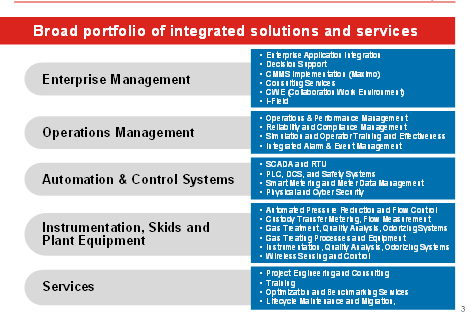
Integration across ISA Levels 1-4, Plus Interfaces to Level 5
Low Total Cost of Ownership
Honeywell believes its main differentiation lies in providing customers with the lowest total cost of ownership (TCO) based on both technology and application/industry expertise. According to the company, some key components that drive HPS's lower TCO value proposition include:
HPS has been deeply involved with the Abnormal Situation Management (ASM) Consortium for over 20 years. The company believes that this involvement in developing best practices has been instrumental in enabling its own intuitive operations management, alarm management, and workflow optimization solutions and services for customers across the entire gas value chain.
Conclusion
Companies operating within the natural gas value chain face constant price pressures and increasingly stringent regulatory oversight. To profitably meet long-term demand for gas, companies should seek partners with deep domain expertise, a comprehensive portfolio, and experience helping users integrate operations, maximize asset utilization, and reduce TCO.
It appears that HPS is well-positioned to serve in this capacity for new and upgrade projects alike in the natural gas industry.
SmartLine and Experion are registered trademarks of Honeywell, Inc. MeterSuite and LEAP are trademarks of Honeywell, Inc. All other trademarks mentioned are the property of their respective owners.
All signed-in ARC Advisory Group clients can view this report in pdf format at this Link
If you would like to buy this report or obtain information about how to become a client, please Request ARC Info
Keywords: Honeywell Process Solutions (HPS), Gas Value Chain, Gas Measurement & Control, Experion, SmartLine, MeterSuite, Abnormal Situation Management (ASM) Consortium, ARC Advisory Group.